The bag is the only part of a private label program a customer physically handles. They never read the mineral spec sheet or the batch test record, but they do notice a handle that tears on the way from the car to the laundry room, and they notice when the green on the 10L bag doesn’t match the green on the 4L bag sitting beside it. That is why packaging carries more weight for a young cat litter brand than most buyers expect going in — the formula wins the repeat purchase, but the bag wins the first one.
Putting your own logo on litter is really three decisions rather than one: what the brand mark looks like, which bag styles and sizes it goes on, and what visual direction the range takes across price tiers. Buyers who arrive with a finished logo and no view on the other two usually end up with a private label cat litter range that looks like three unrelated products on the same shelf.
Designing the Brand Mark, Not Just Placing It
Plenty of distributors starting a litter line have a company name but no usable brand asset — or a logo built for a website that falls apart at bag scale. Design support at the manufacturing stage covers both cases: developing a wordmark and brand title from scratch, or rebuilding an existing mark so it survives the conditions a litter bag puts it through.
Three constraints shape a mark that works on packaging. It has to stay legible at roughly 40 mm, because that is the size it appears at in a marketplace thumbnail. It needs a single-colour version, since the same mark will sit on white film, brown kraft and a dark accent panel across one product family. And it needs a horizontal lock-up alongside a stacked one, because a bag front panel and a bag side panel want different proportions. A brand title that reads cleanly as a small monochrome block on a side gusset will work everywhere else; one that depends on a gradient and fine outline strokes will not.
A Bag Range That Matches How Customers Buy
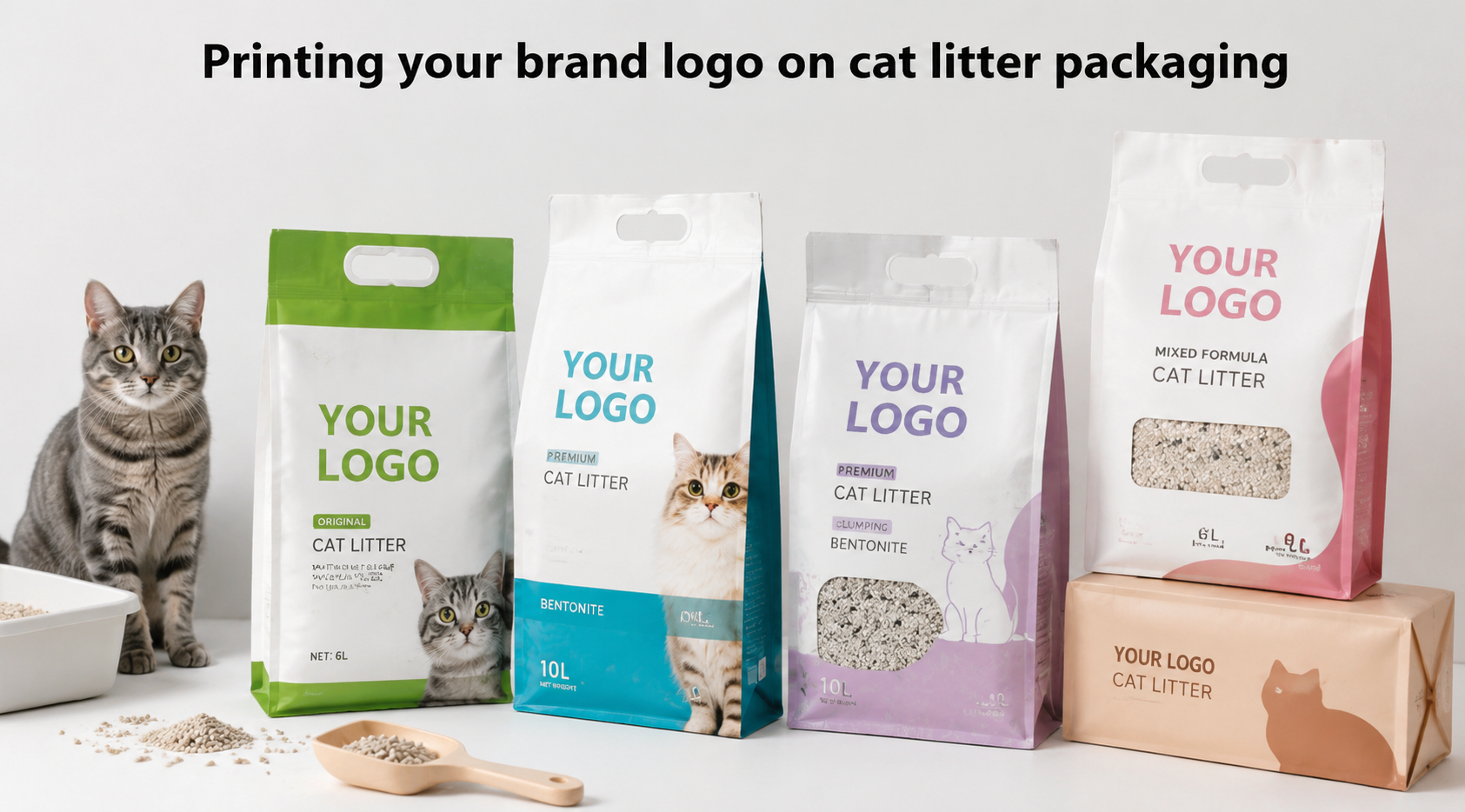
Litter is bought in very different ways depending on channel, and a single bag format cannot serve all of them. Grocery and pet-specialty shelves are dominated by 4L to 10L sizes that a shopper carries by hand, which makes a reinforced handle and a stable flat base non-negotiable. E-commerce moves toward larger 12L to 20L units where transit durability matters more than shelf presence. Trial and sampling sizes in the 1L to 2L range are used mainly for new-brand introductions and vet-clinic placement.
Format choice widens the range further. BOPP-laminated woven bags give the stiffness and puncture resistance that larger sizes need and hold a printed image well. Laminated film gusset bags suit mid-size retail units and take a matte or gloss finish cleanly. Kraft composite structures are chosen mostly for plant-based lines where the substrate itself carries an eco message. Add-on features — carry handles, resealable closures, pour spouts, clear windows showing granule texture — are specified per size rather than across the board. A well-planned pet litter packaging range typically launches with two or three sizes sharing one visual system, then expands once sell-through data shows which size actually moves.
What Shoppers Respond To on a Litter Bag?
When shoppers search for cat litter bags online or browse retail shelves, their purchase decisions are driven by hard-learned practical frustrations. In countless product reviews and complaints, structural failure is the number one grievance. Pet owners deal with heavy, damp clumps daily; when a thin bag tears at the seam, punctures from sharp corners, or snaps while pulling the drawstring, it creates an immediate mess and a ruined user experience.
1. Brand & Packaging Advantage
Your packaging design must visually and textually communicate physical strength. By positioning your brand logo right above clear material-grade callouts—such as puncture-resistant gauges, tear-proof icons, or reinforced drawstrings—you transform your logo from a simple label into a mark of uncompromised quality. A clean, premium layout that highlights heavy-duty durability reassures buyers before they even open the box.
2. The Demand for True Containment
The Customer Problem: The second most frequent complaint revolves around odour leakage. Many budget bags use thin, porous plastic that lets foul smells permeate the surrounding area long before disposal day, leaving owners frustrated with masks that fail.
Brand & Packaging Advantage: By dedicating an uncluttered panel on your packaging to highlight multi-layer odour barrier technology, your brand instantly separates itself from generic competitors. Placing your brand logo alongside a distinct icon or badge for odour defense anchors your corporate identity directly to product performance, driving high repeat purchase rates and long-term brand loyalty.
Colour and Design Direction Across a Litter Range
Colour in this category carries meaning that shoppers read before they read any text. Blue signals freshness and odour control and is heavily used, which makes it safe but crowded. Green reads natural and plant-based. Kraft brown, muted sage and unbleached tones support eco positioning. Black, deep navy and off-white with a single metallic or spot accent read premium. Saturated primaries with oversized typography are the visual language of the value tier, and using them on a premium formula undercuts the price point before a customer picks the bag up.
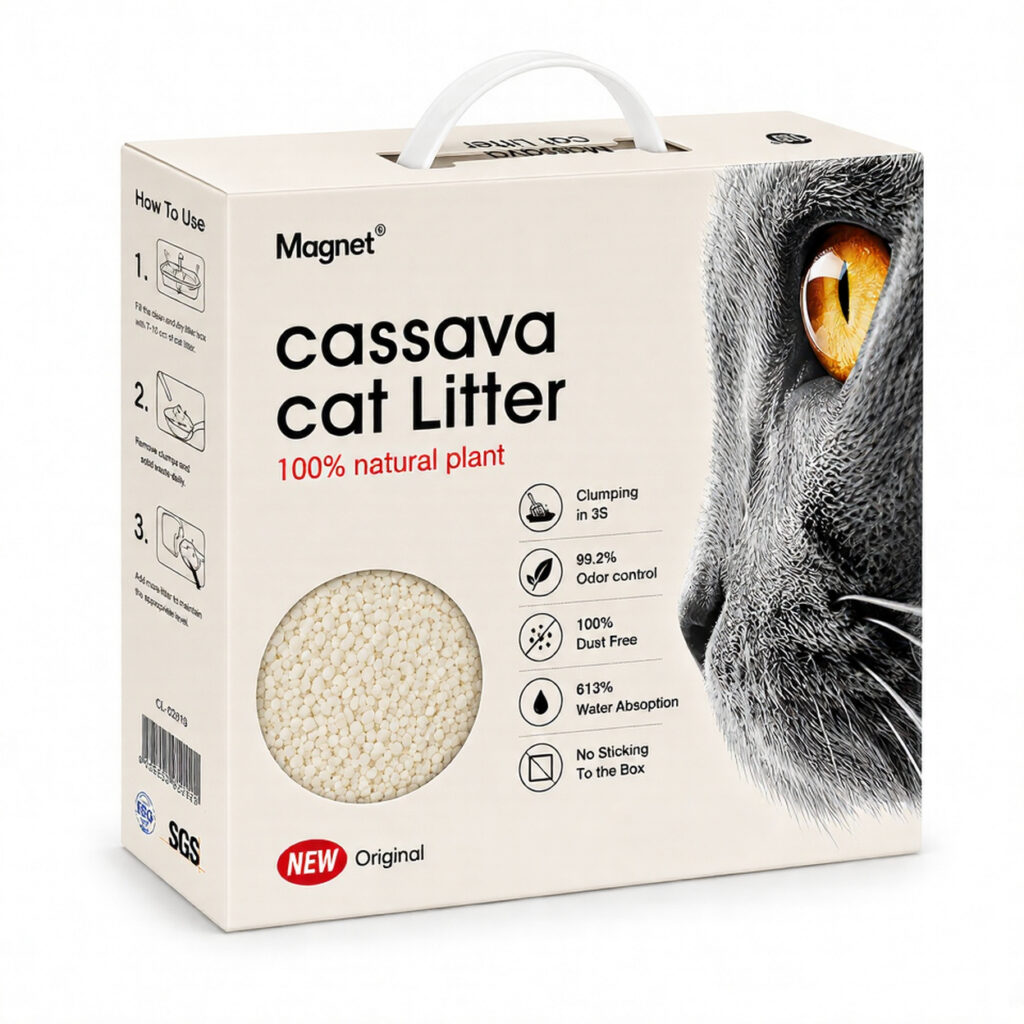
The more useful decision is the system rather than the individual colour. A strong range keeps one shell — same layout grid, same logo position, same typeface — and differentiates tiers through a colour band or accent block. That way bentonite, tofu and cassava lines are immediately recognisable as one brand while still being distinguishable at arm’s length, and adding a fourth formula later doesn’t require redesigning the family. Finish choice supports the same logic: matte lamination with a spot-gloss logo hides handling marks and reads premium, while high-gloss film photographs brighter for online listings but shows scuffs from stacking.
Your Formula Decides Part of the Packaging Spec
Design direction still has to respect what goes inside the bag. Plant-based formulas are moisture-sensitive in a way clay is not — a cassava or tofu pellet that takes on humidity in transit clumps before it reaches a litter box, so working with a cassava cat litter manufacturer generally means a higher-barrier laminate and a tighter seal specification, which in turn limits some of the more breathable paper-look structures. Bentonite pushes the other way: weight and fine dust make puncture resistance and dust-tight seams the priority, and a slightly heavier woven fabric costs less than a returns claim.
Running Design, Formula and Packaging Through One Factory
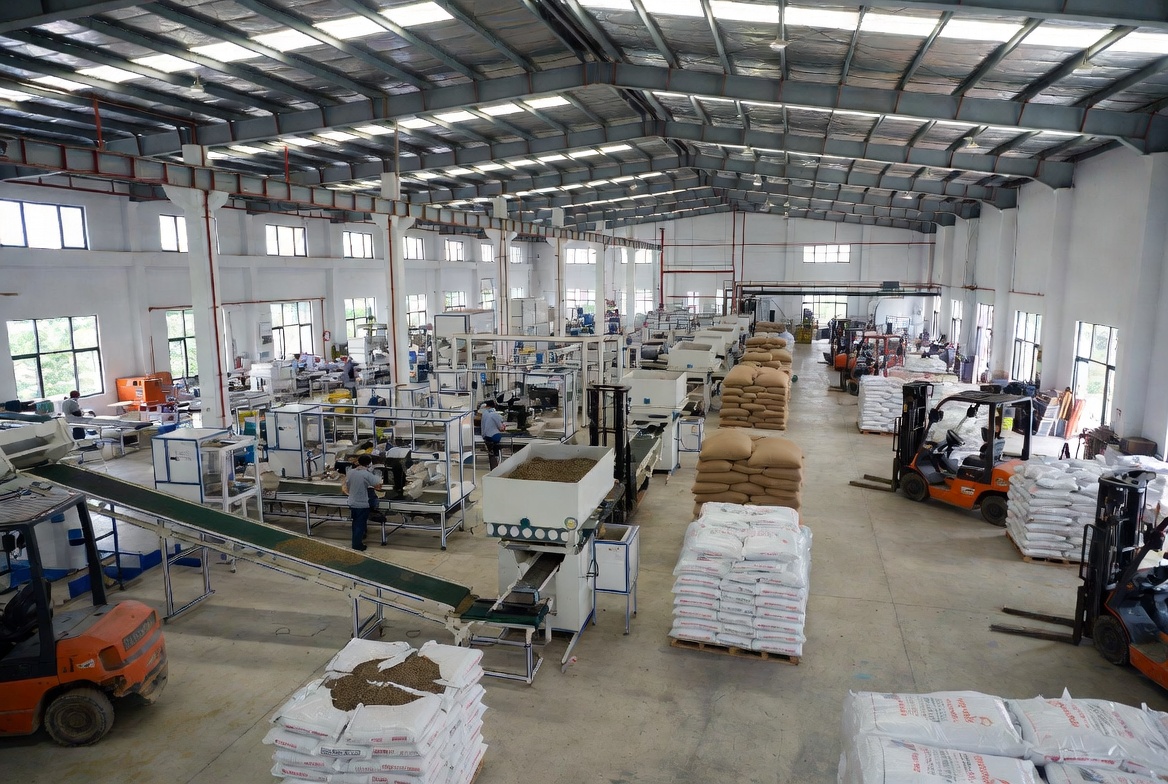
Splitting a private label program across a design studio, a bag printer and a filling plant creates gaps where responsibility for a defect gets contested. Handling all three in one place removes those gaps, which is one practical reason buyers comparing cat litter manufacturers in china increasingly weigh in-house design and packaging capability alongside formula range and certification.
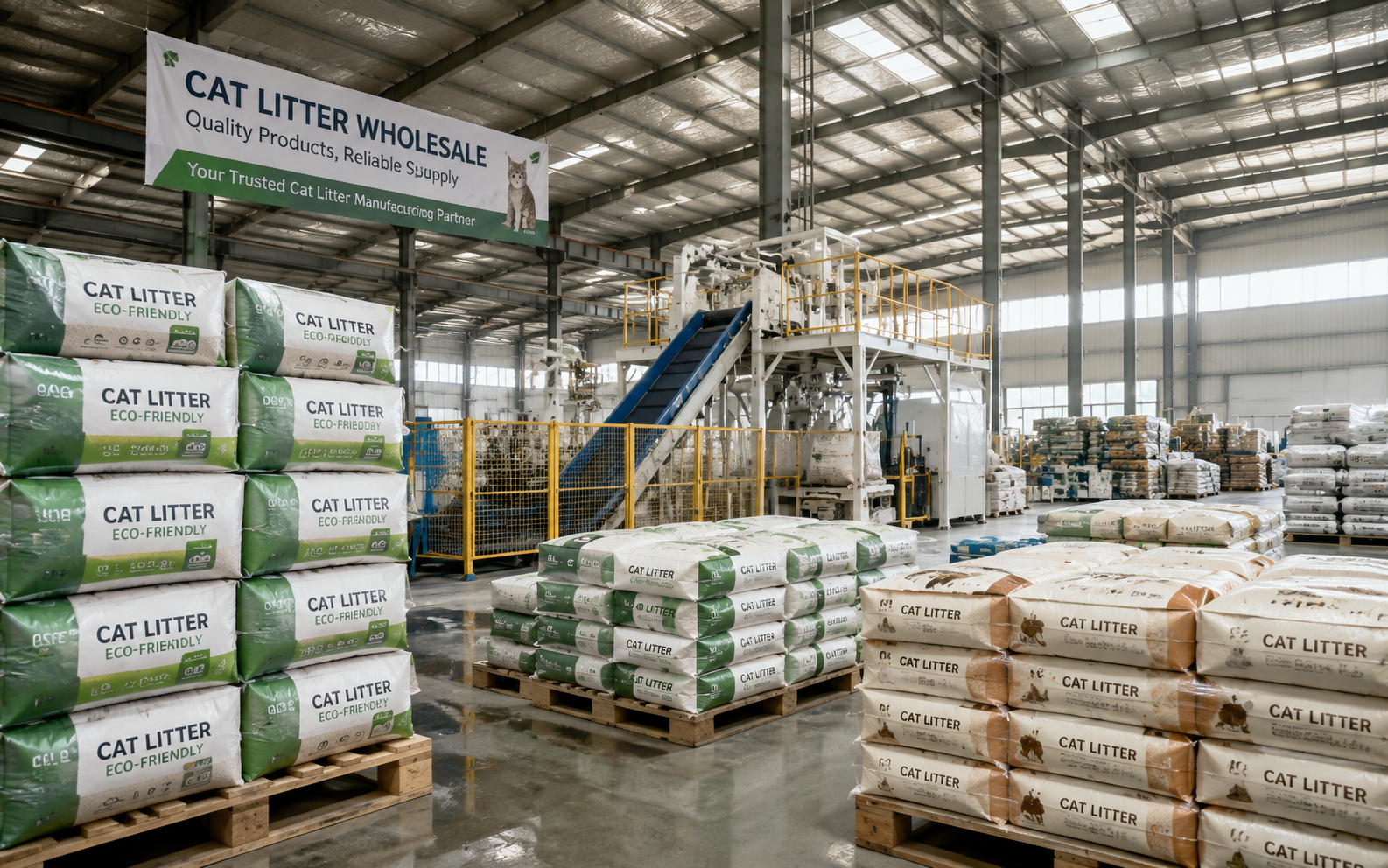
Magnet cat litter produces bentonite, cassava, tofu and blended formulas as a direct manufacturer under documented OEM and ODM specifications with ISO, SGS and TÜV certification, and provides brand mark and packaging design support within the same program. Buyers who arrive with finished artwork can supply it directly; buyers with only a brand name can have the mark, colour system and bag layout developed alongside the formula. Sample quantities are available for anyone who wants a filled, printed bag in hand before committing to a container. Distributors ready to Create Your Private Label Cat Litter can start from existing formula lines and bag structures rather than developing both from scratch, and the full cat litter wholesale range is supplied FCL and LCL.
Common Questions From First-Time Private Label Buyers
Can you design the logo if we only have a brand name?
Yes. A wordmark, colour system and full bag layout can be developed from the name alone, then applied consistently across every size and formula in the range.
How many bag sizes should a new brand launch with?
Two or three is usually the right start — one core retail size, one larger e-commerce size, and optionally a trial size. Expanding after sell-through data arrives is cheaper than committing to five sizes upfront.
Can different formulas share one packaging design?
They should. Keeping one layout and logo position while changing a colour band per formula is what makes a range read as a single brand rather than as unrelated products.
Private label packaging snapshot: Design: brand mark, colour system, and full bag layout | Sizes: 1L–20L, trial to e-commerce | Structures: BOPP-laminated woven / laminated film gusset / kraft composite | Options: handles, resealable closures, spouts, view windows | Formula lines: bentonite / cassava / tofu / blended | Certifications: ISO, SGS, TÜV | Supply: FCL, LCL, and sample quantities
Get Your Logo on a Sample Bag First
Factory-direct OEM and ODM supply across bentonite, cassava, tofu, and blended formula lines, with brand design and packaging developed in-house.
Request Samples & Wholesale Pricing →