








The first order is often managed carefully. Samples are checked, packaging is approved and delivery gets daily attention. The second order can receive less scrutiny because everyone believes the difficult work is finished.
That is where a growing cat litter brand can run into trouble. The factory may have capacity, but the printed bags are not ready. A container may be booked, but its arrival is later than the date the best-selling SKU will run out. Meanwhile, the warehouse looks comfortably full because slower products occupy most of the space.
Private label cat litter reorder planning needs to answer two different questions: when must a purchase decision be made, and how much of each product should be ordered? A container total cannot answer either one by itself.
Plan the Sellable SKU, Not Just the Formula
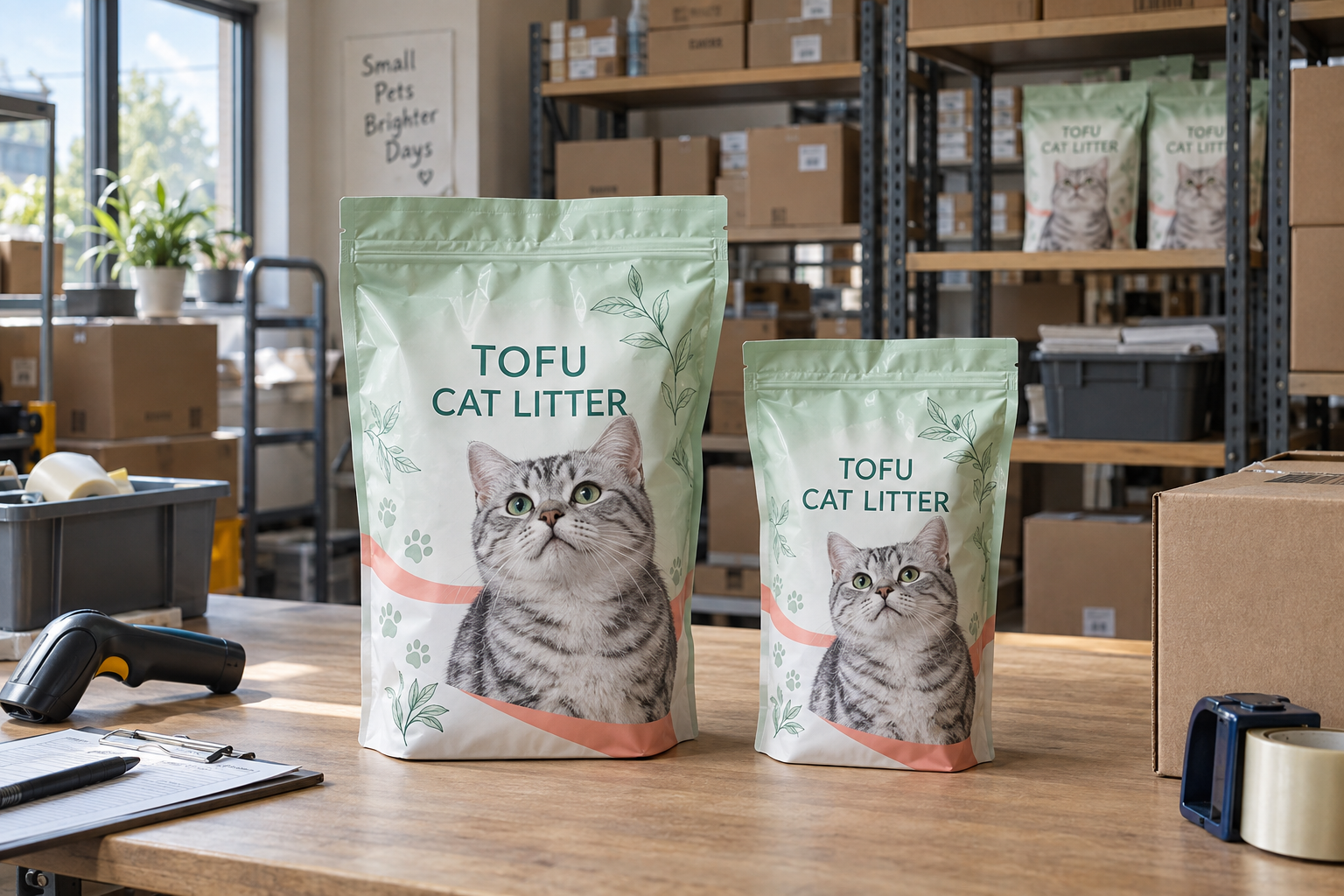
A fragrance-free tofu formula sold in two bag sizes creates two replenishment problems. Each size can have a different sales rate, packaging balance, case pack and retail commitment. Combining them into one total hides the shortage risk.
Start with a separate planning line for each formula, fragrance, bag size and market-specific packaging version. If two retailers use different artwork, do not assume their stock is interchangeable. A physically identical product may still be unsuitable for the other channel’s listing or agreed packaging.
Before expanding a wholesale tofu cat litter range, ask whether each additional variant earns its own packaging commitment and storage space. Replenishment becomes harder when a modest sales volume is divided across many finished SKUs.
Measure Lead Time to Saleable Stock
The useful endpoint is not the day production finishes. It is the day the stock is available for the orders you intend it to serve.
Build the timeline backwards from that date. It can include order confirmation, packaging availability, production scheduling, inspection and release, export handling, transport, import processing, local delivery and warehouse receiving. Some activities overlap; others cannot start until an approval or material arrives. Ask for the actual sequence instead of simply adding every department’s estimate.
Record three dates separately: the supplier’s expected readiness date, the expected destination arrival and the expected saleable-stock date. A shipping delay and an internal receiving delay require different responses, even if both leave the online listing unavailable.
For repeat orders, ask what has changed since the last shipment. An unchanged formula does not guarantee unchanged packaging availability or scheduling. Forecasts help the conversation, but do not treat an unconfirmed forecast as a reserved production slot.
Use a Reorder Trigger With Clearly Defined Inputs
A basic trigger combines expected demand during replenishment with a buffer. Oracle’s inventory planning documentation describes a reorder point as safety stock plus average daily demand multiplied by average lead time. This is a starting principle, not a guarantee against shortages.
For the example below, define inventory position as usable on-hand stock plus confirmed open purchase-order quantities, less outstanding customer commitments. Do not include damaged or quarantined bags as usable stock. Count demand commitments only once: if a warehouse report already subtracts allocations, do not subtract them again.
Keep dates alongside quantities. An open purchase order belongs in the overall position, but if it arrives after the shortage date it cannot fill the intervening gap. A dated stock projection is the necessary second check.
A Worked Example for One Tofu Litter SKU
The following numbers are invented to demonstrate the method. They are not Magnet sales data, quoted lead times or a recommended stock level. Assume one SKU sells 60 bags per calendar day and requires 70 days from reorder approval to saleable receipt. The buyer provisionally allows a further 14 days of average demand as a buffer.
- Expected demand during replenishment is 60 x 70 = 4,200 bags.
- The illustrative buffer is 60 x 14 = 840 bags.
- The resulting reorder trigger is 4,200 + 840 = 5,040 bags.
Suppose usable stock is 3,600 bags, a confirmed shipment contains 1,800 bags, and 600 bags are committed to orders outside the future demand forecast. Inventory position is 3,600 + 1,800 – 600 = 4,800 bags. It is below the trigger, so the buyer should review and release a reorder rather than wait for the warehouse to look empty.
Now check timing. After serving the 600 committed bags immediately, 3,000 bags remain for forecast demand. At 60 per day, that covers 50 days. If the inbound shipment becomes saleable on day 30, it arrives before depletion. If it becomes saleable on day 55, the plan contains a five-day gap even though the inventory-position calculation is unchanged.
The practical response is to investigate an earlier receipt, a split shipment or a revised promotion plan. Increasing a new order that arrives on day 70 does not fix a shortage on day 50.
Stress-Test the Buffer Before Calling It Safety Stock
Fourteen days is an assumption in the example, not a statistically justified service level. A newer brand may have too little history to calculate a reliable probability of running out. It can still compare explicit scenarios rather than quietly assuming every delivery will be on time.
Using the same illustrative baseline, a ten-day delay adds 600 bags of demand. A 20% increase in daily demand adds 840 bags across the original 70 days. If both happen together, 72 bags per day over 80 days requires 5,760 bags. That is 1,560 above the original 4,200-bag lead-time demand, exceeding the provisional 840-bag buffer.
This comparison does not prescribe carrying 1,560 extra bags. It identifies the exposure so the buyer can choose between extra stock, a shorter replenishment route, a supplier scheduling arrangement or a less aggressive sales commitment. Each option has a cost and operational limit.
Review sales history carefully. A week with no inventory can show low sales while hiding unmet demand. Equally, a launch promotion can produce a temporary spike that should not become the permanent forecast without evidence of repeat purchases.
Keep Printed Packaging on Its Own Schedule
Finished stock and printed packaging are different assets. Ask the supplier to confirm the quantity of usable bags remaining for each artwork revision, where they are held and whether they have already been allocated to another order.
Clarify who owns unused packaging and what happens after a design change. An old ingredient statement, market-specific label or retailer barcode can make remaining bags unsuitable for the next run. Do not subtract an unverified packaging balance from a new packaging requirement.
A useful repeat-order confirmation names the finished SKU, approved formula revision, approved artwork revision, usable packaging balance and any new print run needed. This turns a vague assurance that materials are available into information the purchasing team can check.
Decide Quantity Separately From Timing
Crossing a reorder trigger does not mean ordering exactly that many bags. Quantity also depends on expected demand until the following receipt, purchase minimums, storage limits and the time available to sell the stock under the agreed storage and shelf-life conditions.
Ask a private label cat litter supplier which minimums apply per formula, fragrance and printed bag. A mixed container may solve transport utilization without solving a packaging minimum. Conversely, filling empty container space with a slow SKU may reduce freight per bag while tying up stock for much longer.
Compare the proposed arrival quantities by SKU, not just the container’s total cost. Your top seller and your experimental fragrance should not automatically receive the same number of cartons.
Agree a Repeat Order Review Before the First Shipment
Use the initial order to establish a short replenishment record. It should contain the actual approval-to-receipt timeline, sales by SKU, stock held from sale, packaging balances and the assumptions behind the next order.
For a new launch, review this record weekly while demand is still uncertain. Review it immediately after a major promotion, an arrival delay or a change to packaging. As the range settles, choose a cadence that still leaves enough time to act before the reorder trigger is crossed.
The most useful question for your supplier is not simply whether another container is available. It is whether the specific products you need, in the correct packaging, can become saleable before the dated stock projection reaches zero. That is a much stronger basis for repeat business.
Build a Repeat Order Brief With Magnet
Share your selected formula, pack size, expected monthly demand and required warehouse availability date. Ask Magnet to confirm the current repeat-order dependencies and quotation.
Discuss Cat Litter Supply