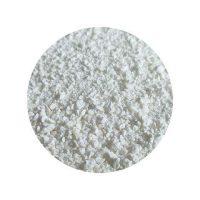
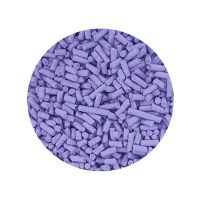
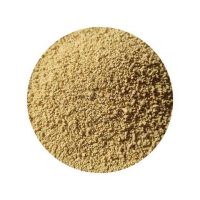
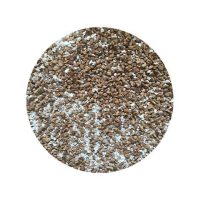
China supplies the majority of the world’s cat litter. That’s not a recent development — Chinese manufacturers have dominated bentonite cat litter production for decades, and the combination of abundant sodium bentonite reserves, large-scale processing infrastructure, and competitive export logistics has made China the default sourcing destination for importers across Europe, Southeast Asia, the Middle East, and beyond. What has changed is the product itself. The most competitive Chinese wholesalers are no longer selling straight sodium bentonite. They’re supplying a clay–cassava hybrid that keeps the cost advantage of conventional bentonite while correcting its two most significant performance liabilities: excessive dust and litter box adhesion.
For cattery wholesale buyers and pet shop importers evaluating Chinese suppliers, understanding what separates the blend from standard bentonite — and knowing what questions to ask a wholesaler — is the difference between a supply chain that performs and one that generates customer complaints.
The Problem with Standard Sodium Bentonite — and What the Blend Fixes
Standard sodium bentonite cat litter clumps reliably and absorbs liquid efficiently. Those two properties made it the dominant formula globally for 40 years, and they remain relevant. But bentonite has structural weaknesses that become more pronounced at scale — particularly in professional environments such as catteries, boarding facilities, and multi-unit retail settings where litter performance is stress-tested every day.
The first problem is dust. Pure sodium bentonite granules fracture under compression — during pouring, digging, and scooping — releasing fine silica particles into the air at levels consistently measured between 1.5 and 3 mg/m³ under normal use conditions. In enclosed spaces with multiple cats, this dust load accumulates across every litter room simultaneously. It’s a respiratory concern for cats, staff, and the cats’ owners — and increasingly, it’s a product liability issue that retail buyers are beginning to flag during category reviews.
The second problem is box adhesion. Wet bentonite at the base of the litter box bonds to the plastic surface as it dries, creating a hardened residue that requires soaking and scraping to remove. In high-turnover cattery environments, that adhesion adds cleaning labor per box per cycle — a cost that’s invisible in the product’s purchase price but very visible in the time it consumes.
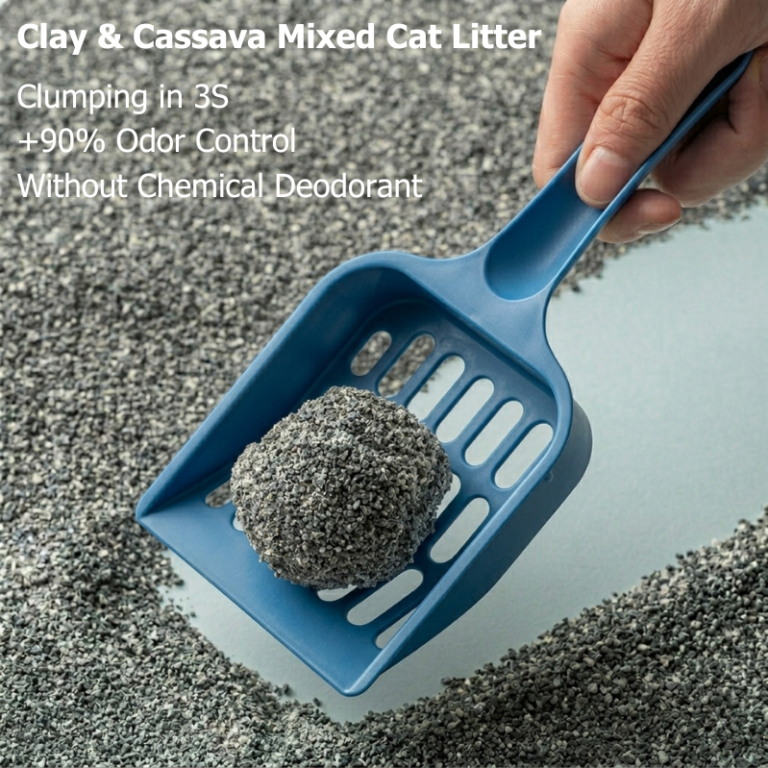
The clay–cassava blend resolves both. Tapioca starch, added at 15–30% of the formula, acts as a particle binder that significantly reduces the silica dust generated during use — cutting airborne dust by approximately 50% compared to pure bentonite under equivalent conditions. The starch also creates a hydrophilic coating on the granule surface that prevents wet litter from fusing to the box lining. Clumps lift cleanly, the box stays cleaner between full changes, and cleaning labor per box decreases meaningfully.
Who the Clay–Cassava Blend Is Right For
Pet retailers transitioning from pure clay
The blend is the lowest-friction upgrade path for stores whose customers are familiar with bentonite. Performance improves significantly; the clumping behavior and appearance remain familiar enough that no customer education is required.
Cattery and boarding operators
Reduced dust and zero box adhesion are the two most operationally significant improvements for professional environments. Both translate directly into lower labor cost and better air quality in enclosed litter rooms.
Importers building a private label cat litter range
The blend offers a compelling product story — better than standard clay, lower cost than fully plant-based — that positions well at mid-market price points in competitive retail environments.
Distributors sourcing pet shop supplies wholesale
The blend’s price-to-performance ratio makes it the right product for volume accounts where full plant-based formulas are outside the buyer’s cost ceiling but pure bentonite is generating customer dissatisfaction.
Markets with dust sensitivity regulations
Several European and Asia-Pacific markets have tightened standards around silica dust exposure in pet products. The blend’s −50% dust reduction provides meaningful compliance headroom for importers operating in these regions.
Buyers seeking exclusive cat litter differentiation
OEM customization options — blend ratio, granule size, fragrance, and packaging — allow buyers to develop a product specification that competitors cannot replicate without switching to the same manufacturer.
What to Ask a Chinese Bentonite Wholesaler Before You Order
The Chinese cat litter export market is large and varied. Factory quality, product consistency, and service capability differ significantly between suppliers, and the gap isn’t always visible in a product sample or a price sheet. Buyers who have sourced from multiple Chinese wholesalers consistently identify the same set of evaluation points that separate reliable long-term suppliers from those who perform acceptably on the first order and deteriorate thereafter.
Certification documentation is the first filter. Any credible bulk cat litter supplier exporting to regulated markets should hold current ISO, SGS, TÜV, and MSDS certification — and should be able to produce them on request without delay. If a supplier hesitates or provides outdated documentation, that signals gaps in their quality management process that will eventually manifest as production inconsistency.
The second filter is production-level specification control. Ask specifically whether the cassava blend ratio is fixed at the production stage or adjusted based on raw material availability. A supplier who cannot give a firm answer — or who indicates that ratios are approximate — is telling you that the product you receive in month six may not perform the same as the sample you approved in month one. For wholesale cattery supplies and branded retail programs, that inconsistency is a significant supply chain risk.
Third, confirm OEM capability in full. Packaging format, label design, granule size, fragrance specification, and blend ratio should all be buyer-specifiable. A manufacturer that locks buyers into standard configurations is limiting your ability to build a differentiated product — and limiting your ability to move your business if a better option emerges.
“We moved to the clay–cassava blend two seasons ago after customer complaints about dust from our previous clay supplier. The blend has eliminated the complaints entirely — and our cattery accounts specifically requested more of it once they saw how much easier the boxes were to clean.” — Pet supplies importer, Southeast Asian distribution network
Sourcing the Clay–Cassava Blend at Wholesale Volume
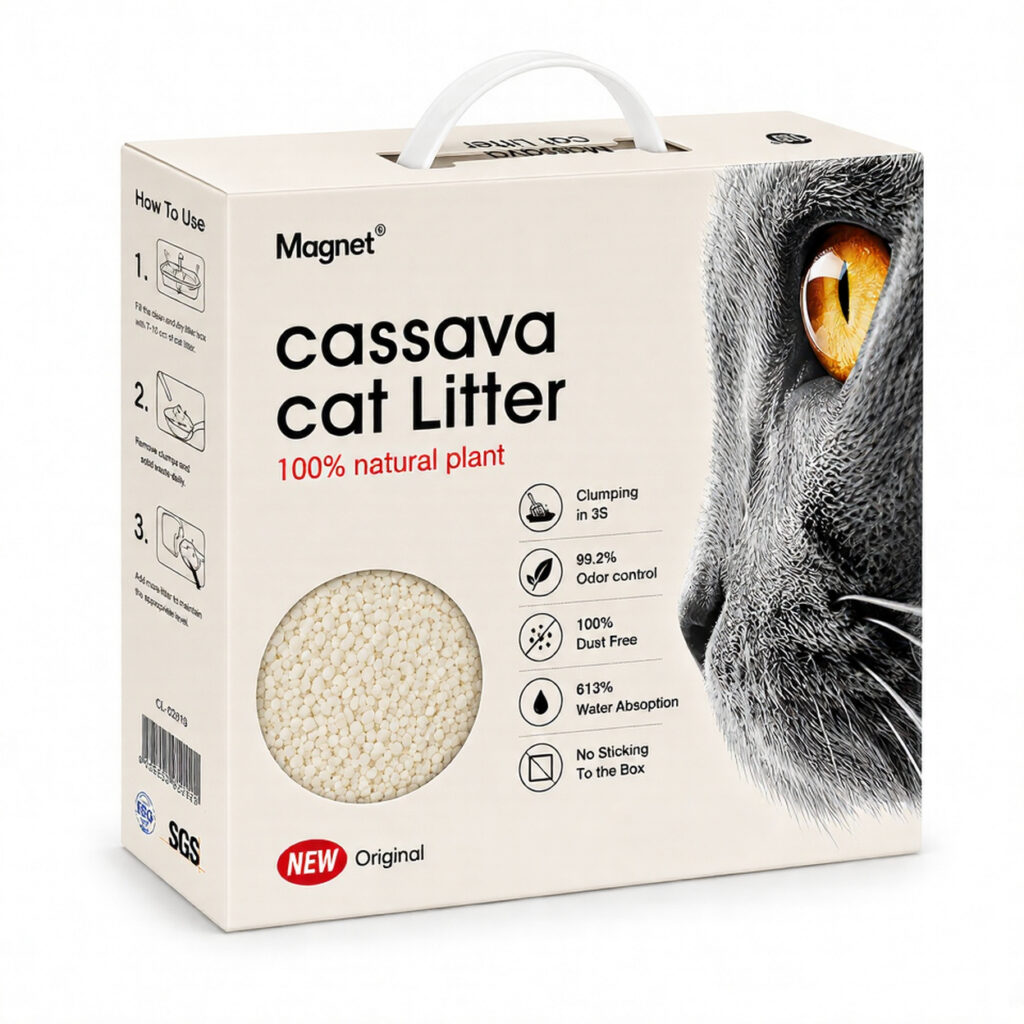
Magnet Cat Litter manufactures the clay–cassava mixed formula as part of its full range of wholesale cat litter products, available in container-load quantities at factory-direct pricing. The blend is offered in standard granule configurations with full OEM/ODM customization for buyers developing branded product lines. Fragrance options include activated carbon, green tea, and unscented. Packaging format, bag weight, and label design are all buyer-specifiable under the private label program.
For buyers evaluating the blend against their current bentonite supplier, product samples are dispatched within five business days. Sample requests can be submitted alongside specification requirements — blend ratio, granule size, fragrance, and packaging format — so the sample received reflects the actual production specification rather than a generic factory standard.
Product specification: Base: sodium bentonite + cassava (tapioca) starch blend | Cassava ratio: 15–30% (buyer-specifiable) | Dust reduction: −50% vs pure bentonite | Odor control: +90% | Box adhesion: none | Granule size: standard and fine options | Fragrance: activated carbon / green tea / unscented | Certifications: ISO, SGS, TÜV, MSDS | OEM/ODM: fully available | Supply: FCL and LCL container-load
Request Clay–Cassava Blend Samples & Wholesale Pricing
Factory-direct supply for importers, pet retailers, and cattery operators. Free samples dispatched within 5 business days. Full OEM customization available for private label programs.
Get Bulk Pricing →