There’s a moment many cat owners describe the same way: you pour a fresh bag of clay litter and a cloud of pale dust rises off the box. You step back, your cat steps back, and someone coughs. Then you wonder — this is going into a box my cat sits in multiple times a day. What exactly is in this dust, and where does it all end up? That discomfort is driving one of the most significant category shifts in pet care. Traditional clay litter currently contributes over 2 million tons of non-degradable waste to landfills annually in the US alone. Biodegradable cat litter brands comparison data shows plant-based alternatives are now growing at roughly 28–30% per year — and 2025 testing from multiple independent reviewers confirms that performance has reached genuine parity with clay.
What “Biodegradable” Actually Means in Practice
A litter labeled biodegradable should break down through natural microbial activity after disposal — but the timeline varies enormously by material. Biodegradable cat litter brands using cassava starch or soybean fiber decompose in a home compost environment within 4–8 weeks. Corn and wheat straw litters decompose in 6–12 weeks. Wood pellet litters take 3–6 months but are still drastically better than sodium bentonite clay, which takes an estimated 500+ years in a landfill and is produced through open-pit mining that removes entire layers of topsoil.
Flushability is a separate claim. Only litters made from water-soluble materials — primarily cassava starch and tofu/soybean fiber — are genuinely flushable in small quantities. Wood, walnut shell, and corn litters should be composted or binned, not flushed. Always check product labeling, and consult local sewage guidelines before flushing any litter product.
The Main Biodegradable Cat Litter Materials Compared
Cassava / Tapioca Litter
Cassava Root Starch
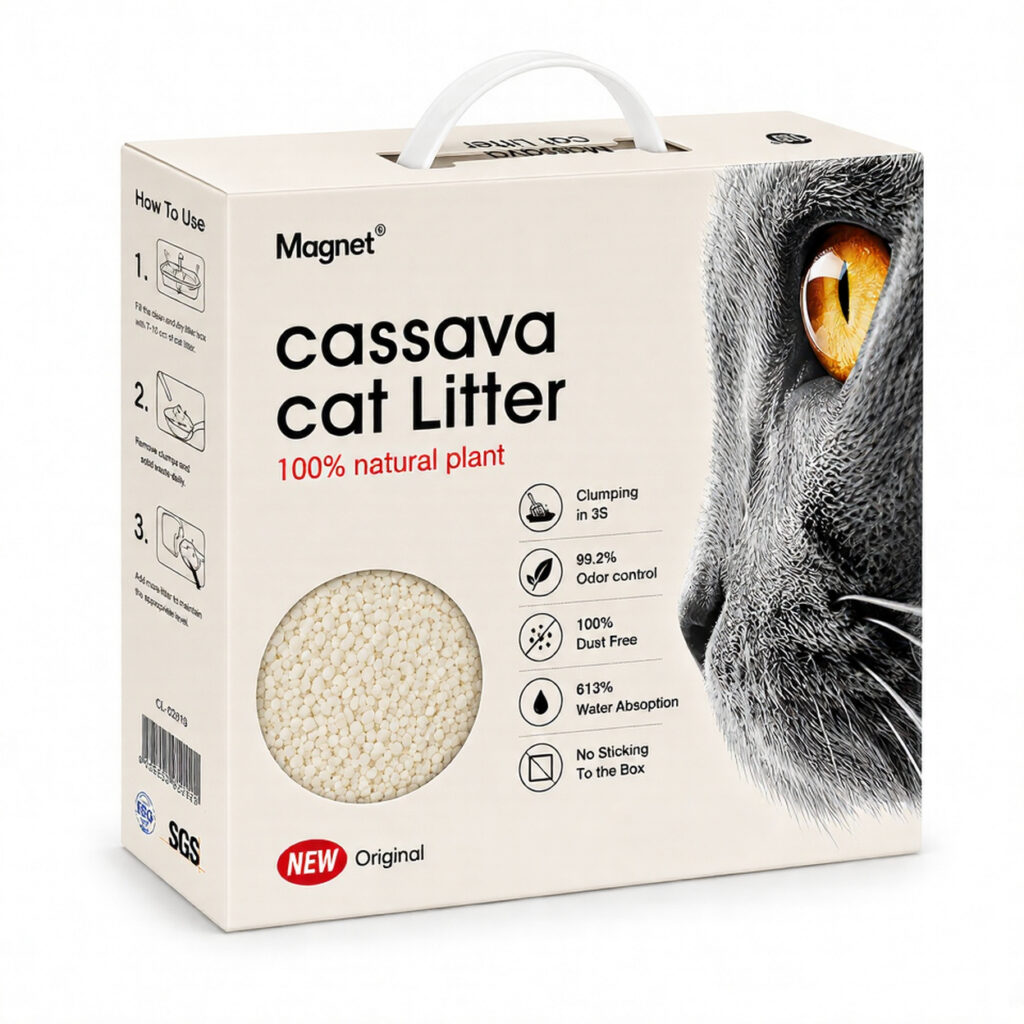
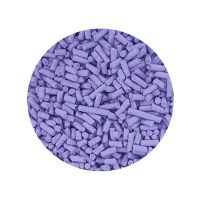
The strongest-clumping plant-based material available. Cassava starch forms dense, hard clumps within 30–45 seconds and absorbs 200–250% of its own weight in liquid. Near-zero dust (<0.3 mg/m³). Fully flushable and compostable. Best choice for owners who want clay-level clumping without the environmental cost. Magnet produces cassava litter as a core wholesale formula with full OEM/ODM customization.
Tofu / Soybean Litter
Soybean Fiber (Okara)
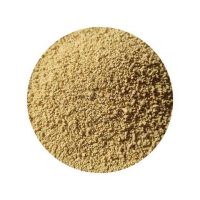
Made from soy milk and tofu manufacturing by-product. Softer granule texture than cassava, with natural enzymatic odor neutralization from soybean protein. Clumps well but slightly softer than cassava. Virtually dust-free. Widely used in Japan and South Korea where ultra-low dust and gentle paw feel are the top purchase drivers. Flushable in small amounts.
Corn Litter
Corn Starch / Corn Grain
Naturally clumping via corn starch gelatinization. World’s Best Cat Litter is the best-known North American brand using this material. Lighter than cassava and good odor control through natural corn enzymes. Some cats prefer the finer texture. Not flushable in most sewage systems. Biodegrades in 6–8 weeks in compost.
Walnut Shell Litter
Crushed Walnut Shells
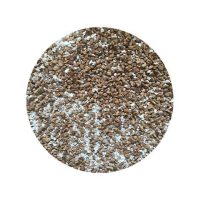
Made from recycled agricultural by-product. Dark color makes it easy to spot waste. Outstanding natural odor absorption — walnut tannins neutralize ammonia effectively. Less common but increasingly popular in premium retail segments. Not clumping in the traditional sense, but absorbs and clumps moderately. Biodegradable and compostable.
Wood / Pine Litter
Recycled Pine or Softwood
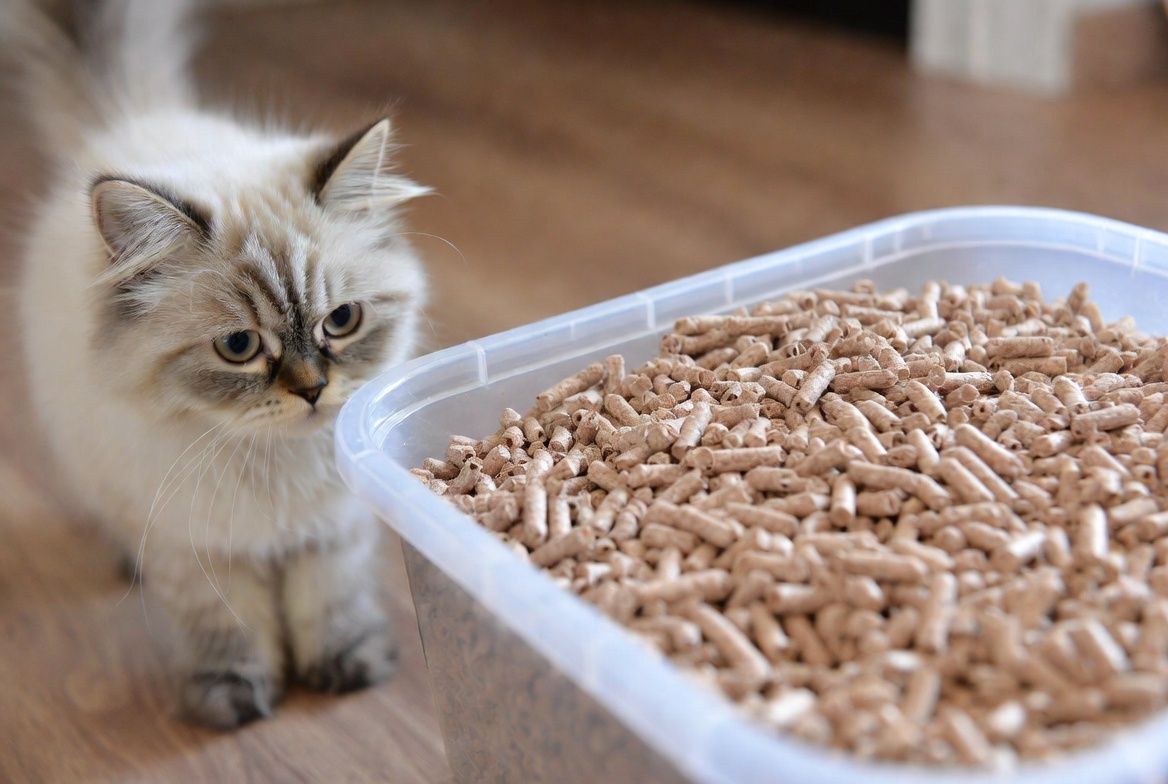
Ökocat and Catalyst Pet are the dominant names. Made from upcycled softwood that hasn’t been chemically treated. Natural pine oils provide odor absorption. Available as pellet or clumping forms. Lightweight, low-dust, and fully biodegradable. Cats transitioning from clay sometimes take longer to accept the texture.
Wheat Straw Litter
Wheat Fiber
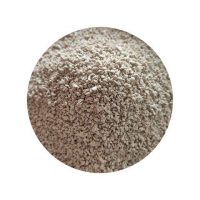
Clumps through naturally occurring wheat starch enzymes. Soft texture and near-zero dust. Grown as a renewable crop and biodegrades quickly — typically within 4–6 weeks. Less common than tofu or cassava at the retail level, but growing in Europe particularly. Safe for septic systems and compostable.
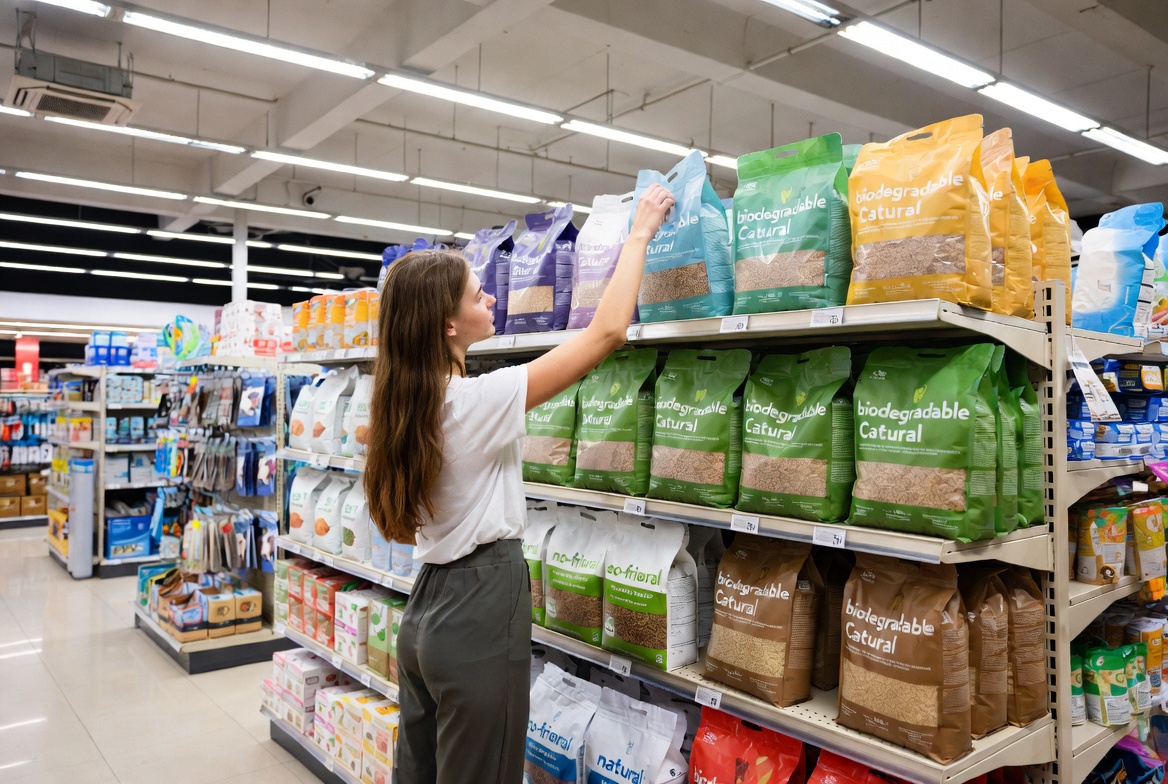
Biodegradable cat litter brands
What Users Actually Report After Switching
The most consistent feedback from cat owners who have switched from clay to a biodegradable formula follows a pattern. In the first week, the most noticeable change is air quality — the absence of airborne clay dust is immediately apparent, particularly for households where someone has asthma or a cat with respiratory sensitivity. By the end of the first month, most users report that odor control is equivalent to or better than their previous clay litter, provided they maintained daily scooping. The one category where users sometimes find an adjustment period is clumping: cassava and corn litters match clay well; tofu and wood pellets require scooping before clumps fully dry to get the cleanest removal.
“I was skeptical. I’d used the same clay litter for eight years. Within two weeks of switching to a plant-based litter, the dusty film that used to coat the shelf above the litter box was gone. I hadn’t even realized that was from the litter until it stopped.”
Three Questions to Ask Before Choosing a Brand
What material is it made from, and is the clumping mechanism right for your cat’s habits? Cassava and corn for strong-clumping households. Tofu for households prioritizing ultra-soft texture and natural odor control. Wood or wheat for cats that respond to natural scent cues.
Is the “biodegradable” claim verified, or just marketing language? Look for brands that specify decomposition timelines and raw material sourcing. Certified manufacturers — those holding ISO, SGS, or equivalent third-party audit certifications — produce to verified specifications, not just label claims.
Is it flushable or only compostable? This matters practically. Cassava and tofu litters can be flushed in small quantities. Everything else should go in a compost bin or general waste. Treating a non-flushable litter as flushable is a plumbing problem waiting to happen.
Wholesale note: For retailers building a biodegradable cat litter range, cassava is currently the highest-performing plant-based base material for clumping performance — and commands premium retail pricing that reflects it. Magnet Litter manufactures cassava, tofu, corn, walnut shell, and wheat straw litters under ISO, SGS, TÜV, CTI, and MSDS certification, with full OEM/ODM customization available for private-label programs.
Source Biodegradable Cat Litter at Wholesale
Six plant-based formulas, certified manufacturing, and full OEM/ODM support from Magnet Litter — factory-direct pricing for retailers and distributors worldwide.
Request Samples & Wholesale Pricing →