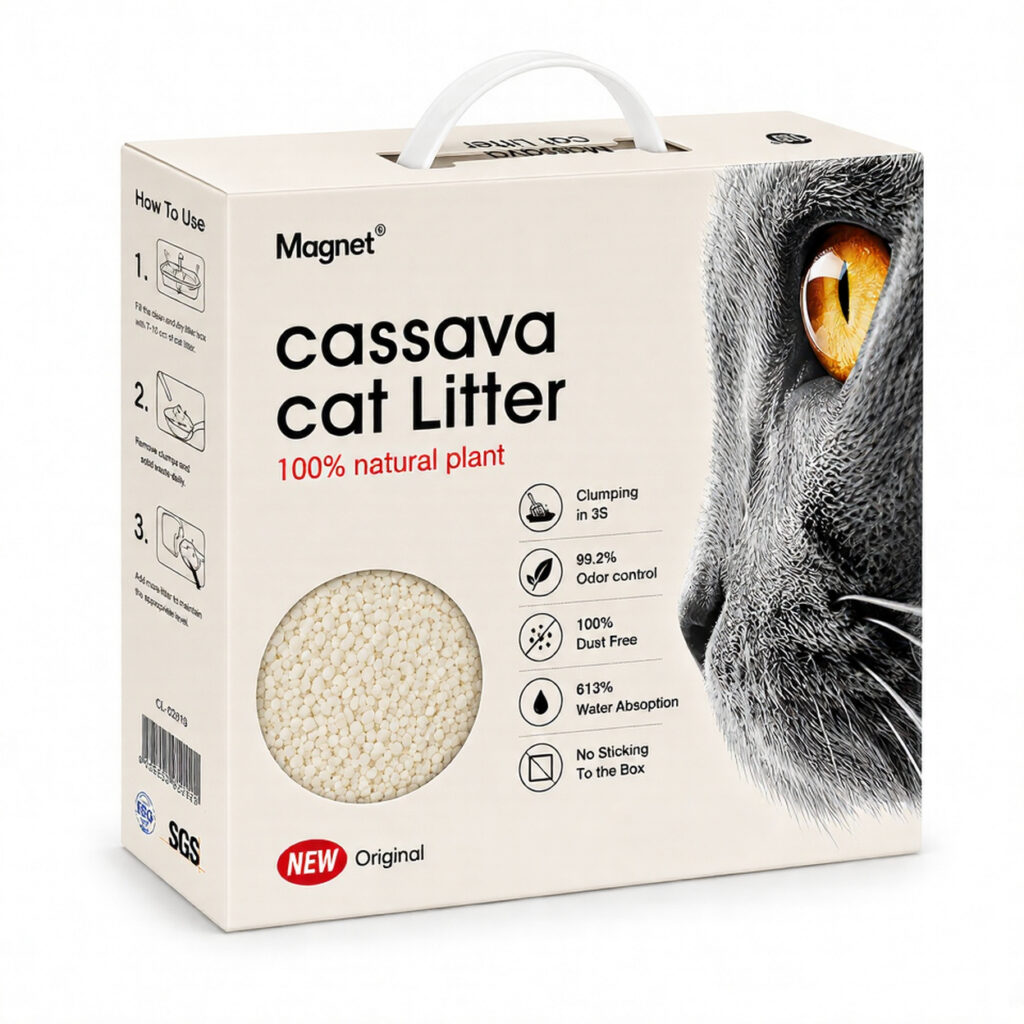
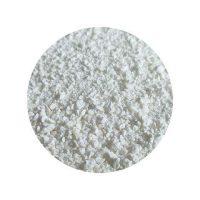
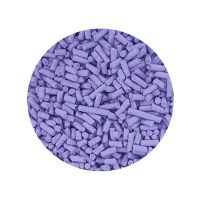
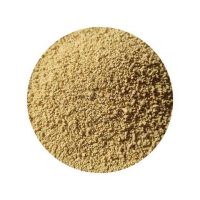
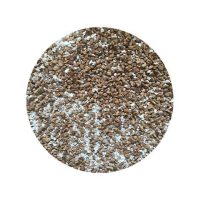
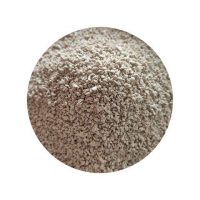
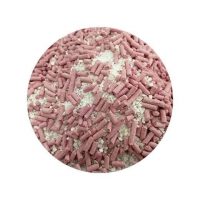
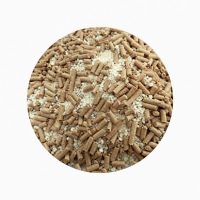
Cassava and tofu cat litter often appear in the same plant-based category, but they do not create the same product on the shelf or in the litter box. Cassava formulas are commonly sold as fine granules with quick, tight clumping. Tofu litter is better known for lightweight pellets, low tracking, and a product format many shoppers already recognize.
For a private label brand, the question is not which material wins a general comparison. It is which product gives the brand a clear reason to buy, performs reliably for the intended customer, fits the delivered-cost model, and can be reproduced from one order to the next.
The Short Answer
Choose cassava cat litter when the planned product needs a finer texture, fast clump formation, clean removal, and a pale natural appearance. Choose tofu cat litter when the brand needs a familiar plant-based format, lighter handling, larger pellets, lower tracking potential, and more established fragrance or charcoal variants.
Those are useful starting points, not guarantees. Formula, particle distribution, moisture, additives, production process, packaging, and storage can matter more than the ingredient name. The final decision should come from matched samples tested under the same conditions.
The Materials Create Different Product Formats
Tofu litter is generally made with plant fiber such as pea or soybean fiber together with starch and other formula components. It is commonly extruded into cylindrical pellets, although crushed tofu versions use shorter, irregular pieces.
Cassava litter is built around starch-rich plant ingredients. Fine-granule formulas can feel more like sand than a traditional tofu pellet. Pellet cassava products also exist, so buyers should not treat cassava as one fixed texture.
This distinction matters because customers experience the finished particle, not the raw-material description. Shape and size affect pouring, paw feel, tracking, clump structure, automatic-box screening, bag volume, and visual identity.
Clumping Depends on More Than the Base Material
Cassava is often selected for fast, firm clumping. A well-balanced fine-granule formula can make close contact with moisture and form a compact clump. That can support clean removal and reduce the amount of surrounding dry litter discarded with each scoop.
Tofu pellets absorb through a larger porous structure. A good formula can clump quickly, but long pellets may create more open space inside the clump. If the formula is too soft or the scoop test happens too early, the clump can break at the edges.
Private label buyers should not compare supplier adjectives such as “instant” or “rock hard.” Use one test method for both products. Keep litter depth, liquid volume, drop height, waiting time, scoop, and lifting action consistent. Record intact clump weight, loose wet fragments, sticking, and the dry litter removed with the clump.
A strong clump that removes half the tray is not efficient. A compact clump that smears across the bottom is not clean. Evaluate the complete scooping result.
Tracking Is Strongly Connected to Particle Shape
Traditional tofu pellets are relatively large. They are less likely to lodge between paw pads than fine sand-like particles, which gives tofu a useful low-tracking position for many indoor households.
Fine cassava granules can offer softer paw feel and close moisture contact, but smaller particles may travel farther outside the box. The result depends on particle weight, static, size distribution, litter depth, box entrance, floor type, and the cat.
Brands that want cassava performance with a larger particle can evaluate pellet cassava cat litter. Brands prioritizing a fine texture can test fine granule cassava cat litter. These should be treated as two different retail propositions rather than one product in two shapes.
Dust Should Be Measured After Handling
Both cassava and tofu products are frequently positioned as low-dust alternatives. The claim still needs a defined method. A freshly screened sample may look clean before shipping but create more fines after vibration, compression, and repeated handling.
Test unopened retail bags after a transport simulation. Measure fines using an agreed sieve and observe airborne material during a controlled pour. Tofu pellets may break at weak points, while a fine cassava formula may already contain particles near the lower size limit.
Avoid building a private label around an absolute “dust free” statement unless the method, result, and legal use of the claim are clear. “Low dust” with a repeatable specification is usually more useful than an impressive percentage with no test conditions.
Odor Control and Fragrance Strategy
Tofu litter gives brands a familiar platform for original, scented, and activated-charcoal variants. That can help a distributor build a small range around one recognizable product format. The risk is creating too many fragrance SKUs before demand is proven.
Cassava products are often positioned around natural odor management without a strong added scent. This can support a cleaner, ingredient-led story, especially in markets where customers prefer unscented litter. The base formula still has to control wet residue and allow complete clump removal. Fragrance cannot compensate for contaminated crumbs left in the tray.
Test odor performance separately from fragrance preference. Then decide whether scent is part of the brand identity or simply an optional second SKU.
Automatic Litter Box Compatibility
Fine cassava particles may pass through automatic-box screens more easily than long tofu pellets. They can also form compact clumps if the setting time and formula suit the machine. However, very light or very fine material can create tracking, sensor, or clean-litter-loss issues.
Standard tofu pellets may bridge across narrow screen openings. Crushed tofu or smaller pellets can improve flow, but the change can also affect tracking and dust.
Do not print “compatible with automatic litter boxes” from an ingredient assumption. Name the target devices, test dry screening and wet cycles, and record clean-litter loss, clump breakage, liner sticking, and sensor behavior. A product that works in a manual tray is not automatically ready for a rotating machine.
Bag Size and Landed Cost Can Change the Decision
Tofu is widely recognized as a lightweight litter, but the retail economics depend on the actual formula and bulk density. Cassava granules and pellet cassava can fill the same bag very differently. Comparing only price per ton hides these differences.
Ask the supplier to fill the proposed retail package and report:
- Net weight and filled-bag dimensions
- Bulk density range
- Bags per master carton
- Cartons or bags per pallet
- Realistic 20ft and 40HQ loading quantity
- Gross container weight
- Expected packaging and product loss
Then calculate landed cost per sellable bag and cost per expected period of use. A formula with a higher factory price can still create a better retail margin if the package is compact, damage is low, and customers use less product per cleaning cycle.
Packaging Has to Match the Formula
Plant litter can change when it absorbs moisture during storage. The bag needs an appropriate barrier, reliable seals, and enough puncture resistance for the product shape.
Tofu pellets can create pressure points against thin film. Fine cassava material can escape through a weak seal or small pinhole. Filled bags should be tested for drops, compression, vibration, seal strength, and storage in the expected climate.
Approve packaging after the formula and fill weight are fixed. Designing printed film first can leave the brand with the wrong dimensions, poor headspace, or artwork distorted by the final bag shape.
Shelf Positioning for Private Label Brands
Tofu is usually easier to explain because many plant-litter customers already know the category. That makes it suitable for retailers that want a recognizable natural alternative with a short customer education process.
Cassava can create stronger differentiation. A fine white or pale product, fast clumping story, and unscented positioning can stand apart from standard tofu pellets. The brand may need to explain cassava more carefully, but that explanation can become valuable content for product pages, retailer training, and social media.
Choose one primary promise. Examples include:
- Lightweight low-tracking plant litter
- Fine-texture fast-clumping plant litter
- Unscented litter for compact urban homes
- Plant-based litter tested for selected automatic boxes
- Premium natural litter designed for clean clump removal
Do not place every possible benefit on the front of the bag. A focused product is easier for customers and store staff to remember.
Which Product Fits Each Sales Channel
Pet stores often benefit from a format customers can understand quickly. Tofu pellets make the plant-based difference visible and can sit naturally beside existing tofu brands. Cassava works well when staff can explain its texture and clumping advantage or when the package demonstrates the distinction clearly.
Ecommerce sellers need to pay extra attention to filled dimensions, fulfillment weight, leakage, and customer reviews. Compact clumps and strong packaging can reduce complaints, but a fine product may need better containment during parcel shipping.
Subscription and direct-to-consumer brands should compare consumption over time. The best product is not simply the one with the cheapest bag. It is the one that delivers a believable reorder interval at a margin the business can sustain.
When a Mixed Formula Makes More Sense
Some brands want the recognizable fiber structure of tofu and a different clumping profile from cassava. A blend can be a useful third route, but it should solve a defined performance problem.
Test more than one ratio and compare the blend with both pure-product controls. Mixing ingredients does not automatically combine every advantage. Particle separation, uneven distribution, settling, and batch consistency need attention.
Buyers considering this route can review Magnet’s tofu and cassava mixed cat litter after testing the two base categories separately.
A Side-by-Side Sample Plan
Ask for production-representative samples rather than small hand-mixed demonstrations. Keep unopened reference samples and use the same test sheet for every option.
The comparison should include:
- Pouring dust before and after transport simulation
- Particle-size distribution and visible breakage
- Clumping at short and normal waiting times
- Clump removal, sticking, and dry-litter loss
- Tracking around the same box and mat
- Odor performance without judging fragrance first
- Automatic-box cycles when that claim is planned
- Filled retail-bag dimensions and seal performance
- Cost per sellable bag at the same destination
- Repeat production sample against the approved reference
Score only the properties that matter to the target customer. A brand aimed at automatic-box owners may accept more tracking for better screening. A traditional pet-store line may prioritize low tracking and an easy-to-explain pellet format.
How to Brief the Manufacturer
A useful request includes the sales country, retail channel, intended customer, formula restrictions, particle preference, bag weight, desired claims, target selling price, launch quantity, and annual forecast.
Ask the supplier to quote cassava and tofu on the same trade term and destination basis. Packaging MOQ, formula MOQ, setup charges, samples, production lead time, inspection, documentation, and container loading should be shown separately.
Magnet offers both cassava cat litter wholesale and tofu cat litter wholesale options. Buyers developing a branded range can discuss samples and commercial terms through the private label cat litter supplier service.
Make the Decision From Repeat Purchase
Cassava can give a private label brand a fine-texture, high-performance position. Tofu can provide a familiar, lightweight, low-tracking proposition with straightforward variant planning. Either can become a strong product when the specification matches the promise.
The safest choice is the one that customers will understand, retailers can explain, logistics can support, and the factory can reproduce. Approve the complete formula, particle form, package, and test method before investing in printed film.
FAQ
Is cassava cat litter better than tofu cat litter?
Neither is better for every brand. Cassava often suits a fine-texture, fast-clumping position, while tofu suits a familiar lightweight pellet and low-tracking position. Compare finished samples for the target customer and channel.
Which litter clumps faster for private label products?
Cassava formulas are often developed for rapid, compact clumping, but actual performance depends on the complete formula and test conditions. Use the same liquid volume, waiting time, and scoop method for both products.
Does cassava litter track more than tofu litter?
Fine cassava granules may travel farther than large tofu pellets. Pellet cassava, crushed tofu, box design, mat size, particle weight, and the cat can all change the result.
Which product is better for automatic litter boxes?
Fine cassava or crushed tofu may screen more easily than long tofu pellets, but compatibility must be tested in the named machine. Check clump strength, clean-litter loss, sticking, and sensor response.
Can a private label brand sell both cassava and tofu litter?
Yes. The two SKUs should serve different customer needs and have clearly different packaging messages. Avoid launching duplicate products that compete for the same shelf position.
What should buyers send when requesting samples?
Send the destination market, customer profile, channel, particle preference, bag size, intended claims, benchmark performance, target cost, launch quantity, and any automatic-box models that must be tested.
Article summary: Cassava litter usually suits brands seeking a fine, fast-setting plant-based product, while tofu litter offers a familiar lightweight pellet format and a broad range of scents and variants. The right private label choice depends on the target customer, machine compatibility, bag economics, testing results, and desired shelf position.
Compare Cassava and Tofu Samples for Your Brand
Tell Magnet your market, channel, target bag size, product claims, price position, and launch quantity. We can prepare suitable cassava and tofu options for side-by-side private label testing.
Request Comparison Samples