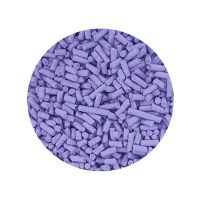
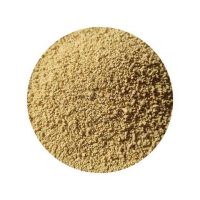
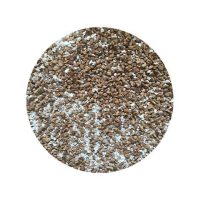
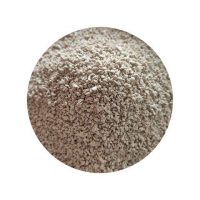
For any brand shipping cat litter into the United States, country of origin is not an administrative detail on a customs form — it’s one of the largest single variables in landed cost. Two identical bags of cassava litter, same formula and same packaging, can carry meaningfully different duty depending on which factory produced them.
This covers how origin actually determines your tariff exposure, what separates genuine Vietnam production from transshipment, and what a manufacturer running both a China base and a Vietnam base can and cannot do for a US-bound order.
Before you read further: US tariff policy has changed several times in 2026, including a Supreme Court ruling that struck down one tariff program and subsequent replacements under different statutory authorities. Specific rates in this article are deliberately omitted because they go stale quickly. Confirm current rates for your HTS classification with a licensed customs broker at the time you place an order — not from any supplier’s blog post, including this one.
Why Country of Origin Determines Your Cat Litter Import Duty
US import duty is assembled in layers. The base layer is the MFN (Most Favored Nation) rate tied to your product’s HTS classification, which applies regardless of origin. On top of that sit country-specific programs — most significantly, the Section 301 surcharges that apply to China-origin goods and not to goods originating elsewhere.
That’s the structural point that has held since 2018 and remains true through the various policy shifts since: a China-origin shipment carries a surcharge layer that a Vietnam-origin shipment of the same product does not. Everything else in this article follows from that one asymmetry.
Two things worth being precise about. First, Vietnam-origin does not mean duty-free — the MFN rate still applies, along with any other program in effect at the time of entry. Second, tariff programs are created and removed by executive and legislative action on short timelines, so the size of the gap between the two origins changes; the existence of the gap has been consistent.
China vs Vietnam Cat Litter Manufacturing: What Actually Differs
| Factor | China Production | Vietnam Production |
|---|---|---|
| China-specific Section 301 surcharge | Applies | Does not apply |
| Base MFN duty | Applies | Applies |
| Raw material access | Deepest supply base, widest formula range | Strong for cassava and plant fiber |
| Production scale | Largest global capacity | Growing, smaller installed base |
| Origin scrutiny from CBP | Standard | Elevated for China-adjacent operations |
| Best fit | Non-US markets, widest formula selection | US-bound volume |
China remains the deepest cat litter production base globally, and for buyers shipping to Europe, Japan, Korea, or Australia, the tariff argument for Vietnam largely disappears — China production is often the better answer on formula range and capacity. The Vietnam case is specifically a US-market case.
What “Substantial Transformation” Means for Cat Litter Origin
US Customs does not determine origin by where a container was loaded or where a company is headquartered. The governing test is substantial transformation: the processing performed in a country must convert the inputs into a new and different article of commerce, with a distinct name, character, or use from what went in.
Applied to cat litter, this is generally straightforward. Raw cassava starch, soybean fiber, or ground shell material is not cat litter. Drying, mixing with clumping agents, granulating or extruding, screening for granule size, and packaging converts it into a distinct commercial article with a different name, character, and use. When that conversion happens at a Vietnamese plant, the finished litter is Vietnam-origin.
What does not meet the test is equally clear. Taking finished cat litter produced in China, shipping it to Vietnam, and repackaging it into Vietnamese-labeled bags changes nothing about the article itself — it’s still the same product with the same name, character, and use. That is transshipment, and it is a customs violation, not a sourcing strategy.
Transshipment Risk: When Vietnam Production Doesn’t Qualify
US Customs actively investigates goods routed through Vietnam using predominantly Chinese inputs and minimal Vietnamese processing. Operations that raise scrutiny typically share a few characteristics: a Chinese-headquartered parent with a recently established Vietnamese assembly site, a production shift that coincided suspiciously with a tariff change, and processing steps that amount to finishing rather than manufacturing.
The consequence of getting this wrong falls primarily on the importer of record, not the factory. If CBP determines that goods declared as Vietnam-origin are actually China-origin, the importer faces retroactive duty assessment, penalties, and potential future shipment holds. This is why origin is a due diligence question a buyer should ask directly, rather than accepting a supplier’s assurance at face value.
The question to ask a supplier: Not “can you ship from Vietnam” — that’s a logistics question with an easy yes. Ask instead: which specific production steps happen at the Vietnamese facility, and what raw material arrives there? A factory genuinely producing in Vietnam can answer immediately and in detail. A transshipment operation will answer vaguely or redirect to shipping arrangements.
What a Dual-Base Cat Litter Manufacturer Actually Provides
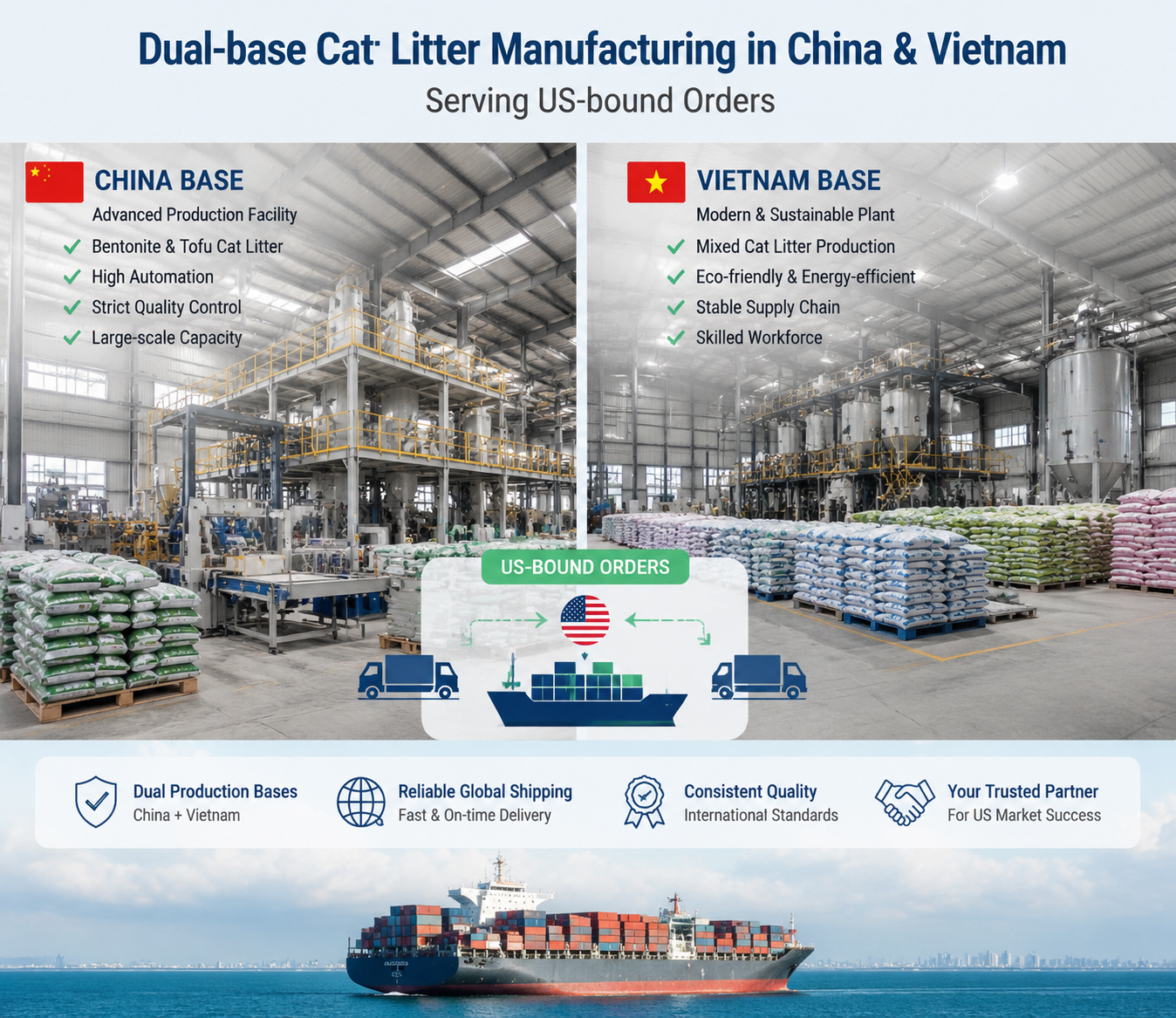
A manufacturer operating production in both China and Vietnam offers something narrower and more practical than “tariff avoidance.” It offers origin flexibility within a single supplier relationship — the same formula specification, the same quality management framework, and the same commercial relationship, with a choice of production origin depending on destination market.
In practice this matters in three situations:
- Split-destination brands. If you ship to both the US and the EU, you can source US-bound volume from the Vietnam base and other markets from the China base, without qualifying and managing two separate suppliers.
- Policy volatility. Tariff programs change on short notice. A supplier with two origins can shift future production between them; a single-origin supplier can only tell you the new rate.
- Capacity redundancy. Two production sites reduce the single-point-of-failure risk that comes from one facility, one region, and one set of local disruptions.
Our own operations run on this model — a facility in Qingdao, China alongside a plant in Tay Ninh Province, Vietnam dedicated to cat litter and pet pad production, which you can read more about on our company and factory page.
Documentation Your Vietnam Cat Litter Supplier Should Provide
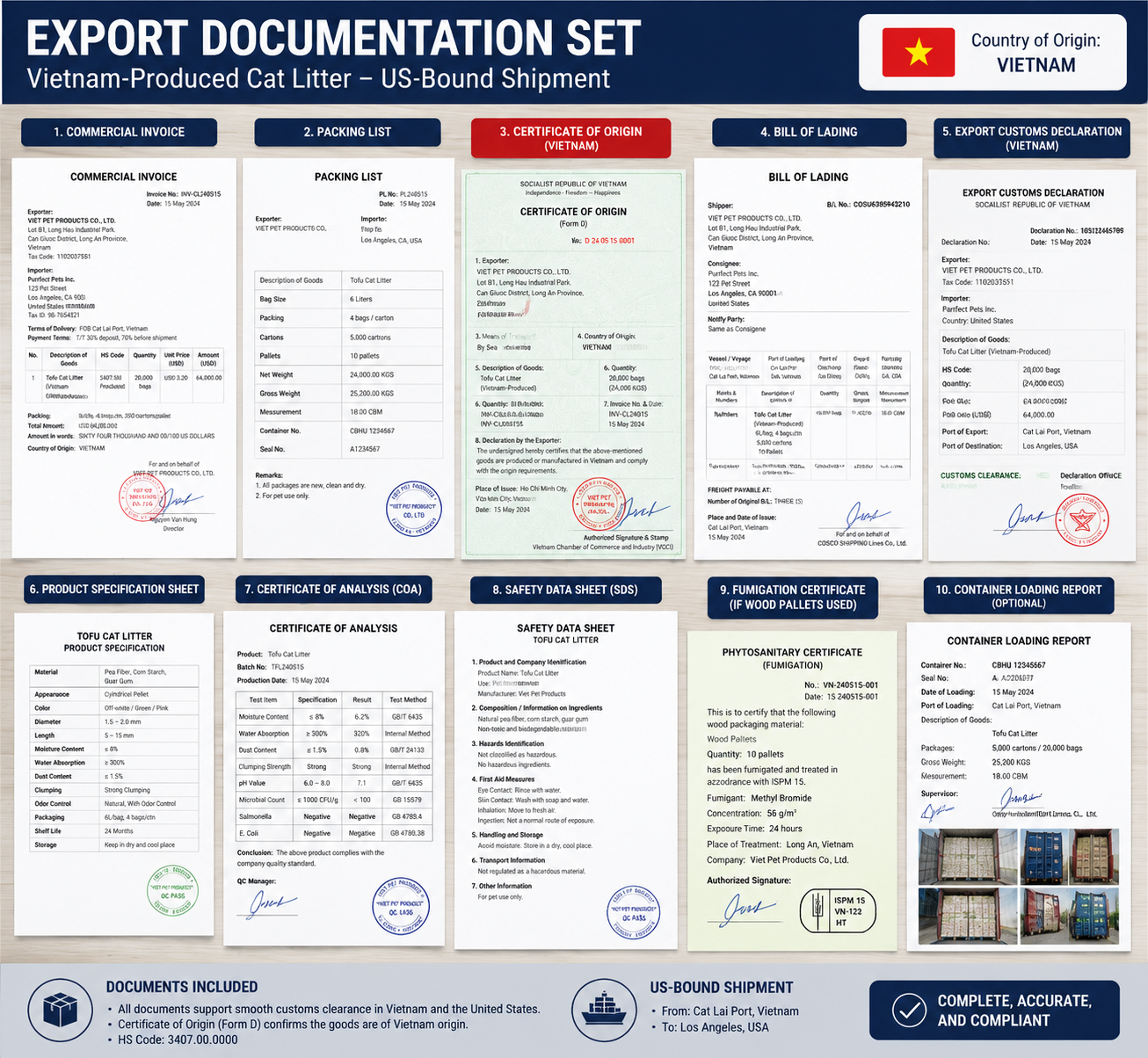
Origin claims live or die on paperwork. Before your first Vietnam-origin shipment, confirm your supplier can provide:
- Certificate of Origin issued for the specific Vietnamese producing facility, not a generic company-level document.
- Commercial invoice and packing list that identify the producing plant, not just the selling entity.
- MSDS documentation for the finished product, required for cross-border shipping compliance regardless of origin.
- Product test certificates tied to the Vietnamese production batch — for plant-based formulas, this should include mould and aflatoxin testing, which matters for organic-origin materials.
- Manufacturing process documentation showing which steps occur at the Vietnam facility, available if origin is ever questioned.
For the broader import process beyond origin — FOB versus CIF terms, container planning, and clearance workflow — see our guide to importing natural cat litter to the USA.
How to Model Landed Cost Across Both Origins
The comparison that matters isn’t the FOB price from each facility — it’s landed cost per unit at your destination port. Build the model with these components for each origin:
- FOB price per unit from that facility
- Ocean freight to your destination port (routes and rates differ between Chinese and Vietnamese ports)
- Base MFN duty for your HTS classification
- Any origin-specific surcharges currently in effect
- Port fees, customs brokerage, and inland delivery
Run the same model for both origins with current rates, and the answer for your specific product and destination becomes a number rather than an argument. Buyers sourcing bulk volume into the US may also find our overview of where to buy cat litter in bulk in the US useful for comparing direct import against domestic distribution.
Frequently Asked Questions
Does cat litter made in Vietnam avoid US tariffs on Chinese goods?
Cat litter genuinely manufactured in Vietnam is classified as Vietnam-origin and is not subject to the China-specific Section 301 surcharges that apply to China-origin goods. It still pays the standard MFN duty rate for its HTS classification, plus any other tariffs in effect at the time of entry. The key word is genuinely — origin is determined by where substantial transformation occurs, not by where the container was loaded.
What is substantial transformation and why does it matter for cat litter?
Substantial transformation is the US customs test for determining country of origin: the processing in a country must change the article into a new and different article of commerce with a distinct name, character, or use. For cat litter, converting raw soybean fiber or cassava starch into finished granulated or extruded litter in Vietnam generally meets this test. Simply repackaging finished Chinese litter into Vietnamese bags does not.
What documentation should a Vietnam cat litter supplier provide?
At minimum: a Certificate of Origin issued for the Vietnam facility, commercial invoice and packing list identifying the producing plant, MSDS documentation, and product test certificates tied to the Vietnamese production batch. Buyers facing origin scrutiny should also be able to obtain manufacturing process records showing where raw material processing takes place.
Article summary: Country of origin drives US duty exposure because China-origin goods carry surcharge layers that Vietnam-origin goods do not. Origin is decided by substantial transformation — where the raw material actually becomes cat litter — not by shipping arrangements. A dual-base manufacturer provides origin flexibility within one supplier relationship; a repackaging operation provides legal exposure. Verify current rates with a customs broker before every order.
Discuss Origin Options for Your US-Bound Order
Production available from our China and Vietnam facilities, with full origin documentation and OEM support across all plant-based formulas.
Talk to Our Team →