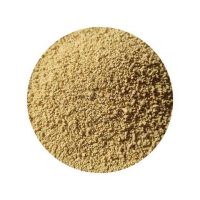
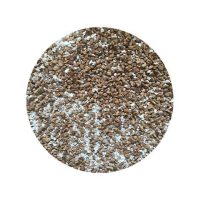
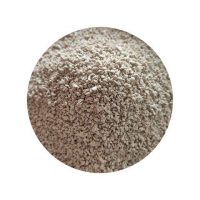
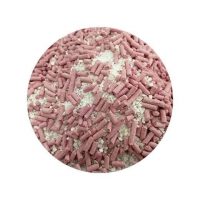
A cat litter sample order should never be treated as a small courtesy from the supplier. For distributors, it is the first serious test of whether a product deserves warehouse space, retail shelf space, and customer trust. A sample that looks fine in the bag can still create problems later if the clumps break too easily, the dust is heavy, the scent is too strong, or the packaging cannot survive shipping.
This guide is written for wholesale buyers, importers, pet product distributors, retailers, and private label brands that want to test cat litter properly before moving into MOQ or bulk production. The point is not to turn every buyer into a laboratory. The point is to make sample testing practical enough that it prevents expensive mistakes.
Start with the product you actually want to sell
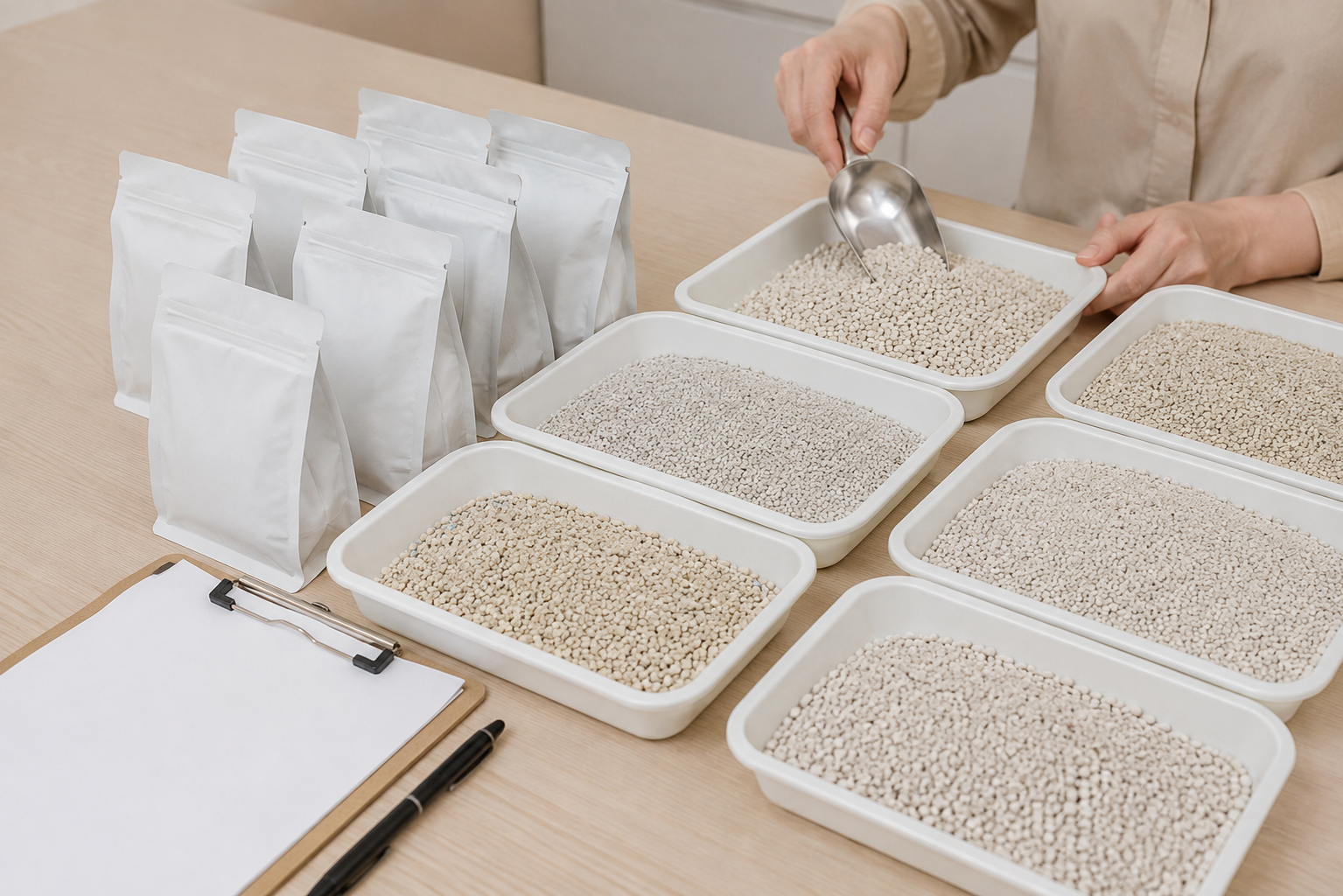
Before asking for cat litter samples, decide what kind of customer you are buying for. A sample request becomes confusing when the buyer asks for everything: tofu litter, cassava litter, bentonite litter, mixed litter, several scents, several granule sizes, and several bag weights at the same time.
That usually creates a weak test. Too many samples arrive, but the buyer does not know which one should win.
A better approach is to start from the sales channel. If you sell to pet specialty stores, you may need cleaner packaging, lower dust, and a stronger product story. If you sell to supermarkets, price point and simple shelf communication may matter more. If you sell online, bag weight, carton strength, leakage risk, and customer reviews become more important. If you sell to shelters or catteries, practical scooping, odor control, and cost per use may decide the order.
Once the target customer is clear, the sample request becomes sharper. You can ask the supplier for two or three formulas that fit the market instead of asking for a random product list.
What to include in a cat litter sample request
A good cat litter sample order should give the supplier enough information to prepare useful samples. If the request is too vague, the supplier may send whatever is easiest, not what your market needs.
Before requesting samples, share these details:
- Target country or region
- Sales channel
- Preferred material
- Expected retail price range
- Preferred bag weight
- Standard packaging or private label plan
- Scent preference
- Dust sensitivity in your market
- Whether flushability, biodegradability, or plant-based positioning matters
- First order target or rough MOQ expectation
This does not need to be a long sourcing document. Even a short message with the right details will produce better samples than a one-line request that says, send me your best cat litter.
If you are still comparing supplier options, use the wholesale cat litter supplier guide to define your buying priorities first, then request samples around those priorities.
Do not judge a sample only by appearance
Cat litter is easy to photograph and easy to misunderstand. A clean tray of granules can look premium even when the litter does not perform well after a few days of real use.
Appearance still matters. Buyers should check color, granule shape, texture, uniformity, broken pieces, and dust inside the bag. But those checks only tell you what the product looks like before use. They do not tell you whether customers will reorder.
The real sample test starts after the litter is poured, wetted, scooped, handled, and left in the tray long enough to test odor control. A distributor should care less about whether the sample looks perfect under a camera and more about whether the product behaves consistently under ordinary use.
That is the difference between a sample review and a real buying test.
Test clumping like a customer will scoop it
For clumping cat litter, the clump test is one of the most important parts of sample approval. But it should be done with a little patience.
Pour a normal depth of litter into a clean tray. Add a controlled amount of liquid in one place. Wait for the clump to form. Then scoop it after a few minutes, not instantly. Watch whether the clump stays firm, breaks into wet pieces, sticks to the tray bottom, or leaves small fragments behind.
A strong clump does three things well. It forms quickly enough to contain moisture. It stays firm enough to scoop cleanly. It does not leave too much dirty litter behind after removal.
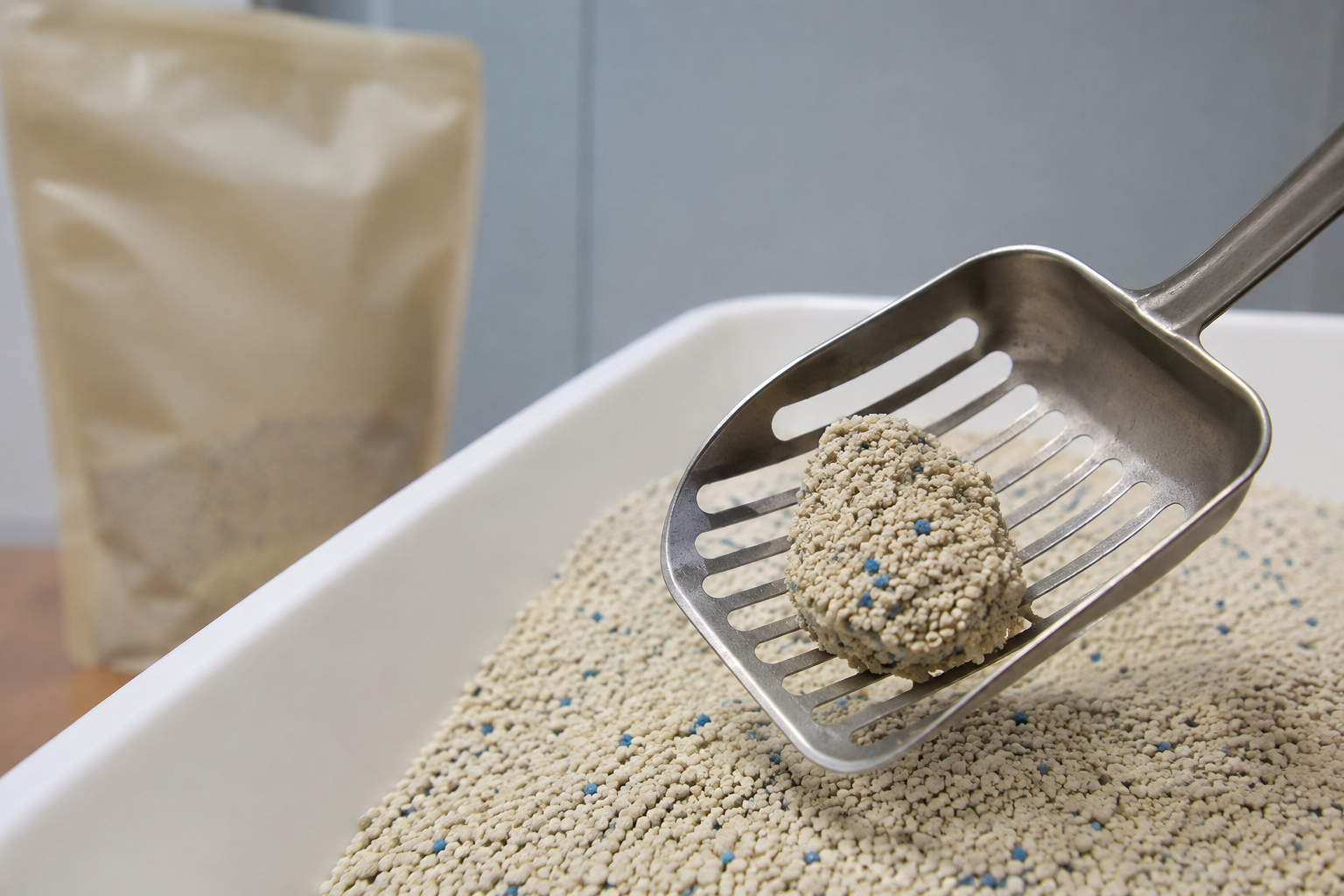
For wholesale buyers, the question is not whether one clump looks good once. The question is whether the litter performs the same way across several tests. Try the test more than once, and test different areas of the tray. If you receive several production samples, compare them under the same conditions.
If you are sourcing clumping cat litter, clump strength should be discussed before price. A cheaper product that breaks during scooping can quickly create customer complaints.
Dust testing should be simple and honest
Low dust is one of the most common claims in cat litter, but buyers should test it with their own eyes before approving a sample.
You do not need complicated equipment for a first review. Pour the litter from a normal height into a clean tray and watch the dust cloud. Let the tray settle. Then scoop through the litter and see whether fine dust rises again. Check the inside of the sample bag for powder buildup. Rub a small amount of granules gently in the scoop to see how easily they break.
The goal is not to create a perfect lab result. The goal is to compare samples fairly.
Use the same tray, same pouring height, same quantity, and same room light for each sample. If one sample creates visible dust while another stays cleaner, that difference matters. It may affect customer reviews, repeat purchase, and the way retailers judge product quality.
For markets where indoor air quality is a major concern, connect sample testing with your low dust cat litter positioning. The claim should match the product, not just the packaging copy.
Odor control needs time, not a quick sniff
Odor control cat litter cannot be judged properly in the first five minutes. Many samples smell clean when the bag is opened. The harder question is what happens after repeated use.
A practical odor control test should run for longer than a simple clump test. Use a clean tray, keep the depth consistent, and test the litter over time. If possible, compare two or three samples under the same conditions instead of testing one product alone.
Watch for several things. Does the litter control ammonia-like odor after moisture contact? Does the scent become too strong in a small room? Does the fragrance cover odor at first but fade quickly? Does the litter keep the tray acceptable after multiple clumps are removed?
For distributors, odor control is not only a product feature. It is a complaint reducer. Customers may forgive average packaging, but they rarely forgive a litter that fails in odor control after one or two days.
If odor control is part of your product positioning, review Magnet’s odor control cat litter manufacturer options before finalizing the sample list.
Test tracking and texture before choosing granule size
Tracking is the litter that leaves the box and appears around the floor. Some tracking is normal, but heavy tracking can hurt customer satisfaction, especially in apartments.
Granule size, weight, shape, and texture all influence tracking. Fine litter may feel soft under paws and clump quickly, but it can travel farther. Larger pellets may track less, but some cats may need time to accept the texture. Plant-based litter, clay litter, and mixed formulas can all behave differently.
For sample testing, do not judge texture only by touching it with your hand. Pour it into a tray and move it with a scoop. If possible, test in a real litter box area and check the floor around the box after use. A sample that performs well on clumping but tracks heavily may need a different granule size for your market.
This is where a cat litter manufacturer can help. Ask which granule sizes are already proven for your channel before creating a new specification from scratch.
Packaging samples matter as much as litter samples
A cat litter sample order should not stop at loose litter. If you are buying wholesale or private label, filled packaging samples matter.
Packaging affects leakage, shelf display, handling, ecommerce delivery, moisture protection, and customer trust. A bag that looks fine when empty may wrinkle, bulge, tear, or leak once filled with several kilograms of litter. A handle may feel strong in a mockup but fail after real lifting. A zipper may look premium but add cost without improving the buyer’s experience.
Ask for packaging samples that match the planned bag weight whenever possible. If the final order will use a 6L, 10L, 5kg, or 10kg bag, test something close to that size. Carry it. Stack it. Place it on a shelf. Check the seal. Look at how the bag stands after filling.
For private label projects, review packaging before approving the MOQ. A private label cat litter manufacturer should be able to explain bag material, printing, proofing, and lead time clearly. If the packaging plan is not clear, the bulk order is not ready.
Compare samples with a simple scoring sheet
Distributors do not need a complicated laboratory report for every sample. But they do need a consistent way to compare products.
Use a simple scoring sheet with the same criteria for every sample:
- Clump speed
- Clump hardness
- Dust when pouring
- Dust when scooping
- Odor control after time
- Tracking around the box
- Granule breakage
- Texture and appearance
- Packaging strength
- Bag leakage
- Product positioning fit
- Estimated landed cost fit
Score each item from one to five, then write a short note beside the score. The note is more important than the number. A score of three means very little by itself. A note like good clump but too much dust when poured gives the supplier something useful to improve.
This also helps internal communication. Your sales team, purchasing team, and management can discuss the same facts instead of relying on personal preference.
Give suppliers useful feedback after testing
A supplier cannot improve a sample if the buyer only says it is not good enough. Good feedback should be specific.
Instead of saying the dust is bad, say when the dust appears. Is it during pouring, scooping, or after the granules rub in the bag? Instead of saying the clump is weak, explain whether it breaks immediately, sticks to the tray, or crumbles after scooping. Instead of saying the scent is wrong, explain whether it is too strong, too sweet, too artificial, or too weak after use.
Useful feedback shortens the sampling process. It also shows whether the supplier is technical enough to support repeat orders.
If the supplier responds with a clear adjustment plan, that is a good sign. If every concern is answered with general promises, be careful. Sample approval should be based on observable improvement, not polite emails.
Connect sample approval to MOQ and bulk order planning
Sample approval should lead into MOQ planning naturally. Once you know which formula and packaging work, the supplier can give a more realistic quote for the first wholesale order.
At this stage, ask about:
- MOQ for the approved formula
- MOQ for standard packaging
- MOQ for private label packaging
- Mixed SKU options
- Sample-to-production consistency
- Production lead time
- Container loading quantity
- Reorder lead time
- Quality checks before shipment
This is where the previous article, the cat litter MOQ guide, becomes useful. Samples tell you what product deserves a first order. MOQ planning tells you what order size makes commercial sense.
Do not separate the two decisions too much. A great sample with an unrealistic MOQ may not fit your launch. A flexible MOQ with a weak sample is not a bargain. The right supplier helps you balance both.
Common sample order mistakes
The most common mistake is asking for too many samples without a plan. A buyer receives a large box of products, tests them casually, and still does not know what to order.
Another mistake is approving the sample too quickly. Cat litter needs time to show dust, odor control, tracking, and clump stability. One quick office test can miss problems that customers will notice immediately at home.
A third mistake is ignoring packaging. Buyers sometimes approve the formula and only discuss bags later. That can delay production or change the real MOQ.
A fourth mistake is comparing samples from different suppliers under different conditions. If one sample is tested in a shallow tray and another in a deep tray, the result is not fair. Keep the test method consistent.
Finally, do not forget repeat production. Ask whether the supplier can keep the approved formula stable in future orders. A good sample is only valuable if the factory can repeat it.
A practical sample approval checklist
Before moving from cat litter sample order to purchase order, check the following points:
- The formula matches the target sales channel.
- Clumps form quickly and scoop cleanly.
- Dust is acceptable when pouring and scooping.
- Odor control holds up after repeated use.
- Tracking is acceptable for the intended customer.
- Granule size and texture fit the product positioning.
- The sample bag or planned packaging is strong enough.
- The supplier can explain the production MOQ clearly.
- The supplier can repeat the approved specification.
- The landed cost can support your expected retail price.
If the sample passes these checks, the buyer can move into MOQ, packaging, and bulk order discussion with much more confidence.
Good samples make wholesale buying easier
A cat litter sample order is not just a small step before the real order. It is the step that protects the real order.
For distributors, the best sample process is practical, fair, and connected to the buying plan. Test the formula like a customer will use it. Test the packaging like a warehouse and retailer will handle it. Compare samples under the same conditions. Give clear feedback. Then connect the approved sample to MOQ, container loading, and repeat-order planning.
That is how sample testing becomes more than product curiosity. It becomes a sourcing tool.
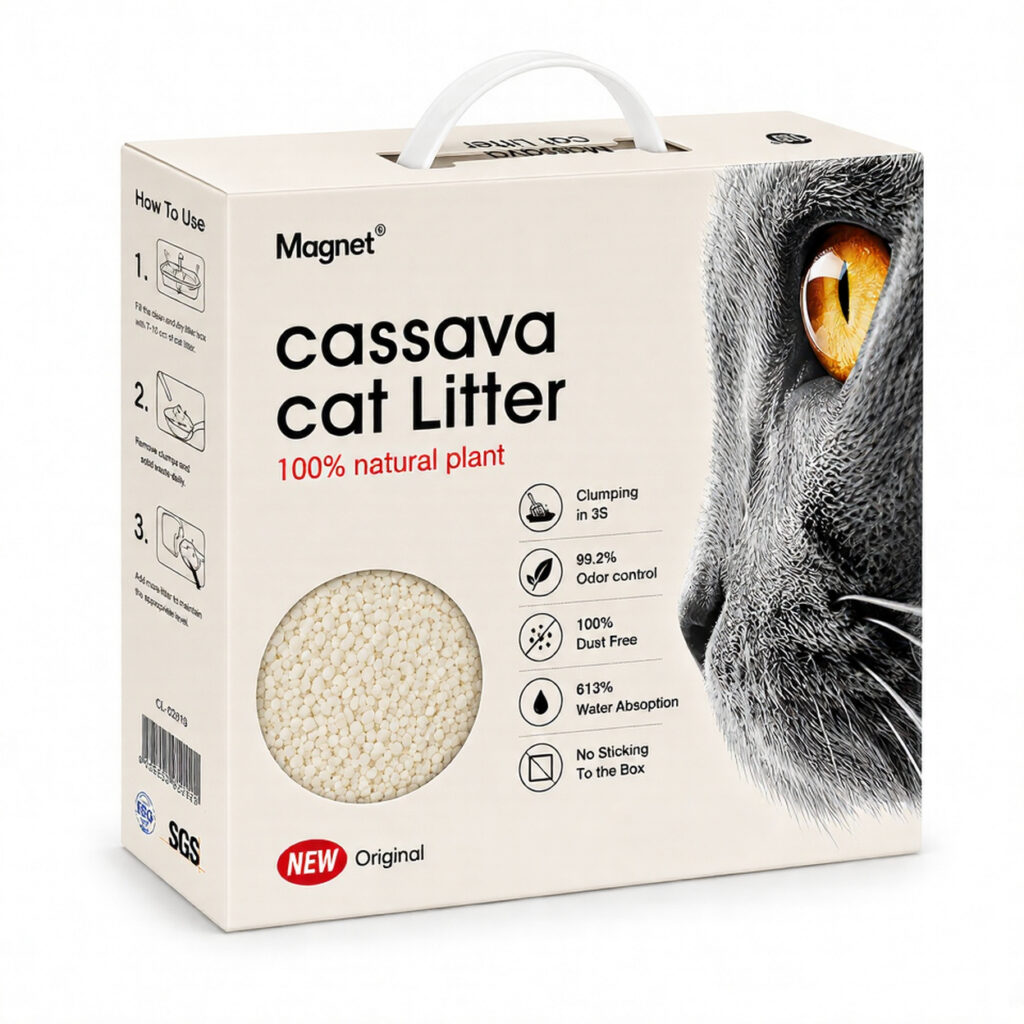
Magnet Cat Litter supplies wholesale, bulk, and private label cat litter for distributors, importers, retailers, and pet product brands. If you are comparing tofu, cassava, clumping, low-dust, odor-control, or custom packaging options, start with samples that match the market you actually want to serve.
FAQ
How many cat litter samples should a distributor request?
Most distributors should start with two to four well-matched samples instead of asking for every available formula. A smaller sample set makes testing clearer and helps the buyer compare clumping, dust, odor control, texture, and packaging more carefully.
What should I test in a cat litter sample order?
Test clump speed, clump strength, dust during pouring and scooping, odor control over time, tracking, granule breakage, texture, bag strength, leakage, and whether the product fits your target sales channel.
Should I test packaging before placing a private label cat litter order?
Yes. Private label buyers should test filled packaging samples before approving bulk production. Bag material, seal strength, handle strength, zipper quality, and pallet stability can all affect complaints, damage rate, and reorder confidence.
Can sample approval reduce risk before a wholesale cat litter MOQ order?
Yes. Sample approval helps confirm whether the formula and packaging are worth ordering at MOQ level. It also gives the supplier clear specifications to repeat during bulk production.
Article summary: A cat litter sample order should help distributors judge real selling risk before bulk production. Test clumping, dust, odor control, packaging, texture, bag strength, and repeat-order consistency before approving MOQ.
Request Cat Litter Samples From Magnet
Tell us your target market, formula preference, bag size, and launch plan. Magnet can prepare cat litter samples for wholesale, bulk, and private label evaluation.
Request Samples