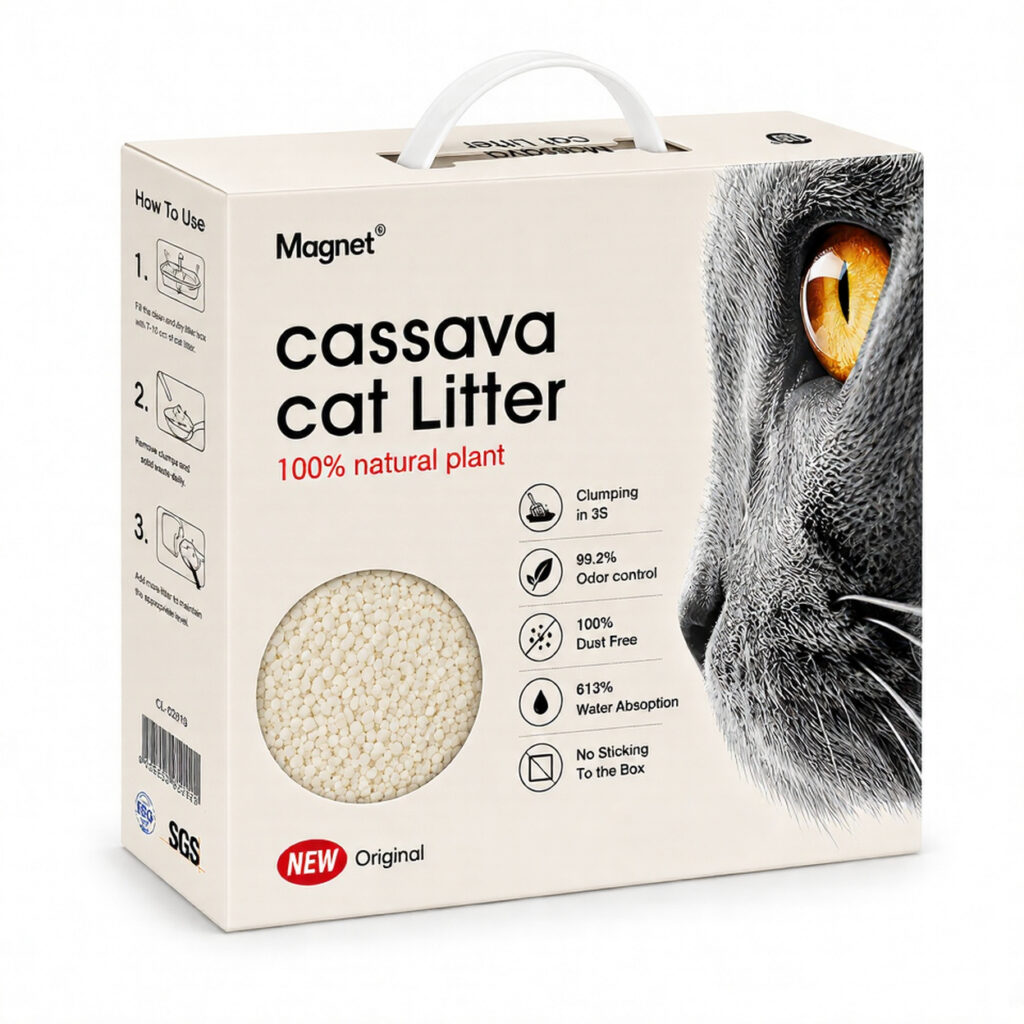

A litter can make a firm clump in a tray and still perform poorly in an automatic box. Clean material may fall into the waste drawer, wet clumps may smear across the liner, or a refill sensor may report the wrong level. None of those problems is answered by the word cassava on the bag.
For a private label buyer, cassava cat litter for automatic litter boxes is a model-specific development project. Start with the machine’s requirements, then decide whether the proposed formula can meet them. A broad compatibility claim should be the result of testing, not the opening line of a purchase order.
Start With the Device Manufacturer’s Instructions
Ask which exact devices your customers own. A rotating drum, a rake system and a sifting tray do not move litter in the same way. Their screens, cleaning delays and fill limits differ. Accessories that refill the box introduce another set of restrictions.
For example, Litter-Robot’s instructions for filling the Litter-Robot 3 specify clumping litter and exclude several unsuitable litter types. That guidance is not an endorsement of every plant-based formula. Check the current instructions for the exact model and accessory before testing or making a claim.
If the manufacturer excludes your proposed material or particle format, do not describe it as compatible simply because one demonstration looked successful.
Specify More Than the Average Particle Size
An average can conceal the particles that cause trouble. Ask for the size distribution, including oversized pieces and fines, and request samples from normal production rather than a specially selected handful.
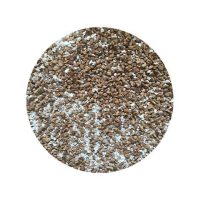
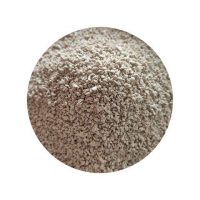
When considering fine granule cassava cat litter, check whether clean material passes through the relevant screen without excessive retention. Then examine a sample after representative transport handling. The delivered product is what the customer’s machine will receive.
Use the same fill level and operating settings across candidate samples. Do not overfill a machine to make a lightweight formula appear to trigger a sensor correctly. Record any setup limitations that a customer would need to follow.
Test the Cleaning Cycle, Not Just the Clump
A useful assessment separates three events: liquid absorption, clump formation and clump release. A sample may succeed at the first two and fail at the third.
Within a controlled, documented comparison, examine:
- Whether the wet area holds together at the permitted cleaning delay.
- Whether the clump releases from the liner without leaving a substantial smear.
- Whether clean litter is discarded with each cycle.
- Whether repeated cycles produce buildup around moving or sensing components.
- Whether the waste drawer remains practical to empty and clean.
Use a consistent test liquid, dose and placement for bench comparisons, agreed with the supplier or laboratory. These trials screen mechanical performance; they do not establish cat acceptance, odor performance or health safety. A supervised household evaluation is a separate step.
Put a Number on Clean Litter Loss
A machine-compatible product should also make commercial sense. Repeatedly discarding unused litter can undermine a premium bag price even when the box completes its cycle.
For an internal comparison, collect and weigh the clean material that is wrongly diverted to waste during a fixed set of dry cycles. Repeat the exercise with fresh samples and the same settings. Keep this result separate from the mass of wet clumps because retained liquid would distort the comparison.
The purpose is to compare candidates under one method, not to invent a universal pass rate. Your acceptable loss depends on the device, retail price and intended usage instructions.
Keep the Compatibility Record Narrow and Traceable
Record the formula revision, batch, particle specification, machine model, relevant firmware, accessory configuration, fill level and test date. Keep photos and the actual observations, including failures.
If only one configuration has been evaluated, say so. Avoid phrases such as works with all automatic litter boxes. If a particle specification changes later, revisit the assessment before continuing the same packaging claim.
Buyers reviewing the wider cassava cat litter range should also separate automatic-box candidates from products intended for ordinary trays. There is no commercial need to force every formula into the same use case.
What to Send With Your Sample Request
Send the device list, the proposed retail claim, your current benchmark product and the bag size. Ask the supplier to identify any known limitations before quoting a production order.
The strongest outcome is not a confident yes from the factory. It is a repeatable result that your product, customer service and purchasing teams can all explain accurately.
Discuss a Cassava Litter Sample Brief
Send Magnet the device models, destination market and proposed bag size so the sample discussion starts with your actual requirements.
Discuss Cassava Cat Litter