A litter can look convincing in a product photograph and still disappoint at the first scoop. The wet area breaks apart, clean litter gets thrown away with it, and the owner has to scrape the tray before leaving for work. For that customer, the material on the front of the bag matters less than what the formula does during cleanup.
Cassava has a strong premium-product case because it brings several useful features into the same formulation: a short ingredient list, clumping without an added binder, and an odor-control proposition that does not depend on added perfume.
Here, outperforming means a potential advantage on defined buying criteria, based on Magnet’s published specifications and product positioning. It does not mean every cassava litter beats every tofu, corn or straw product. This article explains that case for Magnet’s fine-granule formula; it is not an independently conducted head-to-head test.
Fine Granule Cassava Cat Litter
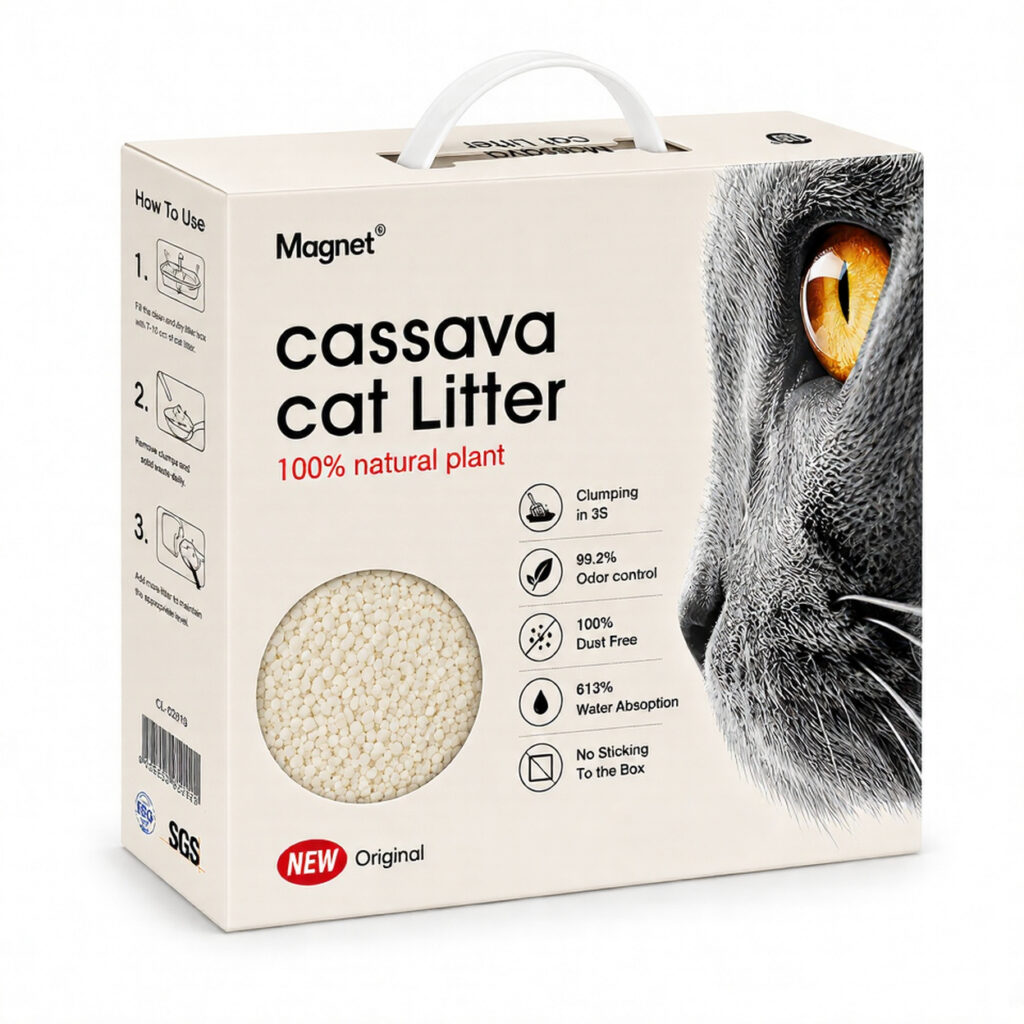
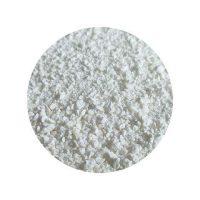
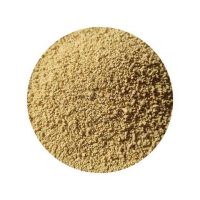
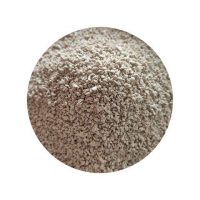
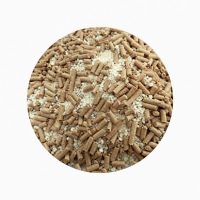
Magnet’s fine granule cassava cat litter lists 60% corn starch and 40% cassava starch, with a 0.5-3 mm granule range. Its specification excludes added guar gum, calcium carbonate, fragrance, baking soda and activated charcoal.
The distinction is worth making early: this is a formulated corn-and-cassava product, not pure cassava root and not every product sold under the cassava name. A buyer should judge the supplied formula, including its processing and finished particle format, rather than assume the raw material alone guarantees performance.
For a private label brand, the short formulation offers a concrete way to differentiate the bag. The message is not that all longer ingredient lists are undesirable. It is that this product is designed to deliver its stated functions without those particular additions. That is more informative than an unexplained premium or natural badge.
The purchasing follow-through is equally specific. Keep the approved ingredient statement with the sample specification. If the formula is later customized, review the label again instead of carrying the original free-from language onto a different product.
Clumping Cassava Cat Litter Without Added Binders
Magnet describes the fine-granule formula as forming clumps in three seconds without an added binding agent. For the buyer, the important distinction is between the beginning of clump formation and a clump being ready for normal removal. A rapid visible reaction is useful, but it does not answer every scooping question.
Consider the full task. The scoop must reach beneath the wet area, lift it and carry it to the waste container. If the material holds together throughout that movement, the owner has fewer separate pieces to retrieve. If it breaks, a fast initial reaction may offer little practical advantage.
That is where the clumping proposition should earn its place in a premium range. Ask for the recommended waiting interval, then assess the formed clump under those instructions. Record fragments left behind as well as the lump removed. A demonstration that shows only the successful lift leaves out half of the cleaning experience.
An added binder in another product is not evidence of poor quality or unsafe composition. The defensible distinction is formulation choice, followed by demonstrated finished-product performance. Cassava’s commercial appeal is strongest when the short ingredient list and the actual scoop experience support each other.
High Absorption Cassava Cat Litter
The cassava cat litter manufacturer page reports 613% water absorption for the fine-granule product. It also lists other materials’ values, including minimum specifications for some alternatives. Those published figures describe the manufacturer’s offer; they are not a complete comparative test report.
Two details prevent a misleading comparison. First, a minimum value is not necessarily the result a particular competing sample achieved. Second, results need the same method and conditions before they can support a numerical superiority claim. Dividing a reported result by another product’s minimum does not prove a matching improvement in real use.
For the customer, the question is more practical: how much litter must be removed to deal with each wet area, and how much usable material leaves with it? Absorption is relevant to that discussion, but clump size, breakage, scoop design and the cleaning routine also enter the calculation.
A buyer considering a higher-priced bag should therefore examine discarded material and replenishment alongside the absorption specification. A formulation has a meaningful economic advantage only when the relevant use record supports it. Avoid converting a laboratory percentage into a promise of extra weeks per bag without that evidence.
Non-Stick Clumping Cat Litter
Easy release and strong clumping are separate benefits. A firm clump can still require scraping, while a clump that releases readily can fall apart during lifting. The most convincing cleanup proposition addresses both.
For a non-stick product review, look at the tray after the usual scoop movement. Is there a damp smear to remove? Does the owner have to change the tool angle repeatedly? Is the difficult patch always in a corner where the scoop cannot sit flat? These observations are more informative than simply describing the tray as clean or dirty.
Use the product’s filling instructions and maintain the working layer during the comparison. A tray that is full at one end but dug nearly bare at the other is not a consistent setup. Equally, a better result after changing both the litter and the tray does not identify which change helped.
For retail copy, describe the intended easier-cleanup benefit without promising that residue is impossible. A credible product recommendation should help customers reproduce the intended experience, not leave them feeling that any remaining maintenance contradicts the label.
Fragrance-Free Cassava Cat Litter
Magnet reports a 99.2% odor-control rate for the fine-granule product and positions it as working without added fragrance. The percentage requires the associated method, target odor and conditions to be meaningful; it should not be translated into that percentage less smell in every home.
The absence of added perfume is a separate, more straightforward purchasing feature. It gives retailers an option for customers who do not want a scented tray area. A fragrance-free formula need not be described as having no natural material smell, and it should not be turned into an allergy or respiratory-health guarantee.
For a customer comparing alternatives, distinguish three experiences: the smell of the unused litter, the smell during normal use and the smell remaining after waste removal. A strong perfume at opening does not establish effective odor control later, just as a mild-smelling unused sample does not prove long-lasting performance.
This makes the sales message clearer. Lead with the confirmed absence of added fragrance, then discuss supported odor-control performance and the recommended cleaning routine. Those facts work together without implying that the tray can be left unattended.
Low Dust Cassava Cat Litter
The fine-granule listing uses the stronger wording 100% dust-free and attributes it to SGS testing. A buyer should request the report before using that absolute claim on packaging. This article has not independently reviewed that report, and a website statement alone does not establish its scope.
Check the tested sample, method, reporting threshold and conditions. A measurement of material separated by a particular procedure is not automatically a measurement of airborne particles during every household activity. The approved claim should describe what the evidence actually supports.
The delivered bag matters too. Record its condition and observe normal pouring and scooping without deliberately creating a dust cloud. A separately prepared sample and the intended retail pack are not identical purchasing references. Keep a representative approved sample so repeat orders can be discussed against something more precise than a memory of the first demonstration.
The commercial opportunity is a cleaner-handling proposition that can be documented. It does not require exaggerating low dust into a medical benefit or treating intended fine granules as dust merely because they are small.
Pellet Cassava Cat Litter for Low Tracking
Fine granules will not be the right answer to every complaint. If the customer mainly wants fewer particles carried beyond the tray, include the pellet format in the shortlist rather than insisting the highest absorption specification must win.
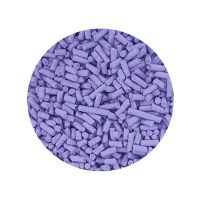
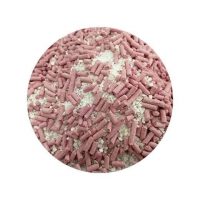
Magnet’s pellet cassava cat litter lists pea fiber, corn starch and cassava starch, with 1.5, 2 and 3 mm diameter options. It is positioned around reduced tracking. That is a different formulation and format, not simply the two-starch fine-granule specification reshaped into a longer particle.
Do not transfer the fine product’s figures or ingredient exclusions onto the pellet listing. Request the selected pellet SKU’s own documents, then review the complaint it is intended to address. Material outside the tray may be kicked out, carried away or spilled during filling, so identify the source before judging the change.
This is an important limit to the headline: performance has several dimensions. A customer who values floor cleanup above all else may make a different selection from one who prioritizes fine texture and clump removal.
Cassava Cat Litter Wholesale
For buyers comparing cassava cat litter wholesale options, the quotation should identify the formula and format before the price. A fine-granule offer and a pellet offer are not interchangeable simply because both use the cassava name. Ask for the selected particle specification, retail bag weight or volume, packaging construction and order quantity on the same quotation.
Separate the product decision from the packing decision. Bulk sacks for repacking and finished retail bags involve different handling and packaging responsibilities. Confirm which costs are included, which sample represents the order and what conditions must be met before production begins. This gives the buyer a useful basis for comparing offers without reducing the choice to a price per tonne.
Private Label Cassava Cat Litter
Cassava earns a premium position most convincingly when a buyer can explain a specific improvement over the product their customer currently uses. Broken clumps, difficult release, unwanted perfume and inconvenient handling are useful starting points. A general assertion that plants are better than other plants is not.
For a private label cassava cat litter range, begin with one target problem and match it to the relevant format. Review the sample against that need, retain the supporting documents and write the retail benefit at the same level of certainty as the evidence. Keep a formula advantage separate from an assumed saving, and a manufacturer specification separate from an independently verified comparison.
The case for fine-granule cassava is the combination: a clearly defined starch formulation, a binder-free clumping proposition and no added fragrance, with published performance figures buyers can investigate. Where those features translate into better everyday cleanup for the intended customer, cassava has a practical reason to command attention beyond its ingredient name.
Put Cassava Cat Litter on Your Product Shortlist
Tell Magnet which issue your customers want to improve, from broken clumps to difficult cleanup. Request the matching cassava format, current specifications and supporting test documentation.
Request Cassava Cat Litter Samples