“Best” is not a single answer in private label sourcing — the right tofu cat litter manufacturer for a DTC brand selling 5kg bags into apartment markets is not the same partner as the right one for a distributor moving bulk volume into pet specialty retail.
What is consistent is the set of capabilities that distinguish a genuine OEM partner from a company that will simply relabel a catalogue product for you. This covers the tofu-specific ones, which differ meaningfully from the generic private label checklist.
What Separates a Tofu OEM Partner From a Relabeller
Any supplier can print your logo on a bag. A private label partner can change what goes inside it. For tofu litter specifically, five capabilities mark the difference:
- Control over okara sourcing and drying. Okara is perishable, and the interval between collection and drying determines mould and aflatoxin risk in your finished product. A partner who controls this can tell you the interval; one who buys dried fiber on the open market cannot.
- In-house extrusion. Forming is where pellet specification is set. A supplier outsourcing extrusion can’t adjust your pellet spec without renegotiating with a third party.
- Adjustable binder ratio. Clump firmness in tofu litter is binder-driven. If a supplier can’t discuss binder ratio, they can’t tune clump strength for you.
- Batch-level test documentation — mould, aflatoxin, salmonella — tied to production runs rather than general company certificates.
- A stated finished moisture specification and the method used to verify it.
The full production sequence behind these capabilities is covered in our breakdown of tofu cat litter raw materials and manufacturing, which also covers what to check on any tofu cat litter factory website before making contact.
Tofu-Specific Decisions in a Private Label Program
Generic OEM guides cover packaging, MOQ, and scent. These are the variables that only come up with tofu:
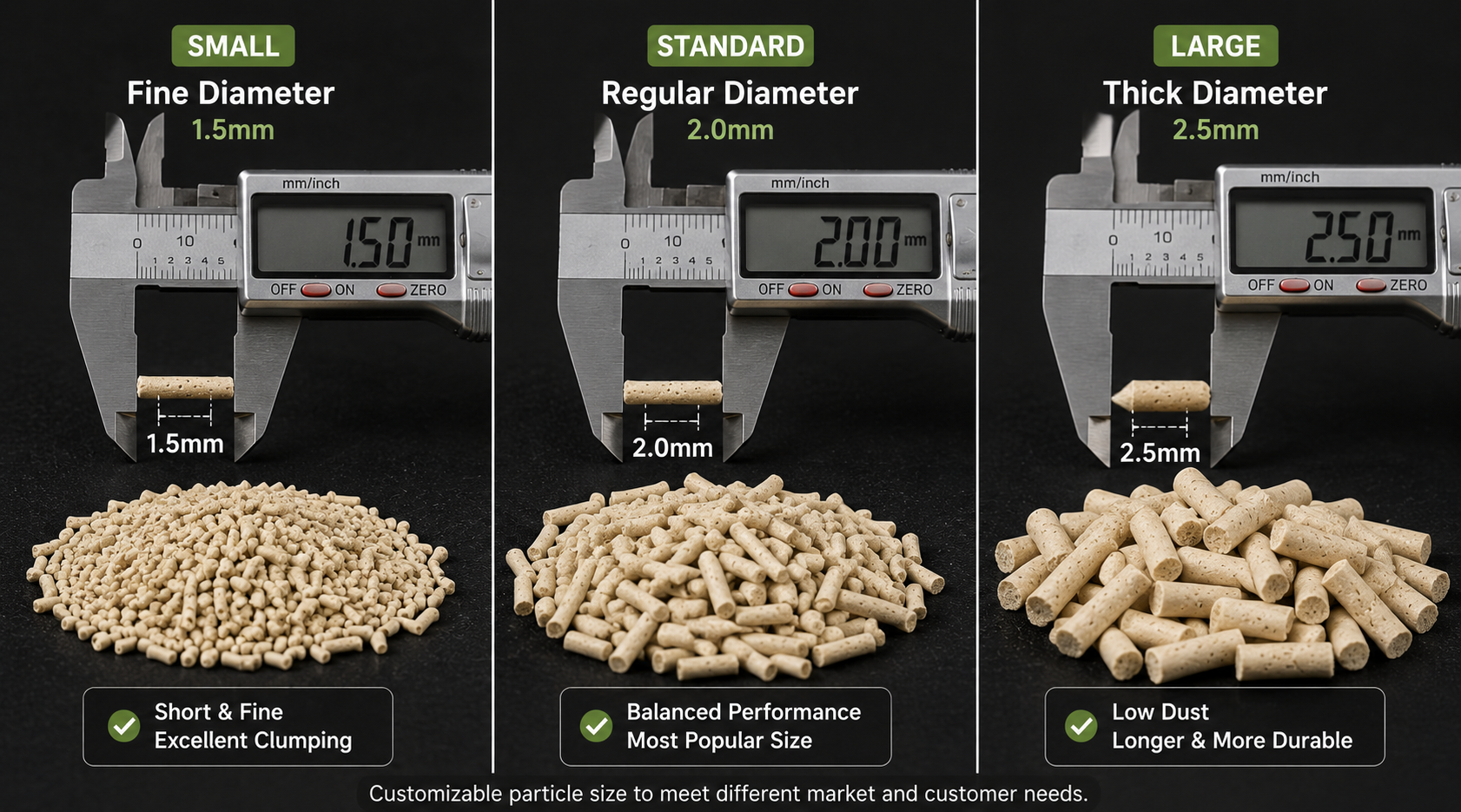
Pellet diameter and length
Pellet diameter is set by the die plate hole size; length is set by cutter speed. Both are specifiable, but they aren’t equally easy to change. Diameter requires a die plate swap — a genuine setup cost that usually carries its own minimum run. Length is a machine setting and far cheaper to adjust.
Commercially, larger pellets track less but feel coarser underfoot, which some cats reject. Smaller pellets feel closer to conventional litter but carry more readily on paws. If your positioning leads on low tracking, specify diameter deliberately rather than accepting the factory default.
Binder system
Most tofu formulas use guar gum. Some use a plant starch instead, and some brands specifically want a guar-free formula for positioning reasons. This is worth raising early — it’s a formulation change, not a packaging note, and it affects both clump behaviour and cost.
Blend ratio with starch
Adding a cassava or corn starch fraction to a tofu base increases clump density. This is the lever to reach for when your target customer is switching from clay and finds pure tofu’s clump too light. It’s a middle path between two separate SKUs.
Why Tofu’s Weight Advantage Changes Your Unit Economics
This is the part most first-time tofu brands underestimate, and it’s a genuine argument for the material rather than a marketing line.
A shipping container has both a volume limit and a weight limit, and cat litter is a category where weight typically binds first. Tofu is the lightest of the common litter materials, so a container holds more saleable units of tofu litter than of clay at the same fill volume. Freight cost per unit drops accordingly.
The effect compounds at the retail end. A customer comparing two bags of equal weight receives noticeably more volume with tofu — a perceived value advantage visible on the shelf without any claim on the packaging. For e-commerce brands the logic is even more direct, since fulfilment cost is weight-driven.
Model this properly: When comparing a tofu quote against clay or cassava, compare freight cost per saleable unit rather than per tonne. Tofu’s higher FOB price per kilogram frequently closes or reverses once container economics are included — and if you’re an e-commerce seller, again at the fulfilment stage.
Flushable Claims: What Your Manufacturer Needs to Support
Flushability is tofu’s most distinctive marketing asset and its most common source of customer complaints, usually because the claim was printed without qualification.
The mechanism is real: soy fiber disperses in water rather than swelling into a solid mass as clay does. But flushability isn’t a single regulated standard, and several municipalities discourage flushing cat waste for reasons unrelated to the litter material.
What to require from your manufacturer:
- Dispersal test data for the specific formulation you’re buying, not for tofu litter generally
- Written confirmation that production formulation matches the tested formulation
- Support for a recommended flush quantity on the packaging, rather than an unqualified claim
A partner who pushes back on an unqualified flushable claim is protecting you. One who agrees to print whatever you ask is not. The regulatory framing behind this is covered in our overview of cat litter packaging and brand printing.
Evaluating Cat Litter Manufacturers in China for Tofu Production
Most global tofu litter capacity sits in China, so the practical question is how to compare producers within that market rather than whether to source there. Our overview of cat litter manufacturers in china covers the broader landscape; these are the tofu-specific comparison points:
| Question | Strong Answer | Weak Answer |
|---|---|---|
| Where does your okara come from? | Named source, stated distance, collection interval | “We source locally” |
| What’s your finished moisture spec? | A number and a test method | “Very dry, no problem” |
| Can you change pellet diameter? | Yes, with die plate cost and minimum run stated | “We have standard size only” |
| What binder do you use and at what ratio? | Specific answer, willing to adjust | Deflects to “natural formula” |
| Can I see recent batch test reports? | Sends batch-level reports | Sends a company ISO certificate |
| Monthly capacity for this formula? | Tonnes per month, by product line | Vague scale claims |
Tofu or Cassava for Your First Private Label SKU?
Worth settling before you brief a factory, because it changes which capabilities matter.
Choose tofu when your positioning leads on flushability, ultra-light weight, or apartment-market convenience — customers for whom carrying a heavy bag upstairs is a real friction point.
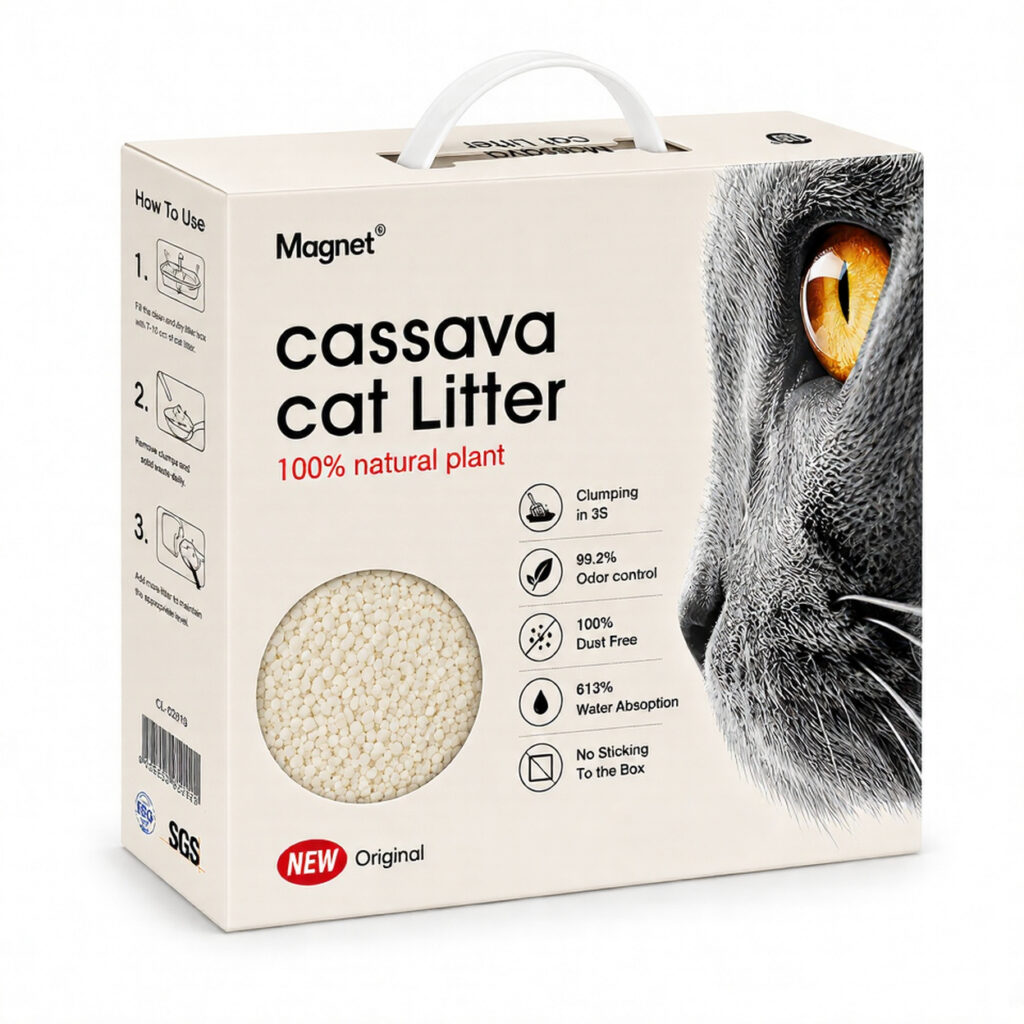
Choose cassava cat litter when you’re converting customers off clumping clay. Cassava’s starch-bound clump is denser and closer to the clay experience those buyers already expect, which lowers the switching barrier and reduces early negative reviews driven by unfamiliarity rather than performance.
Choose a blend when the customer base is genuinely unclear. A tofu-cassava formula lets one SKU cover both profiles, and you can split into separate lines on your second order once sell-through data tells you which way your customers lean.
MOQ and Sample Expectations
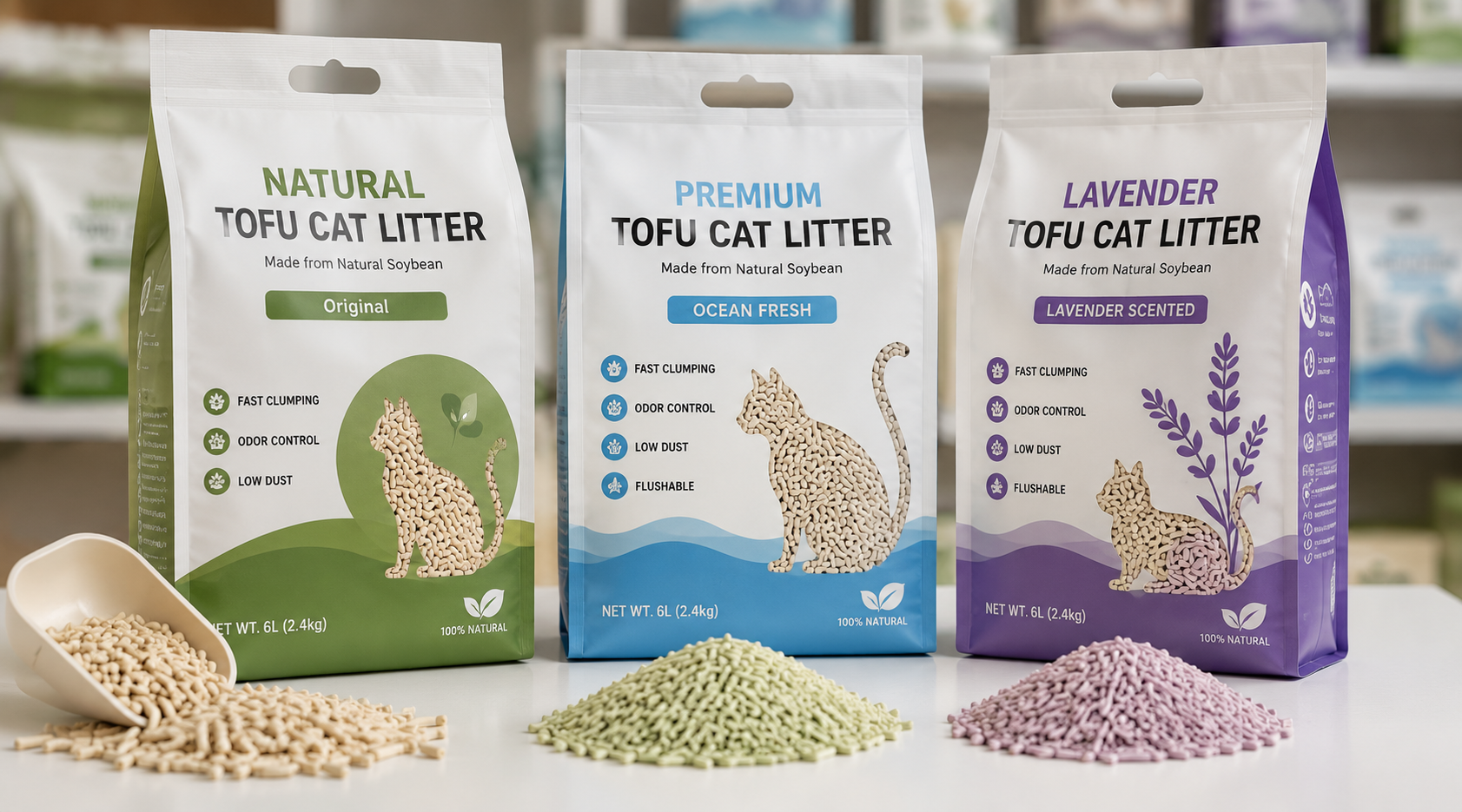
Standard MOQ across tofu producers sits at one 20ft container, driven by production line changeover cost rather than sales policy. Two tofu-specific notes:
- Standard pellet spec lowers your minimum. Accepting the factory’s existing die plate avoids a tooling change and the separate minimum run that comes with it. Save custom diameter for your second order.
- Request the aged sample test. Ask for a sample and retest clumping after several weeks. Tofu’s binder system can degrade with ambient moisture exposure, and this failure mode never appears in a same-day evaluation — only in customer reviews three months after launch.
For the general private label process, timeline, and cost framework, see our guide to working with a private label cat litter manufacturer.
Red Flags Worth Walking Away From
- Cannot state where okara is sourced or how quickly it’s dried
- Offers company certificates in place of batch-level test reports
- Agrees to any packaging claim without asking about your destination market
- Catalogue spans every litter material with no technical depth in any of them
- Quotes a price without asking about bag size, destination, or volume
- Cannot explain what changes between their standard formula and a custom one
Frequently Asked Questions
What should I look for in a private label tofu cat litter manufacturer?
Look for control over okara sourcing and drying, a stated finished moisture specification with a verification method, batch-level mould and aflatoxin test reports, in-house extrusion rather than outsourced forming, and the ability to adjust pellet diameter and binder ratio to your specification. A supplier who can only offer a fixed catalogue product is a reseller, not an OEM partner.
Can pellet size be customized in a private label tofu cat litter order?
Yes. Pellet diameter is determined by the die plate hole size and pellet length by cutter speed, so both are adjustable in production. Diameter changes require a die plate swap, which is a genuine setup cost and typically carries its own minimum run. Length adjustment is a simpler machine setting.
Should my first private label SKU be tofu or cassava?
Tofu suits brands leading on flushability, ultra-light weight, or apartment-market convenience. Cassava suits brands converting customers from clumping clay, since its denser clump matches the expectation those buyers already hold. Where the customer base is unclear, a tofu and cassava blend lets a single SKU cover both profiles before splitting into separate lines.
Article summary: The best private label tofu cat litter manufacturer for your brand is the one that controls okara sourcing and drying, runs its own extrusion, and can adjust pellet diameter and binder ratio to your specification. Compare on process control and batch-level documentation rather than on price per tonne, and model freight per saleable unit to capture tofu’s weight advantage.
Start a Private Label Tofu Line
Send your target pellet specification, bag size, and destination market — we’ll return a formula recommendation, sample, and full test documentation.
Talk to Our Team →