Tofu cat litter is one of the few pet products where the manufacturing process determines product quality more than the raw material does. The base input is a low-cost agricultural byproduct available to any producer. What separates a good bag from a mediocre one is how quickly that byproduct is stabilised, how tightly particle size is controlled, and how consistently moisture is managed through drying and packing.
This walks through the raw materials and the full production sequence, then covers the quality control checkpoints worth verifying before you place an order with any supplier.
What Tofu Cat Litter Is Made From: Raw Materials Explained
Despite the name, tofu litter isn’t made from tofu. The base material is okara — the soybean fiber pulp left over after soy milk and tofu production. It’s a genuine waste-stream material rather than a purpose-grown crop, which is a substantive part of the sustainability case for the category rather than a marketing framing.
A typical formulation contains:
- Okara (soybean fiber) — the structural base, providing the porous fiber matrix that drives absorption and low weight.
- Binder — most commonly guar gum, sometimes a plant starch. This controls clump firmness and integrity.
- Starch component — corn, cassava, or tapioca starch in some formulas, added to increase clump density.
- Functional additives — activated carbon for odor adsorption, fragrance where specified, colorant in charcoal or green tea variants.
- Water — added during mixing to enable extrusion, then driven off again during drying.
Blend ratios vary significantly between producers, and this is where two bags labelled identically can behave very differently. A higher starch fraction produces denser clumps closer to the feel of cassava cat litter; a higher okara fraction produces a lighter product with faster absorption. If you’re evaluating a tofu cat litter line, ask for the ratio rather than accepting the material name alone.
Why Okara Freshness Determines Tofu Litter Quality
This is the single most important production variable, and it’s rarely discussed on supplier pages.
Fresh okara comes off a soy processing line with very high moisture content and a high protein and fiber load — conditions in which microbial growth begins quickly at ambient temperature. Left unprocessed, it spoils within hours rather than days.
The practical consequence is that the interval between okara collection and the start of drying directly determines mould and aflatoxin risk in the finished product. Factories located close to soy processing operations, with cold-chain or rapid-transfer handling, control that interval. Producers sourcing okara over longer distances are managing a materially harder problem, and the result shows up in batch test results rather than in anything visible in a sample bag.
Question worth asking any supplier: How far is your okara source from the production line, and what’s the typical interval between collection and drying? A producer who controls this answers with specifics. A trading company redirects to price and MOQ. It’s one of the fastest ways to distinguish a real cat litter manufacturer from a reseller — see our cat litter manufacturer guide for the wider evaluation framework.
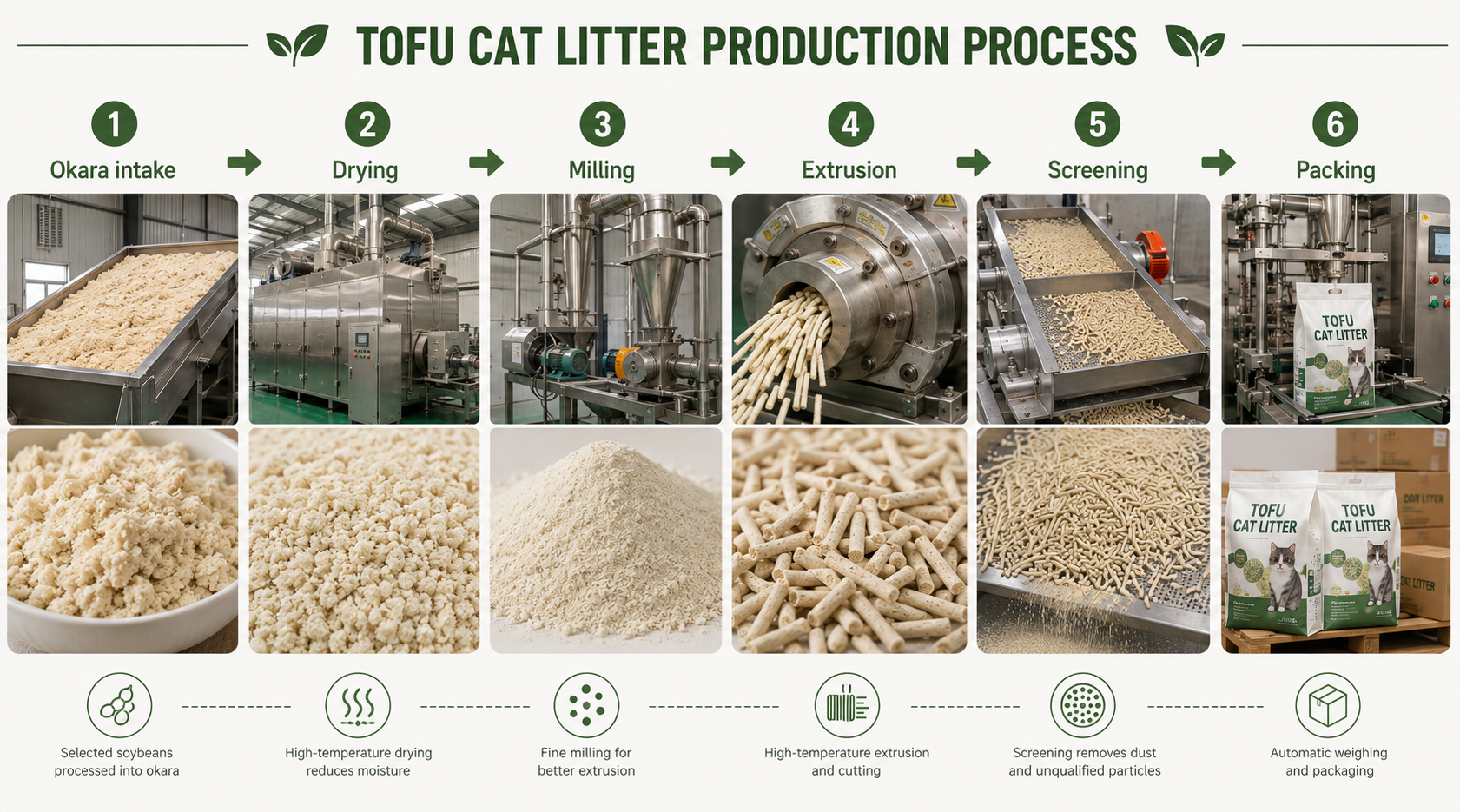
The Tofu Cat Litter Manufacturing Process, Step by Step
- Raw material intake and inspection. Incoming okara is checked for moisture content, odor, and visible spoilage. Rejected material at this stage is far cheaper than a contaminated finished batch.
- Drying. Okara is dried to a stable moisture level, halting microbial activity. Drying temperature and residence time are controlled — over-drying degrades fiber structure and reduces absorption capacity, under-drying leaves spoilage risk.
- Milling. Dried okara is ground to a uniform particle size. Uniformity here determines how evenly binder disperses in the next stage, and inconsistent milling is a common root cause of variable clumping between bags.
- Blending. Milled fiber is dry-mixed with binder, starch, and any functional additives, then water is introduced to bring the mixture to extrusion consistency.
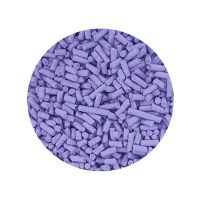
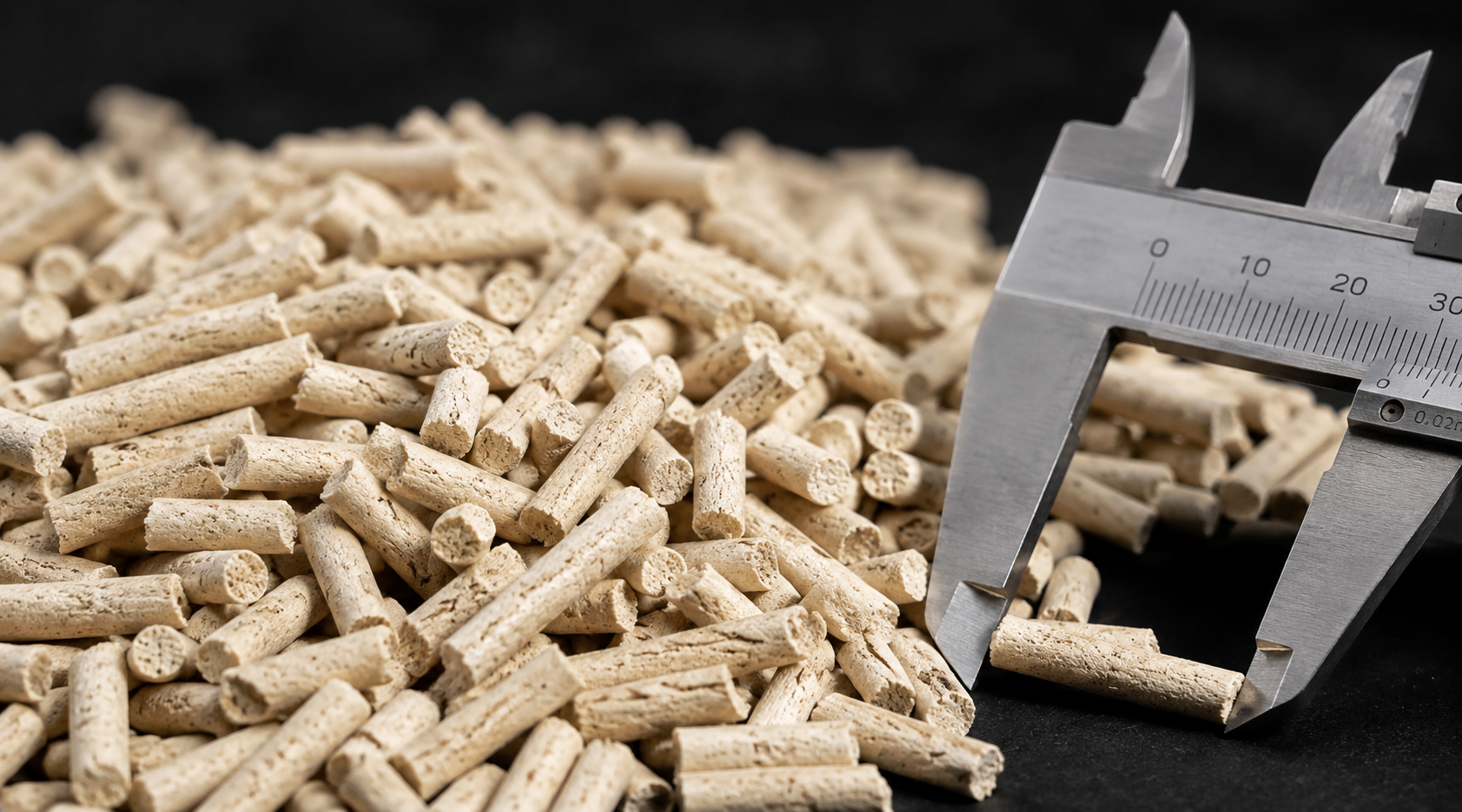
- Extrusion. A screw extruder forces the mixture through a die plate perforated with holes — commonly around 2mm — and a rotating cutter shears the emerging strands into cylindrical pellets. Die hole diameter sets granule diameter; cutter speed sets pellet length.
- Secondary drying. Extruded pellets pass through a rotary or belt dryer to bring moisture down to the finished specification, generally in the region of 10% or below. This step determines both shelf stability and clumping performance.
- Screening. Vibrating screens remove undersized fines and oversized fragments. Fines left in the product are the primary source of dust in a finished bag.
- Dedusting. An air separation stage removes residual surface dust — the difference between a low-dust product and a genuinely dust-free one.
- Metal detection. Finished product passes a metal detector before packing, standard practice in any facility running to a food-adjacent quality system.
- Packing. Product is filled into moisture-barrier bags and sealed. Packaging format matters beyond shelf appeal here — a poor moisture barrier undoes careful drying control during shipping and warehouse storage.
Why Tofu Litter Is Extruded Rather Than Granulated
Worth understanding because it explains two of the product’s defining characteristics.
Mineral litters and fine granule plant litters are typically granulated — built up from powder into particles. Tofu litter is extruded — formed under pressure and cut to shape. Because the pellet is formed rather than agglomerated from fines, there is less loose fine particulate in the finished product from the outset. That’s the structural reason tofu litter tends to perform well on dust, independent of how good the dedusting stage is.
Extrusion also produces the cylindrical pellet shape, which is physically larger than a fine granule and less prone to lodging between paw pads. That’s the mechanism behind tofu litter’s low tracking, and it’s a formation-driven property rather than an additive.
Quality Control Checkpoints in a China Cat Litter Factory
Most global tofu litter capacity sits in China, so evaluating a china cat litter factory is a practical necessity for most buyers. These are the checkpoints that matter:
| Checkpoint | What It Controls | What to Request |
|---|---|---|
| Incoming okara inspection | Spoilage and contamination risk | Intake criteria and rejection records |
| Finished moisture content | Shelf life and clumping consistency | Specification value and test method |
| Mould and aflatoxin testing | Product safety | Batch-level reports, not company certificates |
| Salmonella testing | Microbiological safety | Batch-level reports |
| Bulk density | Shipping weight and fill consistency | Specification range in g/L |
| Clumping time and firmness | Core performance | Test method, not just a claimed figure |
| Dust level | Consumer complaint driver | Measurement method and value |
| Screen mesh maintenance | Granule size consistency | Maintenance schedule |
The distinction between batch-level test data and general company certificates is the one that separates rigorous suppliers from the rest. A certificate showing a company holds ISO 9001 says something about its management system; it says nothing about the aflatoxin content of the container you’re about to receive.
What to Look for on a Tofu Cat Litter Factory Website
A great deal of sourcing now starts with a search, and most buyers form an initial shortlist from supplier sites before any contact is made. When you land on a tofu cat litter factory website, a few signals separate producers from intermediaries:
- Process detail, not just product photos. A producer can describe its drying, extrusion, and screening stages. A reseller shows finished bags.
- Named facility location and capacity figures stated in tonnes per month, rather than vague scale claims.
- Product-level specifications — bulk density, granule size, moisture, absorption rate — rather than adjectives.
- Test documentation offered proactively rather than only on request.
- Consistency across the catalogue. A genuine producer’s range reflects what its lines can actually make. A catalogue spanning every material category with no depth in any usually signals sourcing from multiple third parties.
For a broader view of the supplier landscape, our overview of cat litter manufacturers in china covers how the market is structured, and Chinese cat litter sourcing looks at why most global capacity concentrates there.
Tofu vs Cassava Manufacturing: How the Processes Differ
Both are plant-based, both are produced in similar facilities, and the processes diverge in ways that explain the finished products’ differences.
| Stage | Tofu Litter | Cassava Litter |
|---|---|---|
| Raw material | Okara — perishable, requires rapid drying | Cassava starch — stable, longer handling window |
| Forming method | Extrusion into pellets | Granulation or extrusion by format |
| Binding | Requires added binder | Starch contributes its own binding |
| Main process risk | Spoilage before drying | Moisture uptake in storage |
| Resulting clump | Lighter, fiber-bound | Denser, adhesive |
The binder difference is the most commercially relevant. Because cassava starch binds on contact with liquid, a cassava cat litter manufacturer can often reach a given clump firmness at a lower added-binder ratio than a tofu formula requires. When comparing quotes across the two materials, binder ratio is one of the places a price difference hides.
What This Means When Choosing a Supplier
Tofu litter production is not technically difficult in the sense of requiring rare equipment. It is difficult in the sense of requiring consistent control over a perishable input, a narrow moisture window, and uniform particle sizing across every batch. Those are process discipline problems, and process discipline is what you’re actually buying when you select one cat litter supplier over another.
Three questions surface that discipline quickly: what’s the interval between okara collection and drying, what’s the finished moisture specification and how is it verified, and can you see batch-level aflatoxin and salmonella reports for a recent production run. Suppliers who answer all three directly are a materially different proposition from those who don’t.
Frequently Asked Questions
What raw materials are used to make tofu cat litter?
The base material is okara, the soybean fiber pulp left over from soy milk and tofu production. It is combined with a binder such as guar gum or a plant starch to control clumping strength, and may include activated carbon or other functional additives. Some formulas blend in pea fiber or cassava starch to adjust clump density and cost.
How is tofu cat litter manufactured?
Fresh okara is dried and milled to a uniform particle size, blended with binder and additives, then extruded through a die plate and cut into cylindrical pellets. The pellets are dried to a controlled moisture level, screened to remove fines and oversized particles, dedusted, passed through metal detection, and packed into moisture-barrier bags.
Why does okara freshness matter in tofu cat litter production?
Fresh okara has very high moisture content and spoils quickly at ambient temperature, which creates mould and aflatoxin risk if it is not dried promptly after collection. This is why proximity between the soy processing source and the litter factory affects finished product quality, and why batch-level mould and aflatoxin testing matters more for tofu litter than for mined mineral litters.
Article summary: Tofu cat litter is made from okara soybean fiber, bound with guar gum or plant starch and extruded into pellets. Because okara is perishable, the interval between collection and drying is the defining quality variable, and extrusion rather than granulation is what gives the product its low dust and low tracking. Evaluate suppliers on process control and batch-level test data, not on material claims.
Request Tofu Cat Litter Samples & Specifications
Full product specifications, formulation details, and batch-level test documentation available with every sample request.
Talk to Our Team →