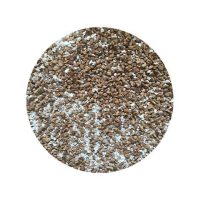
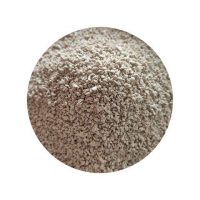
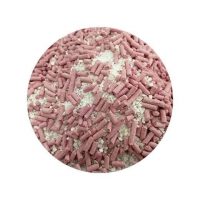
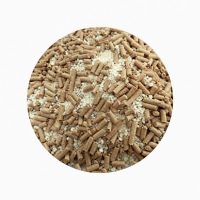

Cassava and tofu are the two fastest-moving plant-based cat litter formulas in North American and European retail, and most sourcing conversations end up narrowing to these two. They’re often presented as interchangeable eco-friendly options, but they’re made from different raw materials, clump through different mechanisms, and appeal to different customers — which means picking one for a first SKU is a positioning decision, not a coin flip.
This compares them across the variables that actually decide a launch: clumping behavior, weight, flushability, dust, cost, and which customer each one converts. It’s part of our OEM & private label cat litter guide.
Cassava vs Tofu Cat Litter: Quick Comparison
| Factor | Cassava Cat Litter | Tofu Cat Litter |
|---|---|---|
| Raw material | Cassava root starch | Soybean fiber (okara byproduct) |
| Granule shape | Fine granules | Cylindrical pellets |
| Clump style | Dense, fast-setting | Light, cohesive |
| Weight | Light | Lightest |
| Flushability | Commonly marketed as flushable | Strong, established flushable claim |
| Dust level | Low | Low |
| Relative cost | Mid-to-high | High |
| Best-fit customer | Switching from clumping clay | Prioritizing weight & flushability |
Cassava Cat Litter Clumping vs Tofu Cat Litter Clumping
The two materials clump through genuinely different mechanisms, which is why the scoop feel differs so noticeably.
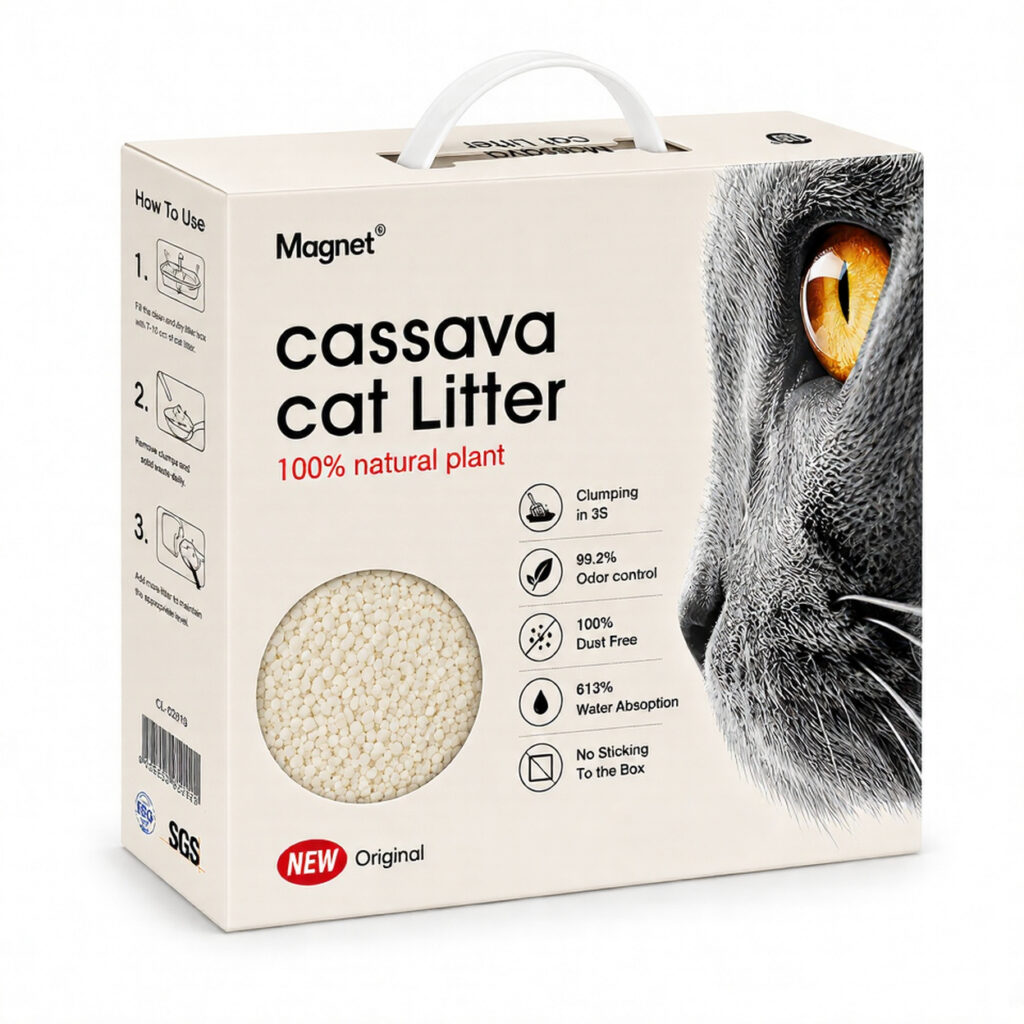
Cassava cat litter clumps because starch binds on contact with liquid — the same basic behavior that makes starch thicken when wet — and because its granules are naturally fine, that binding happens across a tightly packed surface. The result is a dense clump that sets fast and feels solid when lifted.
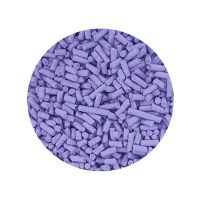
Tofu cat litter clumps by binding soy fiber together, typically assisted by a natural binding agent such as guar gum. The clump holds reliably, but it’s bound fiber rather than compacted dense granules, so it lifts lighter and feels slightly softer.
What this means commercially: Customers coming off clumping clay have a strong learned expectation of what a “good” clump feels like — dense and heavy. Cassava matches that expectation closely, which lowers the switching barrier. Tofu’s lighter clump is objectively fine but reads as unfamiliar to that specific customer, which can generate early negative reviews if your marketing didn’t set the expectation.
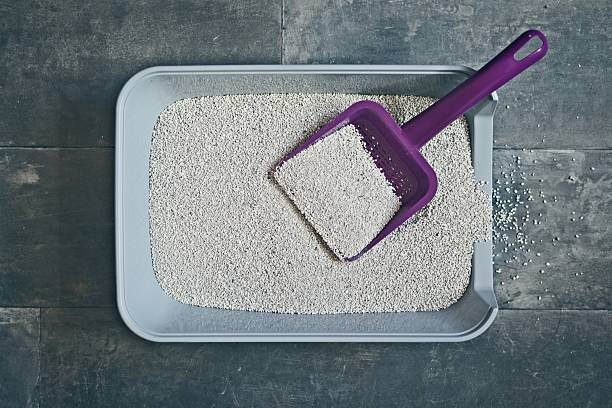
Weight & Flushability: Where Tofu Cat Litter Pulls Ahead
Tofu is the lighter of the two, and the gap comes from structure — soy fiber is porous with substantial internal air space, while cassava starch granules are comparatively dense. That porosity does two things: it lowers shipping weight per unit of volume, and it makes tofu disperse more readily in water, which is the mechanical basis of the flushable claim.
Cassava is also frequently marketed as flushable, and it does break down far faster than clay, but tofu’s dispersal is more complete and its flushable positioning is more established with customers. If your brand story leads on flushability, tofu is the safer material to build that claim on.
Worth noting for both: flushability isn’t a single regulated standard, and some municipalities discourage flushing cat waste for reasons unrelated to the litter material. Whichever you choose, stating a recommended flush quantity on the packaging protects the claim’s credibility.
Cost & Retail Price Positioning for Private Label
Both materials sit in the premium plant-based tier — above corn and wheat straw, well above bentonite. Tofu carries a somewhat higher production cost because soy fiber must be dried and extruded into pellets, whereas cassava starch is processed and granulated in fewer steps.
In practice this cost gap is rarely the deciding factor, because both support a comparable premium shelf price. What moves your actual margin more is bag size, packaging format, and freight — which is why the number to compare is landed cost per unit rather than raw material cost per kilogram.
Dust & Odor Control Compared
Both perform well on dust, but for different structural reasons. Tofu’s extruded pellets contain less loose fine particulate to begin with, since the material is formed rather than granulated from powder. Cassava’s fine granules are denser and less prone to becoming airborne. In both cases, actual dust performance in a finished product depends more on the factory’s moisture control and quality management than on the material itself — which is why dust is a question to ask about a specific supplier, not a specific material.
On odor, cassava’s denser clump traps waste slightly faster on contact, while tofu relies a bit more on prompt scooping since its clumps sit more loosely in the box. Neither difference is large enough to decide a formula on its own.
Which Cat Litter Formula Should You Launch First?
- Choose cassava if: your target customer is switching from clumping clay and expects a dense, familiar clump; or you want to ride the current momentum in the fastest-growing plant-based subcategory.
- Choose tofu if: your positioning leads on flushability or ultra-light weight; or you’re selling into markets where apartment living makes bag weight a real purchase driver.
- Choose a mixed formula if: you’re genuinely unsure. A tofu and cassava mixed formula combines cassava’s denser clump with tofu’s lighter weight, letting you test both profiles in one SKU before splitting into separate lines on your second order.
Practical tip: Request both samples and test them side by side against your own criteria before deciding — clump firmness, dust when pouring, and clump weight when scooped. Reading a spec sheet won’t tell you which one your specific customer base will prefer; a two-week in-home test with a handful of target customers will.
Frequently Asked Questions
Does cassava cat litter clump better than tofu cat litter?
Both clump reliably, but they behave differently. Cassava forms dense, fast-setting clumps because of its fine starch-based granules, while tofu forms lighter clumps from bound soy fiber. Neither is objectively stronger — the difference shows up in scoop feel and clump weight rather than in whether the clump holds together.
Which is cheaper to produce, cassava or tofu cat litter?
Cassava typically carries a slightly lower raw material and processing cost than tofu, since tofu requires drying and extrusion of soy fiber into pellets. Both sit in the premium plant-based tier well above bentonite, and the gap between them is usually smaller than the difference in how each is positioned at retail.
Can I launch both cassava and tofu cat litter in one order?
Splitting a first container across two formulas is possible with some manufacturers, though it usually means smaller quantities per SKU and slightly higher per-unit cost. A mixed tofu and cassava formula is another way to test both material profiles within a single SKU before committing to separate lines.
Article summary: Cassava clumps dense and familiar, making it the easier switch for customers coming off clay. Tofu is lighter with a stronger flushable claim, making it the better fit for weight- and convenience-led positioning. Both are premium-tier; the decision is about which customer you’re converting, not which material is objectively better.
Request Cassava & Tofu Samples Side by Side
Test both formulas against your own clumping, dust, and odor criteria before choosing your first private label SKU.
Request Samples →