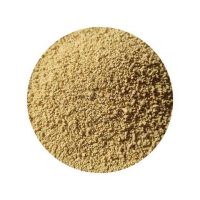
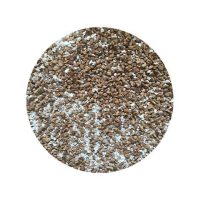
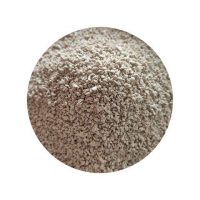
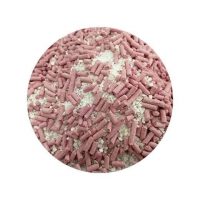
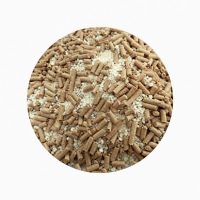
Pellet Cassava Cat Litter vs Fine Granule Cassava Cat Litter
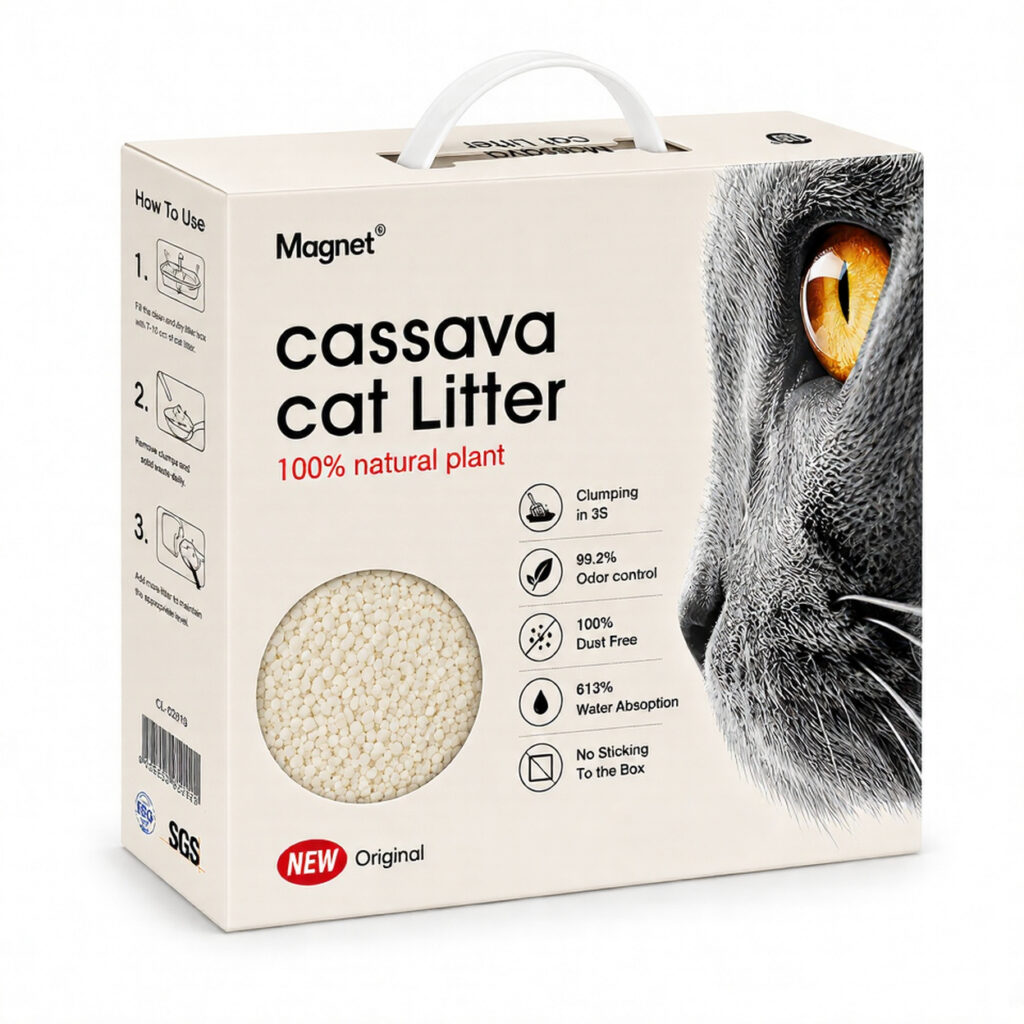
Cassava litter is produced in two main formats, and the difference isn’t cosmetic — it changes tracking behaviour, clump density, and which customer the product suits.
| Factor | Pellet Cassava | Fine Granule Cassava |
|---|---|---|
| Production method | Extruded into cylindrical pellets | Granulated into fine particles |
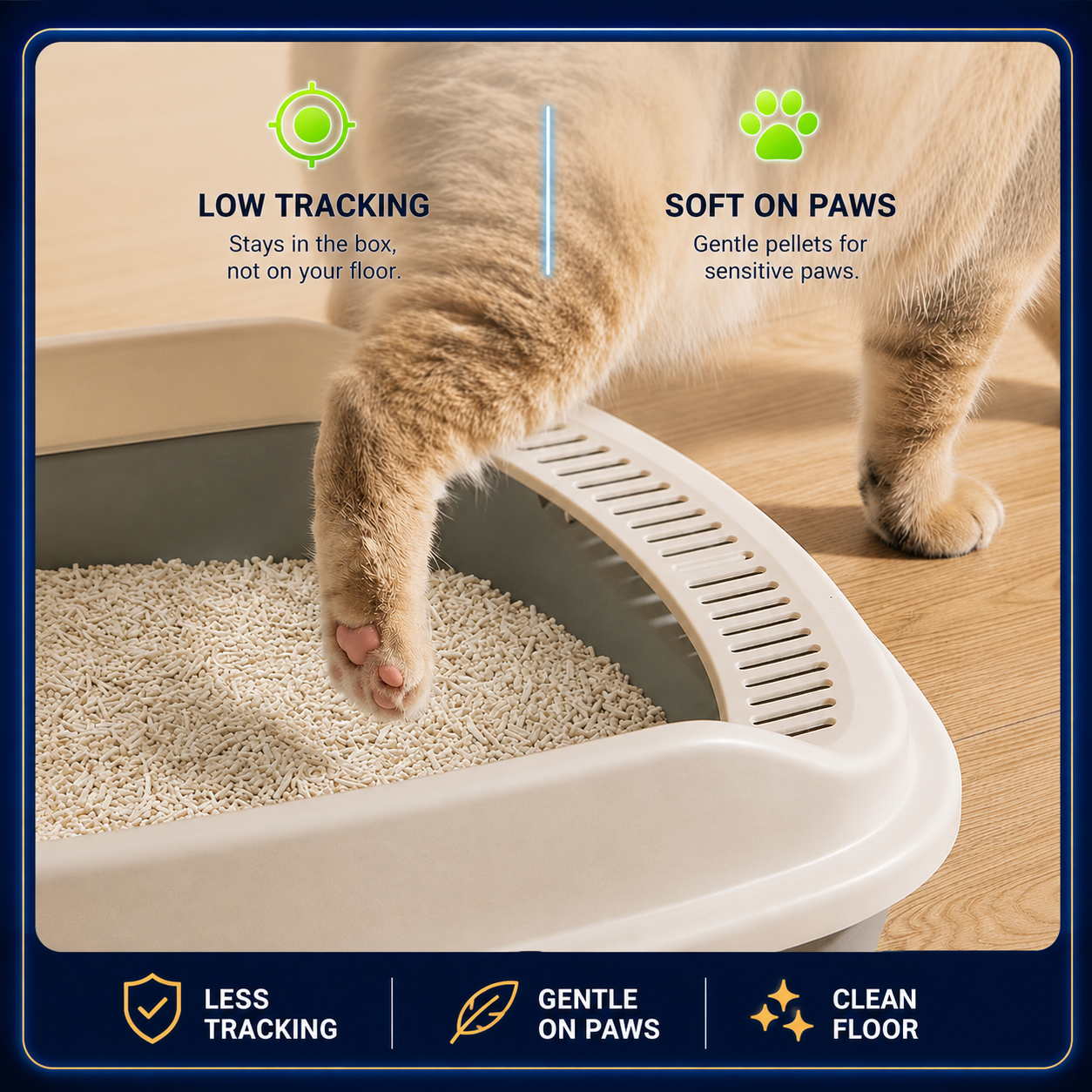
| Tracking | Lower — larger particles resist sticking to paws | Higher — fine particles carry more easily |
| Clump density | Cohesive, lighter feel | Denser, firmer, closer to clay |
| Dust at pour | Very low — formed rather than milled | Low, dependent on screening quality |
| Texture underfoot | Coarser | Softer, sand-like |
| Best-fit customer | Multi-cat homes, tracking-sensitive buyers | Buyers switching from clumping clay |
When to specify pellet cassava
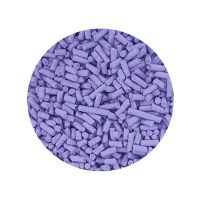
Pellet cassava cat litter suits product lines where litter scatter is the primary complaint being solved. The extruded pellet format is physically larger and less prone to lodging between paw pads, which is the mechanism behind most tracking. It also carries an inherent dust advantage — because pellets are formed under pressure rather than milled down from a powder, there’s less loose fine particulate in the bag to begin with.
When to specify fine granule cassava
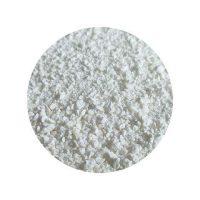
Fine granule cassava cat litter suits lines targeting customers switching off bentonite. The fine particle structure packs tightly, so when cassava starch binds on contact with liquid, it forms a dense clump that lifts solid — close enough to the clay experience that the transition doesn’t feel like a downgrade to a customer with two decades of clay habit.
Texture matters here too. Cats accustomed to a sand-like surface may reject a coarse pellet, which is a real cause of returns and negative reviews that has nothing to do with clumping performance.
.png)
Why Cassava Clumps the Way It Does
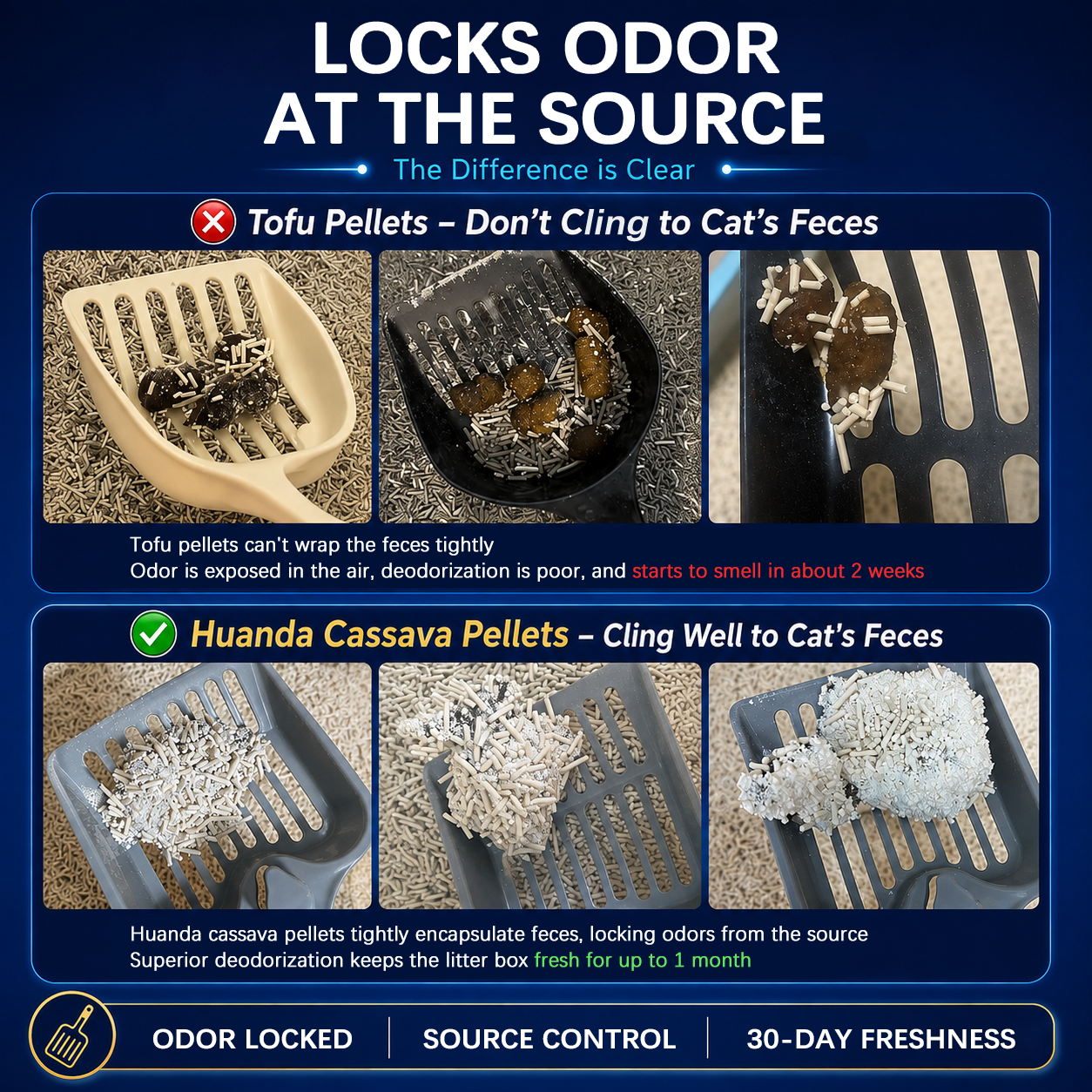
The clumping behaviour comes from the starch itself. Cassava root starch binds when it contacts liquid — the same basic mechanism that thickens a starch-based sauce — and that binding happens across whatever surface area the format provides.
This has a practical consequence when comparing quotes: because cassava contributes its own binding, a well-formulated cassava litter can reach strong clump firmness at a lower total clumping-agent ratio than materials that rely entirely on added agents. If two suppliers quote noticeably different prices on the same format, the additive ratio is one of the places the difference hides. Our breakdown of custom cat litter formula variables covers how clumping agent ratio, granule size, and scent interact.
Odor Control in Cassava Formulas
Cassava’s odor performance works on two levels. The dense clump physically encapsulates waste on contact, limiting how much surface area is exposed to the room — which is why fast, complete clumping matters for odor as much as for scooping convenience. Beyond that, most commercial cassava formulas incorporate activated carbon or a comparable adsorbent to capture ammonia compounds released as urine breaks down.
When evaluating samples, assess odor over several days rather than on first contact. Fresh litter smells fine in every sample; the meaningful test is day three in a closed room. Our article on how cat litter odor elimination works covers the underlying mechanisms.
What to Verify Before Ordering From a Cassava Cat Litter Manufacturer
- Raw material source and processing method — not just the finished formula name.
- Moisture content specification and how it’s controlled through drying and storage.
- Mould and aflatoxin test results tied to a production batch. This matters specifically for organic starch materials and is the test most first-time buyers don’t know to request.
- Product-specific certificates — SGS, ISO, MSDS — issued for the product, not general company-level documents.
- Monthly production capacity measured against your projected volume including peak season.
- Batch traceability — can they identify which production run a given bag came from?
For the broader supplier evaluation process beyond cassava specifically, see our cat litter manufacturer guide.
Cassava Against Other Plant-Based Materials
Cassava isn’t automatically the right material for every line. Tofu is lighter and carries a more established flushable claim. Corn and wheat straw sit at a more accessible price point. Walnut shell tracks less than fine granule cassava, though pellet cassava closes most of that gap.
Where cassava wins is the combination of dense clumping with plant-based positioning — it’s the material that most closely replicates clay performance without being clay. For a full material comparison see our overview of cat litter types, or our breakdown of mixed formula cat litter if you’re considering a cassava blend rather than a single-material line.
Private Label and OEM Cassava Production
Both pellet and fine granule cassava can be produced under your own brand, with customization available across granule size, scent, clumping strength, and packaging format. If you’re planning a private label launch, three things are worth reading before you send a brief: the cat litter OEM process for the production timeline, private label cat litter cost for landed cost modelling, and how small a first cat litter order can be if a full container isn’t realistic on order one.
Request Pellet & Fine Granule Cassava Samples
Factory-direct cassava cat litter in both formats, with full OEM and private label support and batch-level test documentation.
Request Samples →