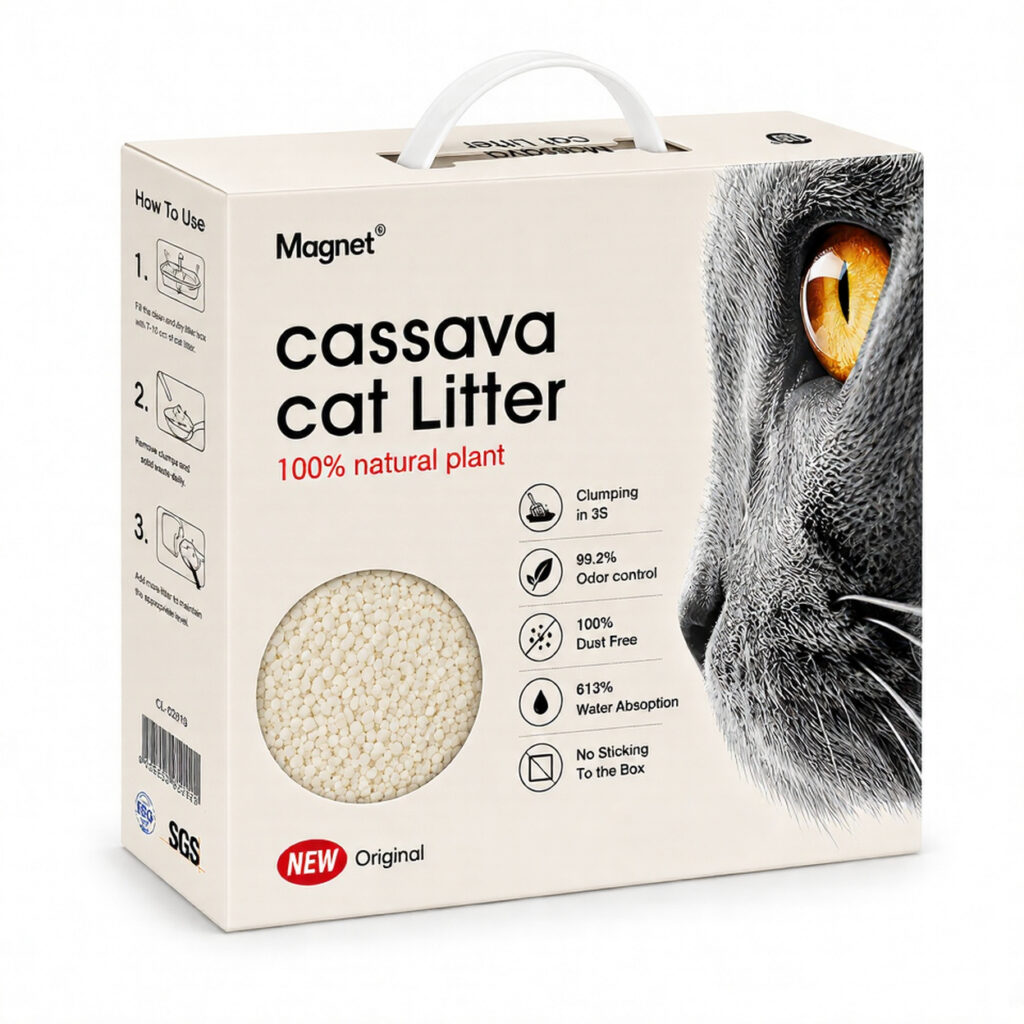
Plant-based cat litter sells on an environmental story, and the words carrying that story go on the bag. The problem is that “biodegradable,” “compostable,” and “eco-friendly” are not marketing adjectives in most major markets — they’re regulated claims with specific substantiation requirements, and the enforcement environment has tightened considerably.
This covers what the rules actually require in the EU and US, why cat litter is a harder case than most product categories, and what to ask your manufacturer for before artwork goes to print.
Important: This is a general overview of the regulatory landscape, not legal advice. Requirements differ by member state and by market, and enforcement practice evolves. Have final packaging copy reviewed by a qualified regulatory or trade lawyer for each market you sell into before committing to a print run.
What Changed in EU Green Claims Rules for 2026
There’s persistent confusion here worth clearing up, because a lot of published guidance is out of date.
The Green Claims Directive — proposed in March 2023 — was never adopted. The European Commission announced its intention to withdraw the proposal in June 2025, before final negotiations concluded. If you’ve been told you need to prepare for it, that guidance is stale.
What does apply is a separate and already-adopted law: the Empowering Consumers for the Green Transition Directive (EU) 2024/825, commonly shortened to EmpCo or ECGT. It amends the Unfair Commercial Practices Directive, member states were required to transpose it by 27 March 2026, and it applies from 27 September 2026.
Three provisions matter directly for cat litter packaging:
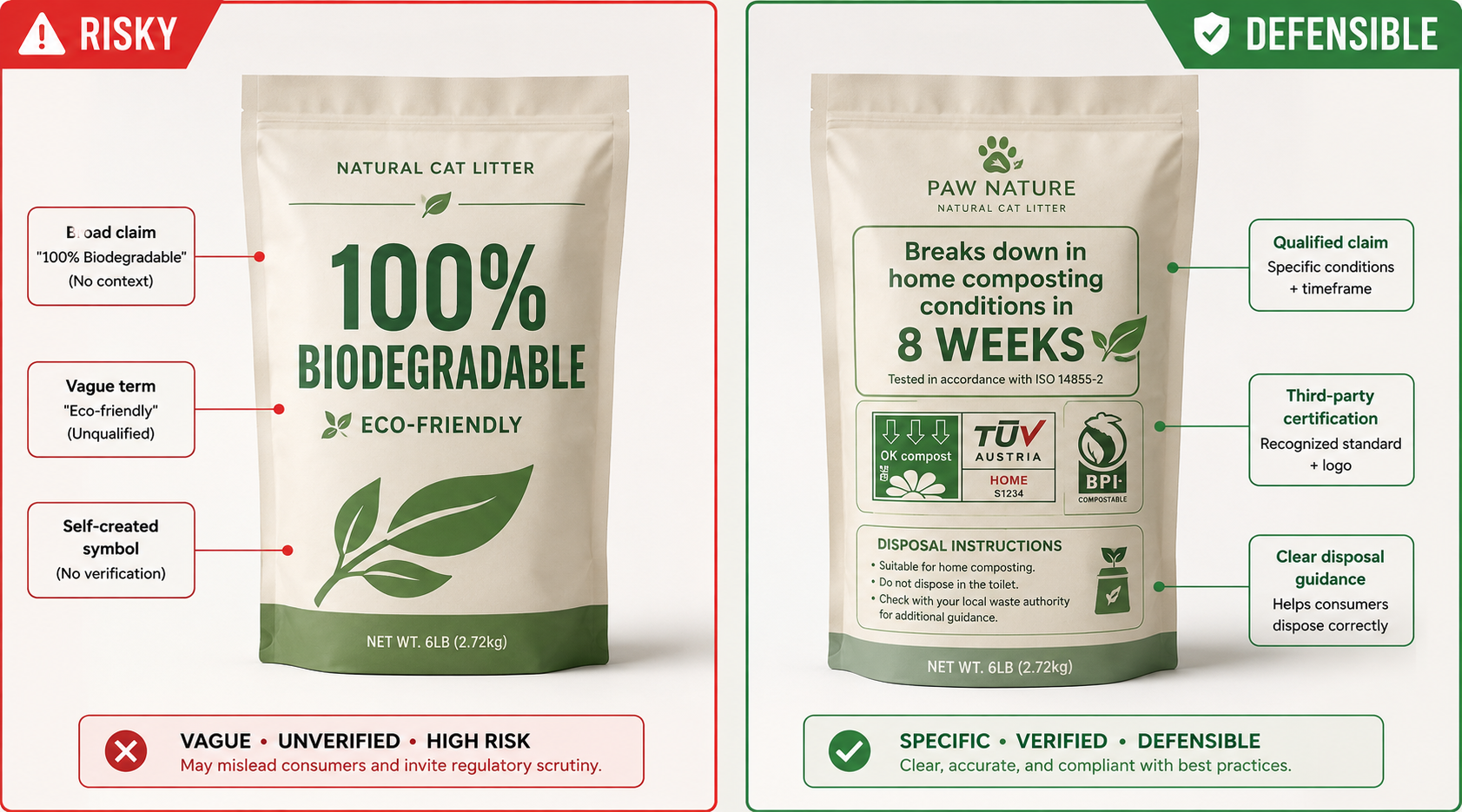
- Generic environmental claims are banned unless recognised excellent environmental performance can be demonstrated. Terms like “eco-friendly,” “green,” “environmentally friendly,” and “natural” used as standalone descriptors fall squarely into this category.
- Sustainability labels are restricted to those based on a certification scheme or established by public authorities. A self-designed green leaf badge on your own bag is not a compliant sustainability label.
- Offset-based carbon neutrality claims are banned at product level — “climate neutral” or “CO₂ neutral” based on purchased offsets rather than actual reductions.
Enforcement runs through national consumer protection authorities under the UCPD framework, which has been an active enforcement area in several member states well before this directive.
FTC Green Guides and the One-Year Decomposition Rule
US requirements come from the FTC Green Guides (16 CFR Part 260), last revised in 2012 with a further revision pending since 2022. The rule that catches cat litter brands sits in §260.8:
An unqualified degradable or biodegradable claim is deceptive if the item does not completely decompose within one year after customary disposal.
The Guides go further and state explicitly that unqualified degradable claims for items customarily disposed of in landfills, incinerators, and recycling facilities are deceptive, because those environments don’t provide conditions for complete decomposition within a year.
The FTC has enforced this. In 2014 it warned fifteen marketers of oxodegradable plastic waste bags over exactly this issue, and enforcement against unsubstantiated degradability claims has continued since.
Why Cat Litter Is a Harder Case Than Most Categories
Here’s the part most brands miss when they brief packaging artwork.
The FTC standard turns on customary disposal — not on what the material is capable of doing under ideal conditions. For cat litter, customary disposal is scooping used clumps into a bag and putting them in household waste, which goes to landfill.
Landfill is anaerobic and compacted. Plant starch that breaks down in weeks in an active compost environment does not achieve complete decomposition in landfill within a year. So a cassava, tofu, or corn litter can be genuinely and demonstrably biodegradable as a material, and an unqualified “biodegradable” claim on the bag can still be non-compliant — because the claim is assessed against how the product is actually thrown away.
This is not a reason to abandon the claim. It’s a reason to qualify it properly.
The practical fix: Name the disposal environment and the timeframe. “Breaks down in home composting conditions within X weeks” is a substantiated, qualified claim. “100% biodegradable” printed alone across the front panel is the version that draws attention. The qualified wording is also more persuasive to an informed customer, because it sounds like a fact rather than a slogan.
Biodegradable vs Compostable vs Flushable: Three Claims, Three Standards
These get used interchangeably in pet product marketing. They aren’t interchangeable, and each carries a different substantiation burden.
| Claim | What It Asserts | Substantiation Basis | Main Risk |
|---|---|---|---|
| Biodegradable | Breaks down through microbial activity | Test data for the actual disposal environment | Landfill disposal defeats an unqualified claim |
| Compostable | Breaks down in a composting environment leaving no toxic residue | EN 13432 / ASTM D6400 (industrial), OK compost HOME (domestic) | Facility availability, and cat waste itself is not compostable |
| Flushable | Disperses safely in wastewater systems | No single global standard | Municipal guidance often discourages flushing cat waste entirely |
The compostable complication specific to cat litter
Even where the litter material passes a compostability standard, the used product contains cat faeces. Many public health authorities advise against home composting cat waste because of Toxoplasma gondii risk. So a compostable claim on a cat litter bag needs to distinguish clearly between the litter material’s properties and what a customer should actually do with a soiled clump — otherwise you’re implicitly instructing customers toward a practice health authorities warn against.
The flushable complication
Flushability is not a single regulated standard, and several municipalities discourage flushing cat waste for reasons unrelated to the litter material — parasites entering water systems. If you carry a flushable claim, state a recommended quantity and add a line directing customers to local guidance. Our overview of whether cat litter is biodegradable covers the material side of these distinctions.
Certification Standards That Substantiate a Claim
Substantiation means test data against a recognised standard, performed on your finished formulation — not on the raw material. Binders, additives, and fragrance systems all affect results, so a certificate covering cassava starch as an ingredient doesn’t substantiate a claim about your finished litter.
- EN 13432 — European standard for industrial compostability of packaging and materials.
- ASTM D6400 — US equivalent for industrial composting conditions.
- OK compost HOME (TÜV Austria) — home composting certification. This runs at lower ambient temperatures and is the harder standard to pass, which is precisely why it’s more valuable on a consumer product.
- ISO 17088 — international specification for compostable plastics, relevant where your packaging film carries its own claim.
Note that the bag and the litter are separate items making separate claims. A compostable litter in a conventional PE bag cannot carry a whole-product compostability claim — see cat litter packaging and brand printing for how packaging format interacts with positioning.
What to Request From Your Cat Litter Manufacturer
Substantiation is your legal exposure as the brand owner, but the data lives at the factory. Request the following before artwork is finalised:
- Biodegradation or compostability test reports on the finished formulation, naming the standard applied and the test conditions.
- Full ingredient disclosure including binders and additives — anything undisclosed is something you can’t substantiate.
- Batch traceability linking test results to production runs, so a certificate corresponds to what actually ships.
- Packaging material specification separately from the litter, with its own test data if the bag carries a claim.
- Written confirmation that the formulation supplied matches the tested formulation. Formula drift between sample approval and production is a real and under-discussed compliance exposure.
A manufacturer that can supply this without friction has done it before. One that offers generic company-level certificates in place of product test data is telling you something useful. Our cat litter manufacturer guide covers the wider supplier evaluation process.
Packaging Claim Checklist Before You Print
- Remove standalone generic terms — “eco-friendly,” “green,” “environmentally friendly” used without qualification.
- Qualify every degradability claim with a disposal environment and a timeframe.
- Remove self-designed sustainability badges; use only third-party certification marks you actually hold.
- Separate claims about the litter from claims about the bag.
- Add clear disposal guidance, particularly for any flushable or compostable claim.
- Confirm test data covers the finished formulation shipping to you.
- Have the final artwork reviewed for each destination market before print.
Why this is a commercial advantage, not just a cost: Retail buyers in Europe are increasingly asking for substantiation documentation during vendor onboarding. A brand that arrives with test reports and correctly qualified claim wording clears that step quickly. A brand that arrives with “100% eco-friendly” across the front panel and nothing behind it does not — and increasingly, doesn’t get listed. The reasons behind that shift are covered in our look at consumer demand for eco-friendly cat litter.
Frequently Asked Questions
Can I print biodegradable on cat litter packaging?
Only as a qualified claim in most markets. Under the US FTC Green Guides, an unqualified biodegradable claim is deceptive unless the entire item completely decomposes within one year after customary disposal — and cat litter is customarily disposed of in landfill, where that does not happen. A qualified claim naming the disposal environment and timeframe, supported by test data, is the defensible approach.
Is the EU Green Claims Directive still coming into force?
No. The European Commission announced its intention to withdraw the Green Claims Directive proposal in June 2025 and it was never adopted. The rules that do apply come from the Empowering Consumers for the Green Transition Directive (EU) 2024/825, a separate and already-adopted law that applies from 27 September 2026 and bans generic environmental claims that cannot be substantiated.
What test standards substantiate a compostable cat litter claim?
EN 13432 and ASTM D6400 cover industrial composting conditions, while TÜV Austria’s OK compost HOME scheme covers home composting, which runs at lower temperatures and is the harder standard to meet. Testing must be performed on the finished product formulation, not on the raw material, since additives and binders affect the result.
Article summary: The EU Green Claims Directive was withdrawn; the EmpCo Directive (EU) 2024/825 applies from 27 September 2026 and bans generic environmental claims. The FTC Green Guides assess biodegradability against customary disposal, which for cat litter means landfill — making unqualified claims risky even for genuinely biodegradable materials. Qualify the claim, name the standard, and get finished-formulation test data from your manufacturer before printing.
Request Test Documentation With Your Samples
Plant-based cat litter produced with full formulation disclosure and product-level test documentation for your compliance review.
Talk to Our Team →