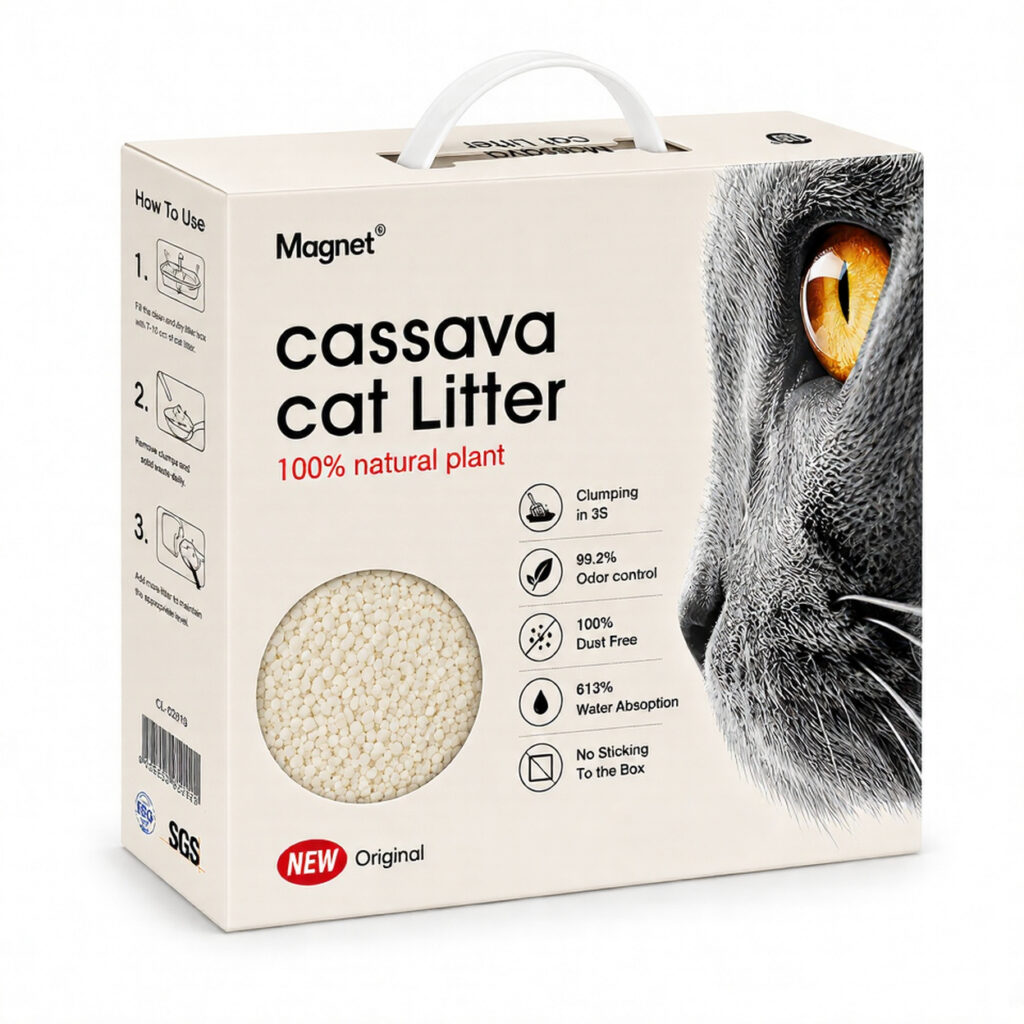
Buying tofu cat litter in bulk is not simply a matter of finding the lowest price per bag. A distributor is buying a product, a freight profile, a shelf position, and a repeat-order promise at the same time. If any one of those pieces is wrong, the first container can become slow-moving stock.
The better way to source tofu litter is to work backward from the customer. Decide how the product should feel, perform, look on the shelf, and fit the local price range. Then compare formulas and suppliers against that brief. This guide covers the decisions that matter before a wholesale or private label order.
Why tofu cat litter works as a wholesale product
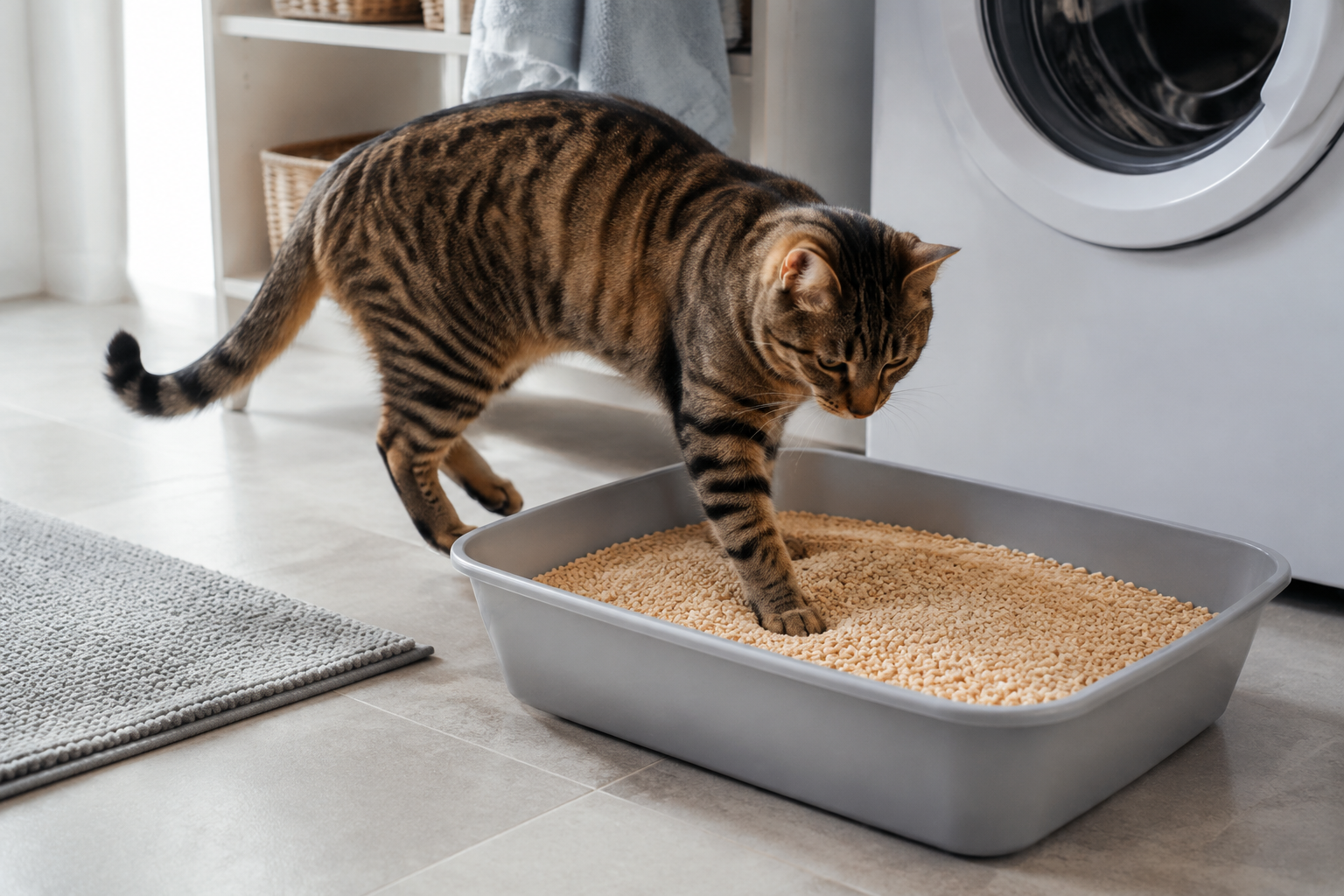
Tofu cat litter has a clear retail story. It is plant-based, lightweight, low in dust, easy to scoop, and available in formats that look noticeably different from traditional clay litter. Those features are easy for store staff to explain and easy for shoppers to understand.
Its low weight is especially important in wholesale. Cat litter is sold by volume but transported by weight. Tofu litter weighs far less per litre than bentonite clay, so a retail bag is easier to carry and an ecommerce parcel is easier to handle. For importers, the useful comparison is not only cost per ton. It is landed cost per sellable bag and per litre of shelf volume.
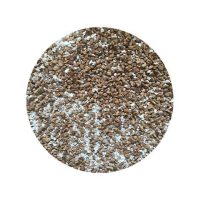
Tofu litter also gives a brand room to build a range. One base formula can be offered in several pellet sizes, an unscented version, an activated charcoal version, selected fragrances, or a crushed format. A distributor can serve more than one customer preference without launching completely unrelated materials.
Define the market before requesting a quotation
A supplier can quote tofu cat litter bulk in many ways, but a useful quotation needs a useful brief. Start with the market rather than the factory specification.
For pet specialty stores, buyers often care about a natural product story, low dust, clean packaging, and clear product differentiation. Supermarkets may need a familiar bag size and a price that makes repeat purchase easy. Ecommerce sellers should pay closer attention to carton strength, bag puncture resistance, leakage, and shipping weight. Multi-cat households may value clump strength and odor control more than fragrance variety.
Before contacting a supplier, write down:
- Target country and sales channel
- Intended retail price
- Expected bag size by litres or kilograms
- Preferred pellet or crushed format
- Unscented, activated charcoal, or scented positioning
- Clumping and dust expectations
- Standard wholesale packaging or private label packaging
- Trial order and repeat-order forecast
This information helps a tofu cat litter manufacturer recommend an existing formula instead of guessing what your market needs.
Compare cylindrical pellets and crushed tofu litter
Most tofu cat litter bulk programs begin with one of two product formats: cylindrical pellets or crushed granules. They are made from similar plant-based ingredients, but they do not create the same user experience.
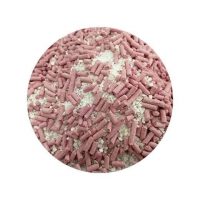
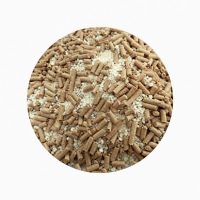
Cylindrical tofu litter is commonly available in 1.5 mm, 2 mm, and 3 mm sizes. The regular shape gives the product a clean appearance and makes it easy to create several SKUs from one base. Larger pellets tend to travel less beyond the litter box. Smaller pellets create more contact area and can form a compact clump, but they may track more easily.
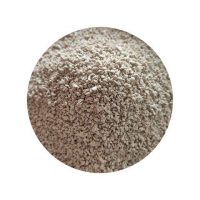
Crushed tofu litter has an irregular, sand-like texture. The finer particles give it more surface area, which can improve liquid contact and clump formation. Cats moving from clay litter may also accept the texture more readily because it feels familiar under the paws.
Neither format is automatically better. A brand focused on low tracking may prefer a larger cylindrical pellet. A brand trying to win over clay users may prefer crushed tofu. Ask for both formats and test them in the same tray before making the decision.
Choose a formula that can support a clear shelf position
The formula should give customers a reason to choose the product. Adding every possible feature to one bag usually makes the message weaker, not stronger.
An original unscented tofu litter is a straightforward choice for households that avoid added fragrance. An activated charcoal version can support an odor-control position without relying on a noticeable perfume. Scented versions can work in markets where shoppers associate fragrance with freshness, but the scent must remain gentle after the bag is opened and after moisture contact.
The decision should be based on local preference. A popular fragrance in one country can feel overpowering in another. Retail buyers may also prefer a simple range with one unscented SKU and one familiar scent instead of seven similar bags competing for the same shelf space.
For a first order, two well-defined SKUs are often safer than a wide fragrance collection. The sales data from those SKUs can guide the second order.
Test clumping with a repeatable method
Tofu litter may look consistent in the bag while behaving differently in use. Binder ratio, pellet density, moisture level, granule size, and drying all affect the finished clump.
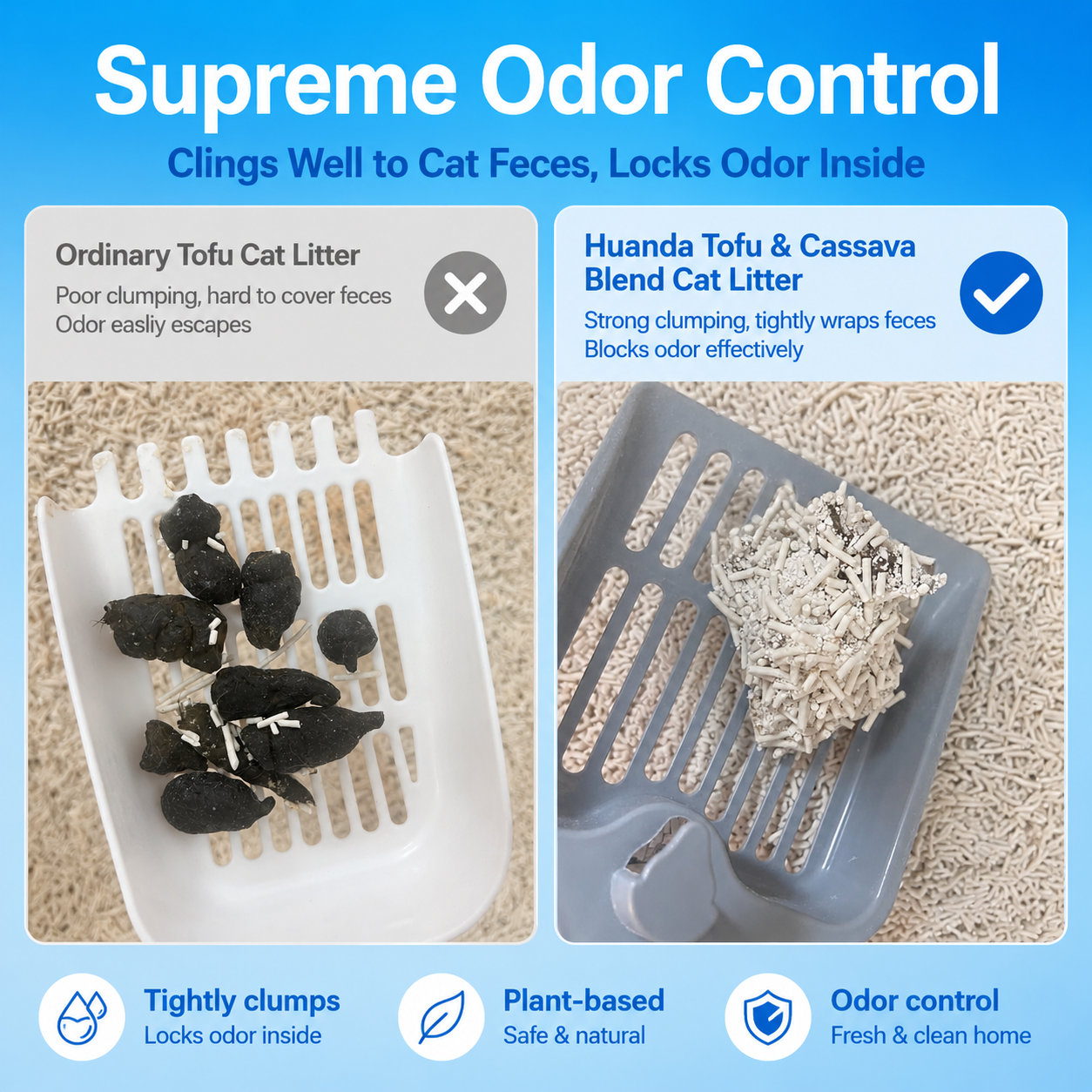
Use the same tray depth and liquid amount for every sample. Allow the clump to form, then scoop it at several time points. A practical bulk product should form a firm clump without turning pasty, sticking heavily to the tray, or breaking into many wet fragments.
Repeat the test. One attractive clump does not prove production consistency. Test from different parts of the sample bag and compare more than one batch if the supplier can provide them.
The best result is not always the hardest possible clump. An extremely hard formula may use more binder than your market wants or may take longer to break down in water. Choose the balance that supports the claims you intend to make.
Check dust before and after transport
Low dust is a major reason customers try tofu litter, so the claim needs careful checking. Look for dust while pouring, while scooping, and at the bottom of the bag. Also rub a small quantity of pellets gently to see how easily they break.
Fresh product from the line may test well, but transport can create additional fines. That is why packaging strength and pellet durability matter. Ask how the supplier screens and de-dusts the product, how moisture is controlled before packing, and whether retained samples are checked after production.
When samples arrive by courier, note any broken pellets or powder caused by handling. The result can reveal more about the retail experience than a factory photograph can.
Evaluate odor control without confusing it with fragrance
Fragrance and odor control are not the same thing. A scented litter can smell pleasant when opened but fail to control waste odor over time. An unscented formula can perform well if it absorbs moisture quickly and removes dirty material cleanly.
Run odor tests over several days under consistent conditions. Compare how the litter performs after repeated clumps are removed. Watch for residual wet particles, because they often become the source of odor later.
If the product contains activated charcoal, confirm the amount and how evenly it is distributed. A few dark particles added for appearance do not guarantee meaningful performance. The supplier should be able to explain the formula and provide a sample that behaves consistently throughout the bag.
Treat flushability as a market-specific claim
Tofu litter is often sold as flushable because the plant-based granules can break down in water. However, plumbing systems and local wastewater rules vary. A claim that is suitable in one market may need qualification in another.
Before printing packaging, check local rules and use responsible instructions. Customers should never be encouraged to flush large amounts at once, and septic systems may require different guidance. Product testing should include breakdown time in water, but legal and wastewater requirements must guide the final label.
This small piece of packaging copy can prevent complaints and protect retailer confidence.
Compare wholesale price using landed economics
When two suppliers quote different prices, compare the same commercial unit. Price per ton alone can be misleading because pellet density, bag volume, packaging weight, and container loading all change the number of retail units you receive.
Calculate:
- Product cost per filled retail bag
- Packaging and carton cost
- Number of bags per carton and pallet
- Number of sellable bags per container
- Freight and destination charges
- Expected damage or leakage allowance
- Distributor margin and retailer margin
A slightly higher factory price can produce a better landed result if the bag is lighter, loading is efficient, and damage is lower. The target is a product that can be reordered profitably, not a quotation that looks cheap in a spreadsheet.
Understand MOQ for formula and packaging separately
The tofu litter MOQ and the printed packaging MOQ may not be the same. A standard formula in neutral bags is usually easier to start than a custom scent in a newly printed pouch.
Ask the supplier to separate these minimums:
- MOQ for an existing formula
- MOQ for a custom formula or fragrance
- MOQ for neutral packaging
- MOQ for custom printed film or bags
- Minimum quantity per SKU in a mixed container
If you are still testing demand, standard packaging or a small number of SKUs can reduce risk. The cat litter MOQ guide explains how to compare these minimums without losing sight of landed cost.
Approve packaging with filled samples
Tofu litter is lighter than clay, but its pellets can break if the pack is compressed or handled badly. Test the actual filled bag rather than approving artwork on a screen.
Lift the bag by the handle, stack it, place it in a carton, and check the seals. Look for sharp folds that could puncture during transport. If the product will be sold online, conduct a practical drop and vibration test using the planned shipping carton.
Bag size also affects how customers judge value. Litres may communicate volume more clearly for a lightweight product, while kilograms may be more familiar in some markets. Many brands show both, provided the conversion is accurate and consistent.
Ask how production consistency is controlled
A good sample is only useful if production can match it. Before placing a tofu cat litter wholesale order, agree on measurable specifications for pellet size, dust, moisture, absorption, clumping, fragrance, colour, and packaging weight.
Ask whether the supplier checks raw materials, drying conditions, screening, and final packing by batch. Confirm how deviations are handled and whether pre-shipment inspection is available. Keep an approved reference sample and attach the agreed specification to the purchase contract.
This is especially important for repeat orders. Customers notice when the second bag performs differently from the first, even if the packaging looks identical.
Build the first order around learning
The first bulk order should teach you what the market will reorder. Keep the range focused, track sales by SKU, collect retailer feedback, and monitor reviews for dust, clumping, tracking, scent, and bag damage.
If two formats are important, a mixed container may let you test them without overcommitting to one. Confirm the minimum per SKU and make sure the loading plan remains efficient.
Use the cat litter sample order guide before final approval, and review the broader wholesale cat litter supplier guide when comparing factories.
The strongest tofu cat litter bulk program is rarely the one with the longest feature list. It is the one with a clear customer, a tested formula, packaging that survives the route to market, and specifications the supplier can repeat.
FAQ
What is the normal MOQ for tofu cat litter in bulk?
MOQ depends on the formula, packaging, number of SKUs, and loading plan. Magnet lists a wholesale MOQ of 10 tons, approximately one 20GP container, with mixed containers accepted and trial samples available before bulk production.
Which tofu cat litter pellet size is best for wholesale?
There is no single best size. Smaller pellets can offer more surface contact and compact clumping, while larger pellets may reduce tracking. Buyers should test 1.5 mm, 2 mm, and 3 mm options with the target customer and litter box style.
Is crushed tofu litter better than cylindrical tofu litter?
Crushed tofu litter offers a finer, sand-like texture and greater surface area. Cylindrical pellets provide a regular appearance and several size options. The right choice depends on cat acceptance, tracking, clumping, and the retail position of the product.
Can tofu cat litter be sold under a private label?
Yes. Private label programs can include formula, pellet size, scent, colour, bag size, and artwork. Buyers should confirm the separate MOQ and lead time for litter production and custom printed packaging.
What should buyers test before approving bulk tofu litter?
Test clump strength, dust, pellet breakage, odor control, tracking, water breakdown, filled bag strength, and consistency across repeated tests. The approved specification should be attached to the order rather than relying on a general product name.
Article summary: Buying tofu cat litter in bulk starts with the customer and sales channel. Compare product format, clumping, dust, odor control, packaging, freight, and production consistency before approving a wholesale order.
Request a Bulk Tofu Cat Litter Quote
Tell Magnet your market, preferred formula, pellet size, bag size, and order volume. We can prepare samples and a wholesale plan for standard or private label tofu cat litter.
Request a Quote