Cat litter is attractive retail inventory because customers buy it repeatedly. It is also unforgiving. The bags are heavy, leaks are obvious, shipping costs can erase margin, and one inconsistent batch can send a regular customer to another brand. A pet store should therefore select a wholesale cat litter supplier by the complete retail outcome, not by the lowest quoted price per ton.
The right supplier helps the store answer three questions: Which formulas suit local customers, what will each bag cost after delivery, and can the same quality be reordered on time?
Start With the Customer You Already Serve
A neighborhood pet store, premium boutique, online seller, and multi-location retailer do not need the same assortment. Review existing sales and customer questions before requesting samples.
Useful segments include:
- Value shoppers wanting dependable clumping clay
- Apartment owners focused on odor and tracking
- Customers seeking lightweight bags
- Buyers preferring unscented products
- Plant-based and biodegradable product shoppers
- Automatic litter-box owners
- Multi-cat households needing stronger odor control
Do not launch six nearly identical bags. A tighter range with a clear reason for each SKU is easier for staff to explain and easier for customers to remember.
Compare Sell-Through Before Purchase Price
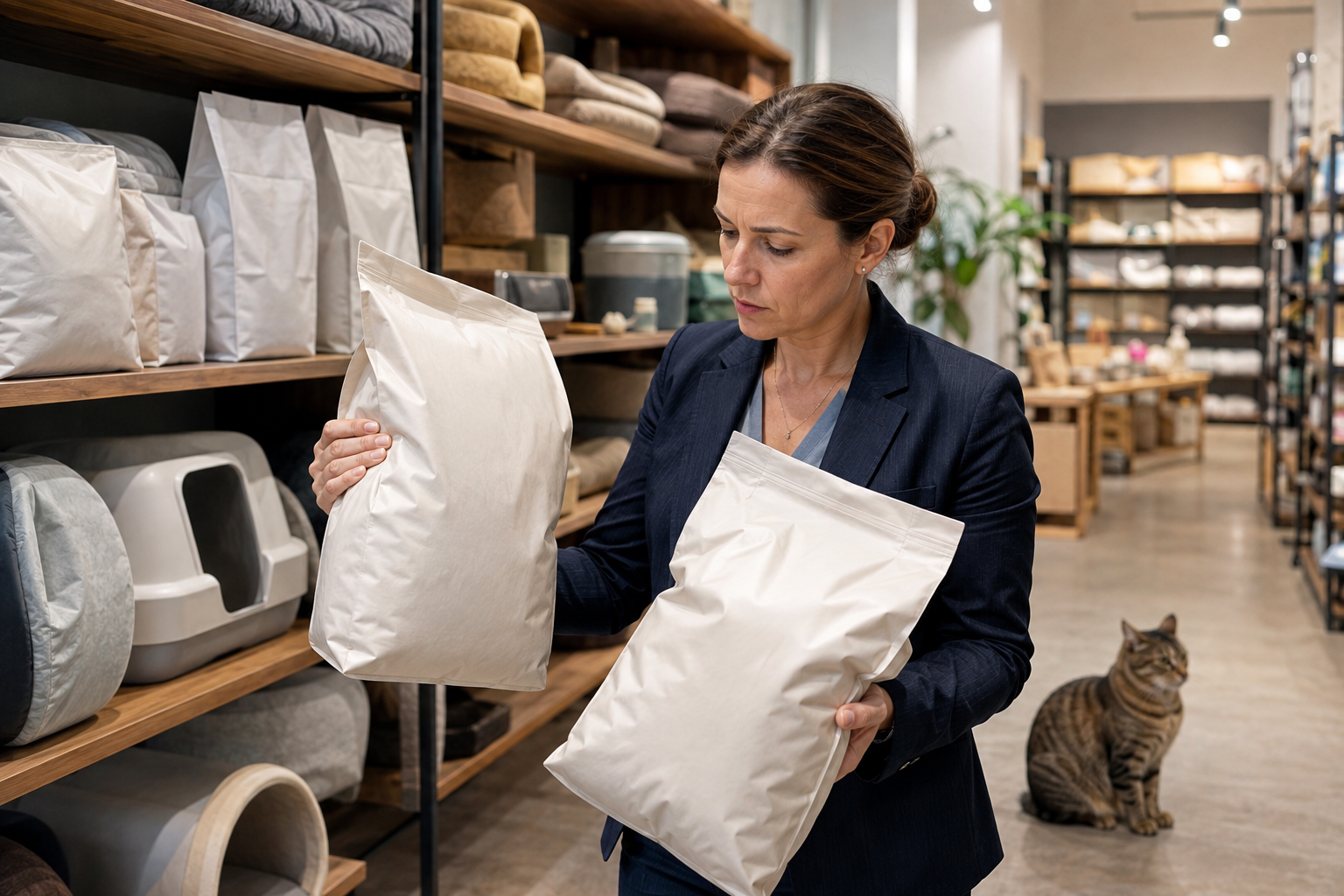
Factory price matters, but it is only one number. A low-cost bag that sits on the shelf for four months ties up cash and storage. A more expensive product may be healthier for the business if it sells quickly, earns repeat purchases, and produces fewer returns.
Estimate sell-through by SKU and store. Start with a controlled trial, record weekly unit sales, and ask staff which product questions recur. Reorders provide better evidence than opening-week curiosity.
Calculate Landed Margin Per Bag
Retail margin should use the landed cost, not the supplier’s unit quote. Include:
- Product and retail packaging
- Master cartons or pallet materials
- Inland transport to the export port
- Ocean or domestic freight
- Insurance
- Duty and import tax where applicable
- Customs broker and port charges
- Delivery to the warehouse or store
- Inspection, storage, and damaged-unit allowance
- Marketplace or payment fees for online sales
Compare gross profit per bag, gross margin percentage, and inventory turn. Heavy bentonite may have a lower factory cost but higher freight per sellable unit. Lightweight tofu may cost more at production yet create a different delivered-cost equation.
Build a Product Range With Distinct Jobs
A practical opening range could include three positions:
- An unscented clumping litter for broad everyday use
- A lightweight plant-based litter for premium buyers
- A stronger odor-control or automatic-box formula for a specific problem
Only add another scent, bag size, or material when it serves a clear customer group. Too many slow variants fragment the order and complicate replenishment.
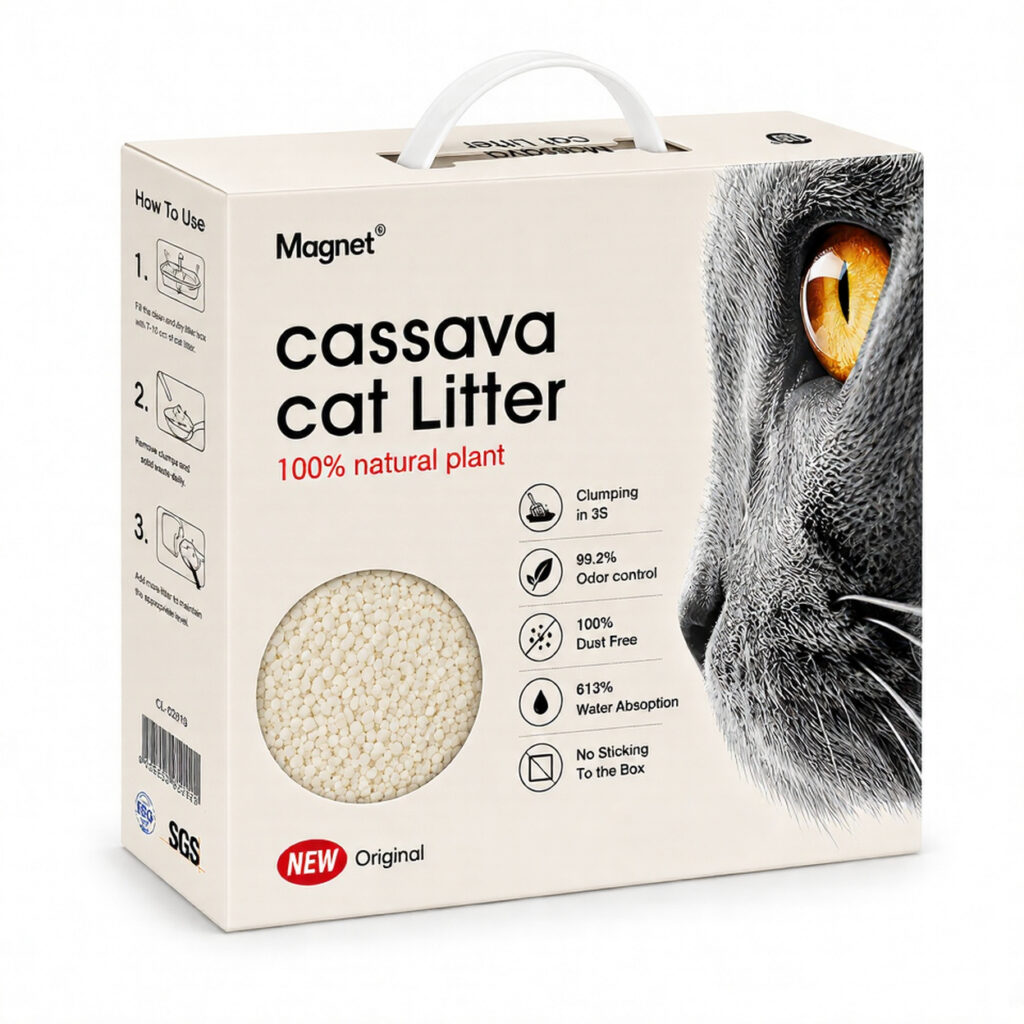
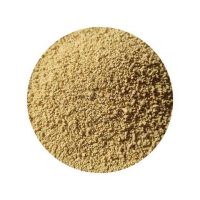
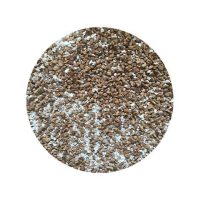
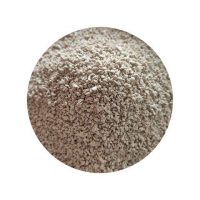
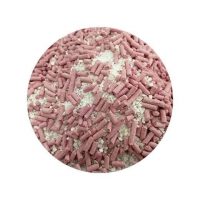
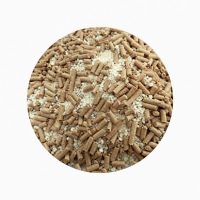
Magnet’s cat litter product range includes tofu, cassava, mixed, corn, walnut shell, wheat straw, and health-monitoring options. A store can compare categories before committing to private label packaging.
Test the Product Like a Retailer
A laboratory result does not reveal every source of a return. Use samples in a realistic store and home evaluation.
Check:
- Dust during the first and last pour
- Clumping at several setting times
- Sticking to common plastic trays
- Clean litter lost with each scoop
- Odor after repeated use
- Tracking on hard floor and carpet
- Cat acceptance during a gradual transition
- Bag grip, opening, pouring, and resealing
- Leakage after handling and a controlled drop test
Document the method. Testing two samples with different litter depths or water volumes produces an attractive comparison but not a reliable one.
Inspect Packaging as Carefully as the Formula
Pet stores sell the bag before the shopper experiences the litter. The package has to survive warehouses, pallets, delivery vans, shelf movement, and customer transport.
Look for strong seals, abrasion resistance, readable usage instructions, a stable base, convenient carrying, accurate net quantity, and enough moisture protection for the formula. Check that cartons do not crush lower bags and that barcodes scan on curved or wrinkled surfaces.
For private label projects, confirm who approves the artwork, who owns the files, what the printing MOQ is, and what happens to unused packaging when a design changes.
Verify Claims and Documents
Do not accept a collection of certificates without checking what each document covers. A management-system certificate is not the same as a product test. A test report for one sample does not prove every future batch is identical.
Ask for:
- Current business and factory details
- Product specification sheet
- Lot-specific certificate of analysis when applicable
- Relevant safety or technical data
- Test reports supporting important claims
- Country-of-origin information
- Packaging and labeling declarations required by the market
- Batch coding and traceability process
The supplier should be able to connect the product name and lot on the bag to production and inspection records.
Understand MOQ at Three Levels
There may be separate minimums for product, formula, and packaging. A supplier may accept a standard formula in modest quantity while the printed-film maker requires a much larger run. Custom scent, particle size, or additive choices can create another threshold.
Ask for the MOQ by SKU and by packaging design. Also ask whether several standard products can share one container. A flexible mixed-SKU order can be more useful than a low headline MOQ attached to only one formula.
Evaluate Reorder Reliability
Opening inventory gets attention; repeat inventory keeps the shelf alive. Request a realistic timeline covering packaging production, litter manufacturing, inspection, booking, and transit. Ask how national holidays, raw-material changes, and peak shipping periods affect the plan.
A good supplier confirms capacity rather than promising every order immediately. It also retains approved samples, reports deviations, and agrees on what happens if a batch misses specification.
Decide Between Wholesale and Private Label
Standard wholesale packaging allows faster testing and a lower commitment. It suits stores that want to validate demand before investing in artwork and printed film.
Private label gives the retailer control over positioning and customer loyalty, but it adds packaging MOQ, compliance work, artwork approval, and inventory risk. The product should prove itself before the package becomes expensive.
A wholesale cat litter supplier should explain both routes honestly. If every conversation immediately pushes a fully custom container, the supplier is optimizing its production rather than the retailer’s launch risk.
A Supplier Scorecard for Pet Stores
Score each candidate from one to five on:
- Product performance
- Batch consistency
- Landed margin
- Packaging durability
- Documentation
- MOQ flexibility
- Lead-time reliability
- Communication speed
- Problem resolution
- Range expansion options
Weight the categories according to the store’s business. A regional chain may value capacity and documentation most. An independent store may need smaller mixed orders and faster assortment changes.
Questions to Include in the First Inquiry
- Which products are already exported to our market?
- What is the MOQ for standard and custom packaging?
- Can we combine formulas in one shipment?
- Which specifications are checked for every batch?
- Can you supply pre-production and production samples?
- What are the filled bag and carton dimensions?
- What is the expected lead time after artwork approval?
- Which Incoterms and destination services are available?
- How are claims such as low dust or flushable supported?
- What is the process if delivered goods miss specification?
Specific questions produce comparable quotations. A message asking only for the “best price” usually produces numbers that hide important differences.
FAQ
What is the best wholesale cat litter for a pet store?
The best choice matches local demand, achieves a workable landed margin, and can be reordered consistently. Many stores benefit from one mainstream clumping SKU and one differentiated plant-based option.
Should a pet store start with private label cat litter?
Not always. Standard packaging is often better for testing demand. Move to private label after the store understands formula preference, bag size, price position, and monthly sell-through.
How should stores compare cat litter prices?
Compare landed cost per sellable bag, not only factory price per ton. Include freight, duty, handling, storage, damage, marketplace fees, and clean-litter consumption.
What documents should a supplier provide?
Request a specification, traceable batch documents, relevant product tests, origin information, and packaging documents required by the destination. Requirements vary by market.
How many samples should a store test?
Test enough formulas to represent distinct retail positions, not every scent in a catalog. Two or three carefully chosen products often produce better decisions than a large unstructured sample box.
Article summary: Pet stores should choose a cat litter supplier by sell-through, landed margin, repeat consistency, packaging strength, documentation, and reorder reliability rather than the lowest factory price alone.
Build a Cat Litter Range for Your Store
Magnet supplies tofu, cassava, corn, walnut, bentonite, and mixed cat litter for distributors, retailers, and private label programs.
Request Wholesale Options